
Context
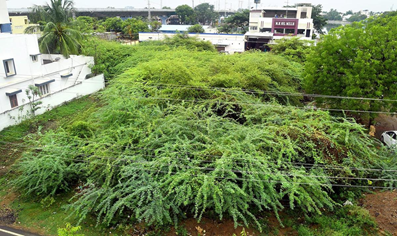
- Recently, India is set to operationalize its first green methanol plant at the Deendayal Port Authority (DPA) in Kandla, Gujarat. This project is particularly significant as it aims to utilize Prosopis juliflora, a highly invasive weed that has threatened the biodiversity of the Banni grasslands in Kutch, as the primary feedstock.
- This initiative aligns with the International Maritime Organization (IMO) rules requiring the global shipping industry to transition toward green fuels like methanol to replace conventional bunker oil.
Project Overview
- Location: Deendayal Port Authority (DPA), Kandla, Gujarat.
- Production Capacity: The pilot plant is designed to produce five tonnes of methanol per day.
- Developers: The facility is being constructed by Thermax Energy (Pune-based) using gasification technology from Ankur Scientific (Vadodara-based).
- Feedstock: The plant primarily uses Prosopis juliflora (Kutch weed) and can also process other agricultural residues like bagasse and cotton stalks.
Prosopis juliflora: The Invasive Feedstock
- Origin and Introduction: Prosopis juliflora is a Mexican-origin shrub that was introduced to India by the British in the 1920s to green Delhi and later by the Gujarat Forest Department in 1961 to halt the encroachment of the salt desert in the Rann of Kutch.
- Invasive Nature: It is ranked among the “top 100 invasive species in the world” and has crowded out native grasses over thousands of kilometers, significantly threatening the biodiversity of the Banni grasslands.
- Common Names: In India, it is locally known as Gando Baval in Gujarat, Vilayati Keekar in North India, and Seemai Karuvelam in Tamil Nadu.
- Feedstock Potential: It is considered an ideal feedstock for green methanol because it is a dense hardwood with a high energy profile and low acid content.
Green Methanol Production Process
- Comparison with Conventional Methanol: While conventional methanol is produced from fossil fuels like natural gas or coal, green methanol is derived from renewable feedstocks such as biomass or agricultural residues.
- The Two-Step Gasification Process:
- Gasification: The biomass is heated in the absence of oxygen (a process sitting between combustion and pyrolysis) to break it down into syngas (a mixture of hydrogen, carbon monoxide, and carbon dioxide).
- Conversion: The syngas is then chemically converted into liquid methanol, which can be used as a direct replacement for traditional “bunker oil” in ships.
- Environmental Benefits: According to the Methanol Institute, using green methanol can reduce a vessel’s CO2 emissions by up to 95%, Nitrogen Oxides by up to 80%, and virtually eliminate Sulphur Oxides and particulate matter.
Strategic Significance
- Maritime Green Ports: This initiative aligns with the Government of India’s policy to convert western coast ports into “green ports” to meet global shipping decarbonization standards.
- Economic Impact: The utilization of agricultural residues and invasive species as fuel could potentially displace a significant portion of India’s oil imports.
- Biodiversity Restoration: By creating a commercial demand for Prosopis juliflora, the project provides a functional method to clear invasive species and allow native ecosystems to recover.
| The Concept of Methanol Economy The NITI Aayog is driving the “Methanol Economy” program to reduce India’s oil import bill and carbon footprint. Blending: Blending 15% methanol in gasoline (M-15) can reduce crude oil imports by 15%. Shipping & Rail: Methanol is a high-density energy carrier, making it ideal for marine fuel and locomotives.Waste-to-Wealth: It allows for the conversion of high-ash coal, municipal solid waste, and agricultural residue into valuable fuel. |
Q. With reference to Green Methanol production in India, consider the following statements:
Statement-I: India’s first green methanol plant is being established at Kandla to convert invasive weed species into marine fuel.
Statement-II: According to the Ministry of New and Renewable Energy (MNRE), green methanol must have a total carbon emission threshold of not more than 0.38 kg CO2 equivalent per kg of methanol.
Which one of the following is correct in respect of the above statements?
(a) Both Statement-I and Statement-II are correct and Statement-II is the correct explanation for Statement-I.
(b) Both Statement-I and Statement-II are correct and Statement-II is not the correct explanation for Statement-I.
(c) Statement-I is correct but Statement-II is incorrect.
(d) Statement-I is incorrect but Statement-II is correct.
Answer: (c)
Solution:
• STATEMENT I CORRECT: The first green methanol plant is indeed located at Deendayal Port (Kandla) and uses Prosopis juliflora (an invasive weed) as feedstock for shipping fuel.
• STATEMENT II INCORRECT: According to the MNRE notification (February 2026), the threshold for Green Methanol is 0.44 kg CO2 eq/kg. The 0.38 kg limit mentioned in the statement actually refers to the standard for Green Ammonia.