
Context
Recently, the Vietnamese President To Lam paid a State Visit to India. This visit resulted in the elevation of bilateral ties to an “Enhanced Comprehensive Strategic Partnership” (a step above the 2016 Comprehensive Strategic Partnership). The visit marks the 10th anniversary of their strategic partnership and reinforces Vietnam as a “major pillar” of India’s Act East Policy and Vision SAGAR.
1. Strategic & Defense Cooperation
Defense is the “central pillar” of this relationship, focusing on a “shared vision for the Indo-Pacific.”
- Joint Vision 2030: Guided by the ‘Joint Vision Statement on India-Vietnam Defence Partnership towards 2030’.
- Defense Lines of Credit (LoC): India has extended LoCs totaling over $400 million for defense procurement and high-speed guard boats.
- Key Assets: India recently gifted the indigenously built missile corvette INS Kirpan to Vietnam (2023).
- Military Exercises: VINBAX (Army exercise) and regular naval PASSEX and OTRs (Operational Turn Arounds).
- Maritime Security: Both nations emphasize adherence to UNCLOS 1982 and a “Code of Conduct” in the South China Sea.
2. Economic & Digital Integration
- Trade Target: A new goal of $25 billion bilateral trade by 2030 (up from current $16 billion).
- Digital Payments: Linking India’s UPI with Vietnam’s NAPAS (fast payment system) for cross-border QR code interoperability.
- Rare Earths & Critical Minerals: A landmark MoU between IREL (India) Ltd. and Vietnam’s ITRRE for cooperation in rare earth elements, vital for the EV and defense sectors.
- Agriculture: Facilitating “pests-free” trade for fruits like Indian pomegranates/grapes and Vietnamese durian/pomelo.
3. Cultural & Development Partnership
- Civilizational Links: Shared Buddhist and Cham heritage. India is actively restoring the My Son Sanctuary (UNESCO site) and Nhan Tower.
- Education: Over 200 annual slots under ITEC (Indian Technical and Economic Cooperation) for Vietnamese professionals.
- Humanitarian Aid: Operation Sadbhav (2024) saw India delivering 35 tons of relief to Vietnam after Typhoon Yagi.
4. All about Vietnam
I. Political System
- Socialist Republic with a one-party system.
- Governed by the Communist Party of Vietnam.
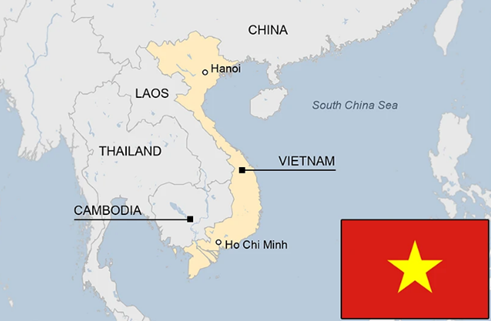
- Capital: Hanoi
- Largest City: Ho Chi Minh City
II. Economic System
- Socialist-oriented market economy under the Đổi Mới reforms (1986).
- Major sectors: manufacturing, agriculture, electronics, textiles, and tourism.
- Major exports: rice, coffee, smartphones, garments, and seafood.
- Minerals: Vietnam is well-endowed with significant mineral reserves, holding the world’s second-largest rare earth deposits (estimated at 22–30 million tonnes) and substantial bauxite, coal, and tungsten reserves.
III. Geographical Borders
- Borders China to the north.
- Borders Laos and Cambodia to the west.
- Eastern coastline along the South China Sea.
- Major rivers: Mekong and Red River.
- The Mekong River flows through six countries: China (where it originates), Myanmar, Laos, Thailand, Cambodia, and Vietnam.
- Famous natural sites: Ha Long Bay, Phong Nha-Ke Bang National Park
Consider the following statements regarding India–Vietnam relations:
1. Vietnam is an important pillar of India’s Act East Policy and Indo-Pacific strategy.
2. Vietnam follows a socialist-oriented market economy introduced through the Đổi Mới reforms.
Which of the statements given above is/are correct?
(a) 1 only
(b) 2 only
(c) Both 1 and 2
(d) Neither 1 nor 2
Answer: C
Explanation:
• Statement 1 is correct: In numerous official statements, including the recent 2026 visit by President To Lam, India has consistently referred to Vietnam as a "major pillar" of its Act East Policy. Vietnam is also a key partner in India’s Vision SAGAR (Security and Growth for All in the Region) and the Indo-Pacific Oceans Initiative (IPOI), serving as a strategic balancer in the South China Sea.
• Statement 2 is correct: Vietnam transitioned from a centrally planned economy to a "socialist-oriented market economy" following the Đổi Mới (Renovation) reforms launched in 1986. These reforms encouraged private enterprise and foreign investment while maintaining the state's socialist framework. This economic shift is the primary reason why bilateral trade between India and Vietnam has grown to approximately $16 billion today.