
Context
As India pushes toward its Net-Zero goals, the focus is shifting toward “hard-to-abate” sectors. While technologies like Green Hydrogen are still in the early stages of adoption, Industrial Heat Pumps (IHPs) have emerged as a ready-to-deploy solution for low-to-medium temperature process heat. Decarbonizing industrial heat is critical as it accounts for nearly half of India’s final energy consumption in 2025 and is a major source of CO2, SO2, and NOx emissions.
1. Core Technology: Industrial Heat Pumps
I. Mechanism: How IHPs Work
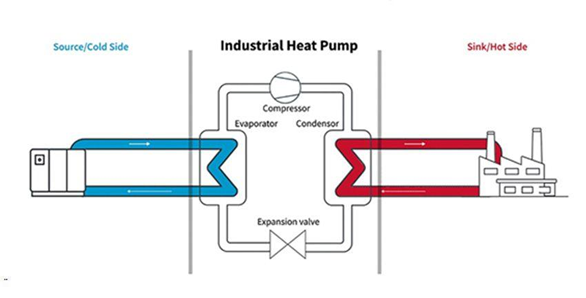
- Heat Transfer: Unlike boilers that generate heat by burning fossil fuels, IHPs move and upgrade low-grade waste heat from one stream to another using electricity.
- Thermodynamic Cycle: They utilize a refrigerant cycle involving four main components: an Evaporator (absorbs heat), a Compressor (increases pressure/temperature), a Condenser (releases heat to the process), and an Expansion Valve.
- Simultaneous Heating and Cooling: IHPs can produce hot water or steam while simultaneously producing chilled water or dehumidified air as a byproduct, making them highly efficient for sectors like food processing.
II. Efficiency and Performance
- Coefficient of Performance (COP): This is the ratio of useful heat output to electricity input. IHPs typically have a COP of 3 to 5, meaning they deliver 3–5 units of heat for every 1 unit of electricity consumed.
- Energy Savings: Transitioning from conventional boilers to IHPs can reduce overall energy use by 40–60% in suitable industrial applications.
2. Significance for India and MSMEs
- Sectoral Impact: IHPs are most effective in sectors requiring low-to-medium temperatures, such as textiles, food processing, chemicals, and pharmaceuticals.
- Focus on MSMEs: Micro, Small, and Medium Enterprises (MSMEs) contribute significantly to industrial emissions (around 17%). IHPs offer a modular and scalable solution for brownfield MSME clusters where replacing large boiler systems is impractical.
- Public Health: By displacing on-site coal and biomass combustion, IHPs reduce air pollutants that contribute to respiratory and cardiovascular diseases, potentially mitigating the high rate of premature deaths linked to industrial air pollution.
Industrial heat pumps are most suitably used in which of the following sectors?
1. Food processing
2. Textile industries
3. Paper industry
Select the correct answer using code given below:
(a) 1 and 2 only
(b) 2 and 3 only
(c) 1 and 3 only
(d) 1, 2 and 3
Answer: D
Explanation:
Industrial Heat Pumps (IHPs) are designed to provide low-to-medium temperature process heat, making them highly effective in sectors where thermal requirements match their operating range.
• Food Processing: This sector is a primary candidate for IHPs. Many processes, such as pasteurization, drying, and washing, require temperatures within the range that heat pumps can efficiently provide. Furthermore, the food industry often requires simultaneous heating and cooling, which IHPs can deliver as a byproduct.
• Textile Industries: Textile units require significant thermal energy for processes like dyeing, washing, and finishing. These processes typically rely on process steam or hot water at low-to-medium temperatures, which are the optimal application zones for IHP technology.
• Paper Industry: The paper and pulp industry is heat-intensive, particularly for drying processes. IHPs can be utilized to recover waste heat and provide the necessary thermal energy for drying and other low-temperature pulp processing stages.