
Context
In the aftermath of state legislative assembly elections, significant constitutional questions often emerge concerning the resignation of the incumbent Chief Minister, the discretionary authority of the Governor in government formation or removal, and the constitutional validity of electoral outcomes.
These issues are principally governed by Articles 164 and 172 of the Constitution of India, which collectively define the tenure of the Council of Ministers and the duration of State Legislatures within the framework of parliamentary democracy.
1. Constitutional Provisions: Article 164
- Appointment: The CM is appointed by the Governor, and other ministers are appointed by the Governor on the advice of the CM.
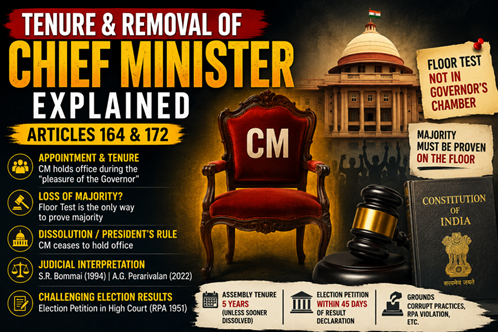
- The “Pleasure” Doctrine: Article 164(1) states that “the Ministers shall hold office during the pleasure of the Governor.”
- Constituent Assembly Debate: While the literal reading suggests the Governor has discretionary power to remove a CM, the Constituent Assembly (notably Dr. B.R. Ambedkar) clarified that “pleasure” is not absolute.
- The Proviso: A CM and the Council of Ministers (CoM) remain in power only so long as they enjoy the confidence of the Legislative Assembly (Lower House).
2. When does a CM cease to hold office?
A Chief Minister must vacate office under the following circumstances:
- Loss of Majority (Floor Test): If the Governor has reason to believe the CM has lost the majority, a Floor Test is conducted. If the CM fails to prove support in the House, they must resign.
- Dissolution of the Assembly: Under Article 172, the normal tenure of an Assembly is 5 years. Upon the expiration of this period, the Assembly stands dissolved, and the CM automatically ceases to hold office.
- Dismissal by Governor: Only if the CM refuses to resign after losing a majority on the floor of the House.
- President’s Rule: Under Article 356, if the constitutional machinery fails, the State Government (including the CM) can be dismissed.
3. Judicial Interpretation
- A.G. Perarivalan v. State (2022): The Supreme Court observed that the Governor is the “formal head” and ordinarily bound by the “aid and advice” of the Council of Ministers.
- S.R. Bommai Case (1994): (Contextual addition) The Court ruled that the majority of a government must be tested on the floor of the House and not in the Governor’s chambers.
4. Challenging Election Results
If a CM or candidate’s election is in question, the following legal routes apply:
- Election Petition: Under Section 100 of the Representation of the People Act (RPA), 1951, an election can be challenged in the High Court.
- Timeline: Such a petition must be filed within 45 days from the declaration of results.
- Grounds for Challenge: Corrupt practices, non-compliance with the Constitution/RPA, or improper rejection of nominations.
- Writ Petition: If the integrity of the electoral process itself is at stake (e.g., large-scale voter deletion), a writ petition can be filed as it involves a violation of fundamental rights.
Quick Facts for Prelims
| Provision | Detail |
| Article 163 | Council of Ministers to aid and advise the Governor. |
| Article 164 | Appointment and tenure of Ministers (Pleasure of Governor). |
| Article 172 | Duration of State Legislatures (5 years unless sooner dissolved). |
| Floor Test | The constitutional mechanism to prove majority in the House. |
| High Court | Has original jurisdiction to hear election petitions (RPA 1951). |
Consider the following statements regarding the tenure and removal of the Chief Minister in India:
1. Under Article 172 of the Constitution, the normal duration of a State Legislative Assembly is five years unless sooner dissolved.
2. A Chief Minister automatically ceases to hold office upon the dissolution of the Legislative Assembly.
3. The Governor can remove a Chief Minister even if the latter enjoys majority support in the Legislative Assembly.
Which of the statements given above are correct?
(a) 1 and 2 only
(b) 2 and 3 only
(c) 1 and 3 only
(d) 1, 2 and 3
Answer: A
Explanation:
Analysis of Statements
• Statement 1 is correct: According to Article 172 of the Indian Constitution, every Legislative Assembly of every State, unless sooner dissolved, shall continue for five years from the date appointed for its first meeting and no longer. The expiration of the said period of five years operates as a dissolution of the Assembly.
• Statement 2 is correct: Since the Chief Minister is a member of the House and heads the Council of Ministers, their legal authority to hold office is tied to the existence of the Legislative Assembly. Once the Assembly is dissolved (either by completion of tenure or by the Governor's order), the CM automatically ceases to hold office, though they may be asked to continue as a "caretaker" CM until a new government is formed.
• Statement 3 is incorrect: While Article 164(1) states that the Chief Minister holds office during the "pleasure of the Governor," this pleasure is not arbitrary. Constitutional experts and the Supreme Court (notably in the S.R. Bommai case) have affirmed that as long as the Chief Minister commands a majority in the Legislative Assembly, the Governor cannot dismiss them. The "pleasure" of the Governor is essentially a shorthand for the "confidence of the House."