
Context
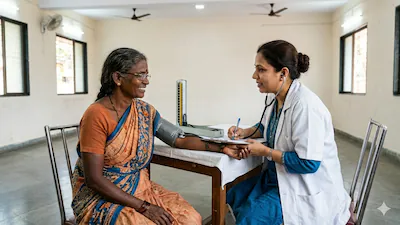
Recently, the Union Ministry of Labour and Employment launched a nationwide initiative to provide free annual health check-ups for all workers aged 40 years and above. This scheme, inaugurated on May 7, 2026, by the Union Labour Minister, is anchored in the transformative reforms introduced through the four new Labour Codes. It aims to strengthen the occupational healthcare and social security framework for India’s workforce, specifically targeting early detection of non-communicable diseases and promoting long-term well-being.
1.Key Features of the Free Health Check-up Scheme
- Eligibility: All workers (insured persons) who have crossed the age of 40 years are eligible for these check-ups.
- Frequency: The health screenings will be conducted every year to ensure continuous health monitoring.
- Implementation Agency: The scheme is being implemented through the extensive network of ESIC (Employees’ State Insurance Corporation) hospitals and medical colleges across the country.
- Scope of Screening: The check-ups include comprehensive tests such as blood work, ECG, and chest X-rays for early diagnosis of potential health issues.
- Mandatory Checks: For workers engaged in hazardous or dangerous operations (e.g., handling toxic chemicals or heavy machinery), medical check-ups are mandatory regardless of their age.
2.Employees’ State Insurance Corporation (ESIC)
- Statutory Body: ESIC is a statutory body established under the Employees’ State Insurance Act, 1948.
- Administrative Control: It functions under the aegis of the Ministry of Labour and Employment, Government of India.
- Funding Mechanism: It is a self-financing social security scheme.
- Employer’s Contribution: 3.25% of the wages.
- Employee’s Contribution: 0.75% of the wages.
- Exemption: Employees earning less than ₹176 per day are exempted from payment of their share.
- Applicability: The ESI Act applies to factories and other establishments (like shops, hotels, cinemas) employing 10 or more persons. The current wage ceiling for coverage is ₹21,000 per month (₹25,000 for persons with disabilities).
3.The Four New Labour Codes: A Brief Overview
The government has consolidated 29 central labour laws into four comprehensive codes to simplify compliance and expand social security:
- Code on Wages, 2019: Ensures minimum wages and timely payment for all workers.
- Industrial Relations Code, 2020: Streamlines dispute resolution and improves ease of doing business.
- Social Security Code, 2020: Extends benefits like ESIC and PF to unorganized workers, gig workers, and platform workers.
- Occupational Safety, Health and Working Conditions Code, 2020: Regulates health and safety standards at the workplace.
| Significant Reforms Maternity Benefit: Increased from 12 weeks to 26 weeks.Gig Workers: India is among the first few countries to proactively bring gig and platform workers under a social security framework.Gender Neutrality: Provisions for equal wages for men and women and allowing women to work night shifts with safety measures. |
Q. With reference to the recently launched Annual Health Check-up initiative and the Employees’ State Insurance (ESI) scheme, consider the following statements:
1. The free annual health check-up is mandatory for all workers across all age groups in India.
2. The ESI scheme is a self-financing health insurance scheme where both employers and employees contribute.
3. The Code on Social Security, 2020, for the first time, provides for the inclusion of gig and platform workers under social security benefits.
How many of the statements given above are correct?
A) Only one
B) Only two
C) All three
D) None
Answer: B) Only two
Solution:
• STATEMENT 1 IS INCORRECT: According to the scheme launched, free annual health check-ups are specifically for workers aged 40 years and above. It is only mandatory regardless of age for those working in hazardous occupations.
• STATEMENT 2 IS CORRECT: The ESI scheme is contributory, with employers currently contributing 3.25% and employees contributing 0.75% of the wages.
• STATEMENT 3 IS CORRECT: The Code on Social Security, 2020, expanded the definition of workers to include gig workers and platform workers, allowing the government to frame specific social security schemes for them.