
Context
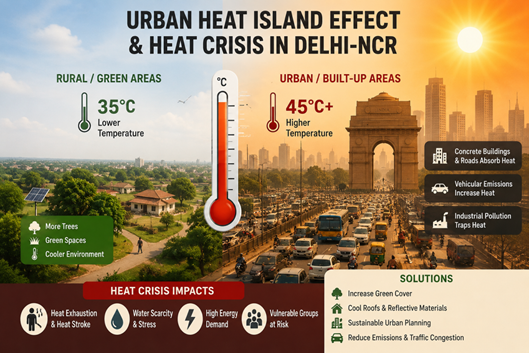
Delhi and the NCR region are experiencing intensified heatwaves characterized by a “heat re-trap” phenomenon. Rapid urbanization and the replacement of natural landscapes with heat-absorbing materials have turned the city into a reservoir of thermal energy, necessitating a shift in urban planning and social protection.
I. Why Delhi is Retaining Heat?
- Material Logic: Domination of concrete, steel, and glass which absorb heat efficiently but release it slowly. Surface temperatures in dense areas reach 50–60°C during peak afternoons.
- Infrastructure Design: Glass-heavy architecture increases indoor solar radiation, while high-density construction and narrow streets restrict airflow.
- Vehicular Contribution: Corridors like NH-48 act as continuous heat sources due to engine exhaust and heat-absorbing asphalt.
- NH 48 passes through Delhi, Haryana, Rajasthan, Gujarat, Maharashtra, Karnataka, and Tamil Nadu. As of May 2026, it is part of the Golden Quadrilateral.
- Anthropogenic Heat: Air conditioning expels heat outdoors, raising ambient temperatures by 1–2°C in dense neighborhoods, creating a feedback loop.
II. Ecological and Economic Impacts
- Loss of Natural Cooling: Shrinking green cover, degraded wetlands, and the loss of Yamuna floodplains have reduced evapotranspiration.
- Economic Productivity: Productivity declines by 2–3% for every degree rise above optimal levels. India loses over $100 billion annually due to heat-related productivity decline.
- Energy Burden: Delhi’s peak electricity demand has crossed 8,000 MW, driven largely by cooling needs.
III. Proposed Structural & Planning Measures
- Urban Design: Adoption of high-albedo surfaces, cool roofs, and reflective coatings. Emphasis on passive design strategies like shading and cross-ventilation.
- Blue-Green Infrastructure: Expansion of urban forests, parks, and water bodies to restore natural cooling.
- Ventilation Corridors: Designing street orientation to restore airflow through the city.
- Social Protection: Subsidized cooling, affordable housing upgrades, and community cooling centers for vulnerable populations.
| Positive Feedback Loop (Climate Change) As global temperatures rise, glaciers and polar ice melt, reducing the Earth’s reflectivity (high albedo replaced by low albedo ocean). This lower albedo causes more heat absorption, leading to more melting. Examples of Albedo: High Albedo: Snow and ice reflect ~80-90% of sunlight. Low Albedo: Water and forests absorb most sunlight, reflecting only 10-20%. Albedo of Different Earth Surfaces: Fresh Snow > Thick Clouds > Desert Sand > Grass > Forests > Asphalt. |
Which of the following factors primarily contribute to the Urban Heat Island effect in Delhi-NCR?
1. Dominance of concrete, steel, and glass surfaces
2. Shrinking green cover and wetlands
3. Expansion of evapotranspiration processes
4. Heat emitted from air conditioners and vehicles
Select the correct answer using the code below:
(a) 1, 2 and 4 only
(b) 1 and 3 only
(c) 2 and 3 only
(d) 1, 2, 3 and 4
Answer: A
Explanation:
•  Statement 1 is correct: Concrete, steel, and glass have high thermal mass and low albedo. They absorb heat during the day and release it slowly at night, creating the "heat re-trap" mentioned in the article.
•  Statement 2 is correct: Green cover and wetlands provide natural cooling. Their destruction reduces the city's ability to regulate temperature through shade and moisture.
•  Statement 3 is incorrect: Loss of vegetation and water bodies has reduced (not expanded) evapotranspiration. Evapotranspiration is a cooling process; its reduction contributes to the heat crisis.
•  Statement 4 is correct: These are sources of anthropogenic heat. Air conditioners cool interiors but expel heat into the streets, while vehicles contribute constant thermal input through engines and exhaust.