
Context
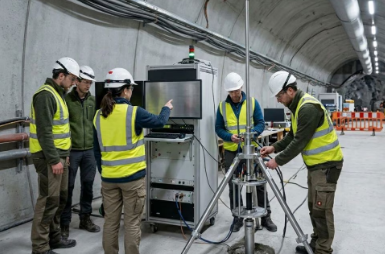
- Researchers in southern Switzerland have successfully triggered thousands of micro-earthquakes in a controlled, monitored environment. Using the BedrettoLab—a laboratory located 1.5 km deep within a tunnel under the Swiss Alps—scientists are studying the mechanics of fault lines to better understand and mitigate the risks of natural seismic events.
Understanding Earthquake Mechanics & Induced Seismicity
1. The Experiment: How it Works
- Method: Scientists injected 700 cubic meters of water into boreholes drilled into the tunnel’s rock walls.
- The Mechanism: The water acts as a lubricant and increases pore pressure within the fault. This reduces the friction holding the rock masses together, causing them to slip and release energy.
- Scale: Over 8,000 small seismic events were recorded, with magnitudes ranging from -4 to 0.14. For perspective, these are “micro-quakes,” but at 0.14 magnitude, the acceleration was 1.3 times the standard acceleration due to gravity.
2. Induced vs. Natural Seismicity
- Natural Earthquakes: Caused by tectonic plate movements and the buildup of stress along fault lines.
- Induced Seismicity: Earthquake activity resulting from human activities.
- Common Causes: Reservoir-induced seismicity (large dams), fracking (shale gas extraction), geothermal energy production, and waste-water injection.
3. Key terminologies
| Term | Meaning |
| Focus (Hypocentre) | Point inside Earth where earthquake originates |
| Epicentre | Point on Earth’s surface directly above the focus |
| Seismic waves | Energy waves produced during earthquakes |
| Fault | Crack/fracture in Earth’s crust |
4. Richter scale vs Mercalli scale
| Basis | Richter Scale | Mercalli Scale |
| What it measures | Magnitude/energy released during an earthquake | Intensity/effects and damage caused by an earthquake |
| Method | Uses seismographs and scientific calculations | Based on human observations and structural damage |
| Scale | Logarithmic scale (generally 0–10+) | Roman numerals I–XII |
| Nature of measurement | Objective and same everywhere | Subjective and varies from place to place |
5. About Alps
- The Alps extend across:
- France
- Switzerland
- Italy
- Austria
- Germany
- Slovenia
- Liechtenstein
- Monaco
Formation: Formed by collision of African and Eurasian tectonic plates.
Major River Sources: Rhine, Rhone, Po, Danube
Economic Importance
- Major tourist destination for skiing and mountaineering.
- Rich source of hydroelectric power.
- Supports dairy farming and cattle rearing.
- Important transport tunnels and passes connect European countries.
Q. With reference to 'Induced Seismicity' and the mechanics of earthquakes, consider the following statements:
1. Increasing the pore water pressure along a fault line can decrease the effective friction, leading to a slip.
2. The Richter scale is a linear scale where a magnitude 4 earthquake is twice as powerful as a magnitude 2 earthquake.
3. Large-scale water reservoir construction is a known cause of human-induced seismic activity.
Which of the statements given above are correct?
(a) 1 and 2 only
(b) 2 and 3 only
(c) 1 and 3 only
(d) 1, 2, and 3
Correct Answer: C) 1 and 3 only
• Explanation:
• Statement 1 is correct: this is the principle used in the Swiss experiment.
• Statement 2 is incorrect: because the Richter scale is logarithmic, not linear; a magnitude 4 is roughly 100 times stronger in terms of energy release than a magnitude 2.
• Statement 3 is correct: (e.g., the Koyna Dam in Maharashtra is a famous example of Reservoir Induced Seismicity).