

Context
Recently, the Periodic Labour Force Survey (PLFS) 2025, released by MoSPI, provided monthly rural and urban labour market data for January–December 2025. The report shows rising employment and labour force participation, while highlighting continuing challenges in female and youth unemployment.
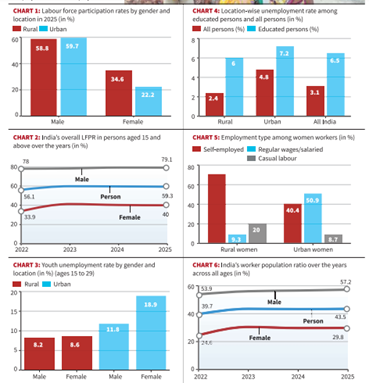
1. India’s Labour Market Dynamics: PLFS 2025 Insights
I. Key Indicators: LFPR and WPR
- Labour Force Participation Rate (LFPR): The overall LFPR for all ages stands at 44.9%.
- Gender Gap: Male participation is significantly higher at 59.7% in urban areas, whereas urban female participation remains low at 22.2%.
- Worker Population Ratio (WPR): This ratio has seen a steady climb from 39.7% in 2022 to 43.5% in 2025.
- Rural Female WPR: A notable increase has been recorded in rural areas, where the female WPR rose from 26.9% to 33.8% over the same period.
II. The Unemployment Challenge
- General Rate: The overall unemployment rate has fallen from 3.6% in 2022 to 3.1% in 2025.
- Youth Unemployment (Ages 15-29): Stands at 9.9%, which is more than three times the national average.
- The situation is most acute for urban young women, with an unemployment rate of 18.9%.
- Educated Unemployment: Persons with secondary schooling and above face a 6.5% unemployment rate.
- In urban areas, this figure reaches 7.2%, suggesting that job creation has not yet matched the growth of the educated workforce.
III. Nature of Employment
- Self-Employment: Highly prevalent in rural areas, especially among women (70.7%), often reflecting subsistence activities.
- Regular Wage/Salaried Work: Urban areas offer better distribution, with 50.9% of working women in regular wage employment compared to only 9.3% in rural areas.
2. Defining Key Terms
- Labour Force Participation Rate (LFPR): Defined as the percentage of persons in the labour force (those working or seeking work) out of the total population.
- Worker Population Ratio (WPR): Defined as the percentage of employed persons out of the total population.
- Unemployment Rate (UR): The percentage of persons unemployed among the persons in the labour force (it does not include those who are not looking for work).
3. About the Periodic Labour Force Survey (PLFS)
- Nodal Agency: National Statistical Office (NSO) under the Ministry of Statistics and Programme Implementation (MoSPI).
- Objectives:
- To estimate key employment and unemployment indicators (WPR, LFPR, UR) in the short time interval of three months for the urban areas only in the ‘Current Weekly Status’ (CWS).
- To estimate employment and unemployment indicators in both rural and urban areas annually in both ‘Usual Status’ and CWS.
Consider the following statements regarding the Periodic Labour Force Survey (PLFS):
1. The PLFS is conducted by the National Statistical Office (NSO) under the Ministry of Statistics and Programme Implementation.
2. Worker Population Ratio (WPR) refers to the percentage of unemployed persons in the labour force.
3. Labour Force Participation Rate (LFPR) includes both employed persons and those seeking work.
Which of the statements given above are correct?
(a) 1 and 3 only
(b) 2 and 3 only
(c) 1 and 2 only
(d) 1, 2 and 3
Answer:
(a) 1 and 3 only
Explanation:
• Statement 1 is correct: PLFS is conducted by the NSO under MoSPI.
• Statement 2 is incorrect: WPR refers to the percentage of employed persons out of the total population.
• Statement 3 is correct: LFPR includes persons who are working or seeking work.