

Context
To stabilize the economy against global volatility, the Government of India has doubled the effective import duty on gold and silver from 9.2% to 18.4%. This move is primarily driven by the need to manage the Current Account Deficit (CAD), which has been pressured by the West Asia crisis and rising global energy prices. By making “non-essential” imports like precious metals more expensive, the government aims to preserve foreign exchange for essential commodities like crude oil and fertilizers.
1. Why India Raised Import Duty on Precious Metals?
- Conserving Foreign Exchange: The government aims to protect India’s foreign exchange reserves, which have faced pressure due to the ongoing West Asia crisis. Officials believe forex should be prioritized for “essential” imports like crude oil, fertilizers, and defense equipment rather than “discretionary” consumption like gold.
- Controlling the Current Account Deficit (CAD): Gold is a major contributor to India’s trade deficit. Despite falling volumes, the value of gold imports surged over 24% to a record $71.98 billion in FY26 due to soaring global prices, significantly widening the CAD.
- Supporting the Rupee: The Indian Rupee has weakened sharply, falling below 95.5 per dollar following regional conflict in late February. Reducing bullion imports is a direct measure to halt the currency’s slide.
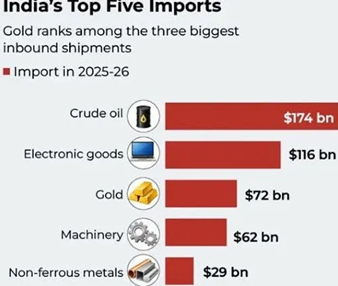
- Responding to Rising Energy Costs: As a major oil importer, India is vulnerable to supply disruptions in the Strait of Hormuz. With Brent crude prices jumping from $73 to nearly $107 per barrel, the government is moving to “moderate avoidable demand” for precious metals to offset the ballooning energy bill.
2. Current Account Deficit (CAD)
- Definition: The margin by which a country’s total imports of goods, services, and transfers exceed its total exports. It is a component of the Balance of Payments (BoP).
- Current Account components:
- Trade in goods (exports and imports)
- Services (IT, tourism, shipping, etc.)
- Income (interest, dividends, profits)
- Transfers/remittances
- Effects of High CAD:
- Pressure on foreign exchange reserves
- Depreciation of domestic currency
- Increase in external borrowing
- Economic vulnerability during global crises
3. Difference Between Current Account & Capital Account
| Current Account | Capital Account |
| Deals with trade in goods & services | Deals with investments & asset flows |
| Includes exports, imports, remittances | Includes FDI, FPI, loans |
| Reflects income and expenditure | Reflects ownership and investments |
| Example: oil import bill | Example: foreign investment in India |
Consider the following statements regarding India’s decision to raise import duties on gold and silver:
1. A rise in gold imports can widen the Current Account Deficit (CAD).
2. The Current Account includes Foreign Direct Investment (FDI) and Foreign Portfolio Investment (FPI).
3. Higher import duties on precious metals can help conserve foreign exchange reserves.
4. The Capital Account deals with investments and asset flows between countries.
Which of the statements given above are correct?
(a) 1, 3 and 4 only
(b) 1 and 2 only
(c) 2, 3 and 4 only
(d) 1, 2, 3 and 4
Answer: (a) 1, 3 and 4 only
Explanation:
• Statement 1 is correct: High gold imports increase the trade deficit and widen the Current Account Deficit (CAD).
• Statement 2 is incorrect: FDI and FPI are components of the Capital Account, not the Current Account.
• Statement 3 is correct: Raising import duties reduces non-essential imports and helps conserve foreign exchange reserves.
• Statement 4 is correct: The Capital Account records investments and financial asset flows such as FDI, FPI, and loans.