
Context
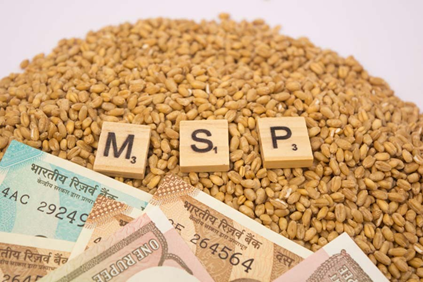
Recently, the Cabinet Committee on Economic Affairs announced the Minimum Support Price (MSP) for kharif crops for the 2026-27 season. The MSP for the common variety of paddy has been increased by ₹72 per quintal to ₹2,441, while the price for A-grade paddy is set at ₹2,461 per quintal. While Union Minister Ashwini Vaishnaw stated that these rates ensure a 50% return over the cost of production, various farmer organizations have flagged concerns regarding the potential “disastrous impact” of the India-U.S. trade deal and other free trade agreements on the domestic agricultural sector.
1. What is Minimum Support Price (MSP)?
Minimum Support Price is a form of market intervention by the Government of India to insure agricultural producers against any sharp fall in farm prices. It acts as a floor price for agricultural produce, ensuring that farmers do not suffer losses during bumper production years.
- Announcement: MSPs are announced at the beginning of the sowing season for certain crops.
- Basis: It is based on the recommendations of the Commission for Agricultural Costs and Prices (CACP).
- Approval: The final decision on MSP levels is taken by the Cabinet Committee on Economic Affairs (CCEA), chaired by the Prime Minister.
2. Mandated Crops (Total 22 + Sugarcane)
The government announces MSP for 22 mandated crops and a Fair and Remunerative Price (FRP) for sugarcane.
| Category | Crops Included |
| Kharif Crops (14) | Paddy, Jowar, Bajra, Maize, Ragi, Arhar, Moong, Urad, Groundnut, Soybean, Sunflower, Sesamum, Nigerseed, Cotton. |
| Rabi Crops (6) | Wheat, Barley, Gram, Masur (Lentil), Rapeseed/Mustard, Safflower. |
| Commercial Crops (2) | Jute, Copra. |
| Sugarcane | Fixed as Fair and Remunerative Price (FRP). |
3. Calculation Methodology (CACP Guidelines)
The CACP considers both “objective” and “subjective” factors while recommending MSP.
- Cost Concepts:
- A2: Covers all paid-out expenses like seeds, fertilizers, chemicals, hired labor, fuel, and irrigation.
- A2+FL: Includes A2 plus an imputed value of unpaid Family Labor (FL).
- C2: A comprehensive cost that includes A2+FL plus the interest on value of owned capital assets and rent paid for leased-in land.
- Government Policy: Since the 2018-19 Union Budget, the MSP is fixed at a level of at least 1.5 times the A2+FL cost.
4. Significance of MSP
- Price Stability: It protects farmers from the vagaries of the market and price volatility.
- Food Security: Assured prices encourage the production of staple food grains like wheat and paddy, maintaining the Central Buffer Stock.
- Crop Diversification: By providing higher price signals for oilseeds and pulses, the government aims to reduce the “wheat-paddy” monoculture.
- Informed Sowing: As it is announced before sowing, it helps farmers decide which crop will be most remunerative.
5. Issues and Challenges
- Lack of Legal Guarantee: Currently, MSP is a policy decision and not a legal right, meaning private buyers are not legally bound to pay it.
- Regional Imbalance: Procurement is heavily concentrated in states like Punjab, Haryana, and Madhya Pradesh.
- Low Awareness: According to the Shanta Kumar Committee (2015), only about 6% of farmers actually benefit from MSP procurement.
- Ecological Impact: High MSP for water-intensive crops like paddy has led to depleting groundwater levels in semi-arid regions.
Q. Consider the following statements regarding the Minimum Support Price (MSP) in India:
I. The Commission for Agricultural Costs and Prices (CACP) is the final authority to approve the MSP for mandated crops.
II. The MSP for all mandated crops is currently fixed at a level of at least 150% of the comprehensive cost (C2).
III. Sugarcane is not included in the list of 22 mandated crops for which MSP is announced.
Which of the statements given above is/are correct according to the recent patterns?
a) I and II only
b) III only
c) II and III only
d) I, II, and III
Solution:
Correct Option: (b)
• STATEMENT I IS INCORRECT: The CACP only "recommends" the MSP. The final "approving" authority is the Cabinet Committee on Economic Affairs (CCEA).
• STATEMENT II IS INCORRECT: The government currently fixes MSP at 1.5 times (150%) of the A2+FL cost, not the comprehensive C2 cost (which is a long-standing demand of the Swaminathan Commission).
• STATEMENT III IS CORRECT: Sugarcane is provided with a Fair and Remunerative Price (FRP) under the Sugarcane (Control) Order, 1966, and is technically distinct from the 22 crops covered under the MSP framework.