
Context
- Recently, President Droupadi Murmu presented the first phase of the prestigious Padma Awards for the year 2026 at a formal Civil Investiture Ceremony held at Rashtrapati Bhavan, conferring honors upon prominent citizens for their exceptional public service across diverse domains. For the current calendar cycle, the President approved a total of 131 decorations across three distinct categories, spotlighting grass-roots achievers, cultural iconoclasts, and veterans posthumously recognized for their foundational legacy.
1. Classification and Hierarchy
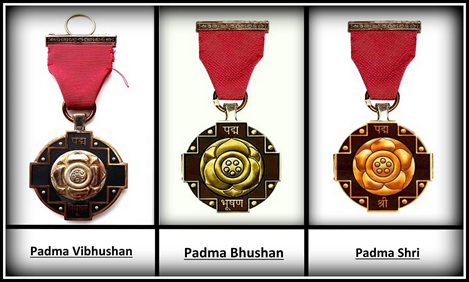
Instituted in the year 1954, the Padma Awards constitute the highest civilian honors of the Republic of India alongside the Bharat Ratna. The structural hierarchy is organized into three specific tiers based on the nature of the contribution:
- Padma Vibhushan: Awarded for “exceptional and distinguished service” (the highest tier among the Padma honors).
- Padma Bhushan: Conferred for “distinguished service of high order”.
- Padma Shri: Conferred for “distinguished service” in any given field.
2. Fields of Activity
The scope of recognition is extensive and includes disciplines such as Art (music, cinema, painting), Social Work, Public Affairs, Science & Engineering, Trade & Industry, Medicine, Literature & Education, Civil Services, and Sports. It also covers distinct sub-categories such as tribal healthcare, traditional martial arts, agricultural innovation, and ancient craftsmanship.
3. The Institutional Nomination Process
The nomination process follows a structured workflow that transitions from public submissions to final executive approval:
- Step 1: Open Submissions: The process begins with public and self-nominations submitted digitally via the centralized Rashtriya Puraskar Portal.
- Step 2: Committee Screening: All incoming nominations are scrutinized by the Padma Awards Committee, a high-level body constituted afresh every year by the Prime Minister. This committee is structurally headed by the Cabinet Secretary and includes the Home Secretary, the Secretary to the President, and four to six eminent persons drawn from public life.
- Step 3: Executive Review: The recommendations formulated by this panel are submitted directly to the Prime Minister and the President of India for final executive clearance.
- Step 4: Public Announcement: The finalized list of awardees is officially declared on the eve of Republic Day every year.
4. Statutory Rules and Strict Exclusions
1. Institutional Disqualifications
The institutional framework establishes a clear wall of separation to ensure impartiality in selections:
- Government Servants: Public servants working with Government Departments or Public Sector Undertakings (PSUs)—including those in scientific, administrative, or technical roles—are not eligible for the Padma Awards while in active service.
- The Structural Exception: An institutional exception is carved out exclusively for doctors and scientists, who remain eligible for nomination despite being employed in state-run medical facilities or public research institutions.
2. Legal Realities: Title vs. Decoration
The constitutional status of these civilian awards was legally scrutinized and settled by the Supreme Court of India in the landmark Balaji Raghavan v. Union of India (1995) case.
- Article 18(1) Alignment: The Supreme Court ruled that the National Awards (Bharat Ratna and Padma Awards) are valid decorations celebrating merit but do not amount to “titles” within the meaning of Article 18(1) of the Constitution of India.
- Prohibition of Usage: Consequently, these honors cannot be utilized as prefixes or suffixes to the recipient’s name. If an awardee uses the decoration as a prefix or suffix in print, stationery, or public life, they can be structurally stripped of the award.
3. Chronological Rules & Ceiling Limits
- Numerical Cap: The total number of Padma awards conferred in any single calendar year cannot exceed 120. However, this structural ceiling strictly excludes awards given posthumously and those conferred upon Non-Resident Indians (NRIs), Overseas Citizens of India (OCIs), and foreigners.
- Higher Tier Progression: A recipient of a lower Padma tier can only be considered for a higher category award if a minimum period of five years has elapsed since the conferment of the previous Padma honor. However, the regulatory framework permits the selection committee to relax this timeframe under exceptional circumstances.
- Posthumous Mandate: The awards are generally not conferred posthumously. Nevertheless, the government can consider highly distinguished cases if the demise of the intended honoure occurred recently, specifically within the year preceding the Republic Day announcement.
Q. Consider the following statements regarding the national civilian honors in India:
STATEMENT I: Public servants working with Public Sector Undertakings and administrative state departments are completely barred from receiving Padma Awards during their active tenure of service, without any institutional exceptions.

STATEMENT II: According to the Supreme Court's ruling in the Balaji Raghavan case, civilian awards constitute decorations of merit rather than titles, and their use as a prefix or suffix to an awardee's name is legally prohibited.

Which one of the following is correct in respect of the above statements?
(a) Both Statement I and Statement II are correct and Statement II is the correct explanation for Statement I
(b) Both Statement I and Statement II are correct and Statement II is not the correct explanation for Statement I
(c) Statement I is correct but Statement II is incorrect
(d) Statement I is incorrect but Statement II is correct
Solution & Explanation
Correct Answer: (d)
• STATEMENT I IS INCORRECT: While it is true that government servants working in public departments and PSUs are generally excluded from the nomination pool during their active service tenure, the structural rules explicitly carve out an institutional exception for doctors and scientists, making the absolute claim of "without any institutional exceptions" factually incorrect.
• STATEMENT II IS CORRECT: The Supreme Court of India upheld the validity of civilian honors in 1995, declaring that they do not violate Article 18(1) as long as they are treated as decorations. The apex court explicitly stated that these honors cannot be used as a prefix or suffix, and any such unauthorized addition can lead to the forfeiture of the award. Since Statement I is false and Statement II is true, option (d) is the correct choice.