
Context
- Scientists from the Physical Research Laboratory (PRL), Ahmedabad, using data from India’s Chandrayaan-2 orbiter, have detected the “possible presence” of sub-surface water-ice in the Lunar South Polar Region.
1. Key Scientific Concepts & Findings
- Permanently Shadowed Regions (PSRs): These are craters near the lunar poles that never receive direct sunlight due to the tilt of the Moon’s spin axis relative to its orbital plane.
- Doubly Shadowed Craters: These are even more shielded pockets within PSRs that remain completely blocked from both direct sunlight and secondary scattered thermal radiation from surrounding crater walls.
- Environmental Conditions: Temperatures in these regions remain extremely cold (dropping to ~25 Kelvin / -248°C). These ultra-cold temperatures serve as stable “cold traps,” allowing water-ice to be preserved over long geological timescales.
- Sub-surface Presence: Unlike surface ice, this finding indicates the presence of ice beneath the top layer of the lunar soil.
2. DFSAR Payload Technology
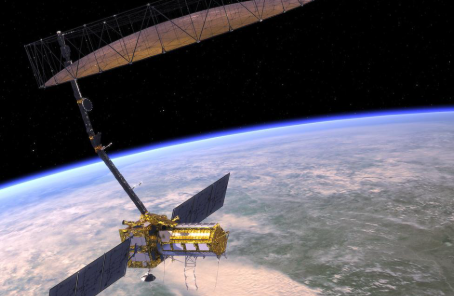
- Instrument Used: Dual Frequency Synthetic Aperture Radar (DFSAR).
- Working Mechanism: It operates in two microwave bands (L-band and S-band). This payload sends radar pulses to the Moon’s surface and reads the reflected signals using advanced radar polarimetric analysis.
- Synthetic Aperture Radar (SAR) Technology uses microwave radiation, not visible light.
- Significance:
- All-Weather, Day/Night Imaging: Unlike optical sensors, microwave radar can pierce through thick clouds, rain, smoke, and darkness.
- Penetration Capabilities: Dual bands allow researchers to see beneath the top layer of surfaces like desert sands and snowpacks.
- Precision Measurement: Using interferometry (InSAR), overlapping radar passes can measure surface elevation changes as small as a centimetre.
- Applications
- Forest and vegetation mapping
- Soil moisture analysis
- Glacier and ice-sheet studies
- Disaster management
- Coastal and ocean studies
- Agricultural monitoring
3. Chandrayaan-2 vs. Chandrayaan-3
- Chandrayaan-2 (Launched 2019): Consisted of an Orbiter, Lander (Vikram), and Rover (Pragyan). While the lander crash-landed, the Orbiter remains fully functional in a 100 km lunar orbit and continues to transmit high-resolution data (as seen in this current discovery).
- Chandrayaan-3 (Launched 2023): Was a follow-on mission consisting only of a Lander and Rover configuration (using a propulsion module instead of a full scientific orbiter). It successfully soft-landed near the lunar south pole at the Shiv Shakti Point.
4. Why is Lunar Water-Ice Critically Important?
- In-Situ Resource Utilization (ISRU): Liquid water is heavy and expensive to transport from Earth. Accessing lunar ice means future crewed bases can extract water for drinking.
- Rocket Propellant: Water can be split into Hydrogen (fuel) and Oxygen (oxidizer) to produce rocket propellant on the Moon, turning it into a refueling stepping stone for deep space missions to Mars.
Which of the following are applications of SAR technology?
1. Forest mapping
2. Soil moisture analysis
3. Glacier studies
4. Agricultural monitoring
Select the correct answer:
(a) 1 and 2 only
(b) 2 and 3 only
(c) 1, 2 and 4 only
(d) 1, 2, 3 and 4
Answer: D
Explanation:
SAR (Synthetic Aperture Radar) uses microwave signals, so it can work in all weather and day/night conditions. Therefore, it is widely used for:
• Forest mapping
• Soil moisture analysis
• Glacier studies
• Agricultural monitoring
Hence, all are correct.