
Context
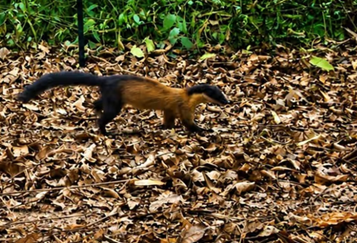
Recently, during routine camera-trapping conducted by the Kaziranga Tiger Cell, a yellow-throated marten (Martes flavigula) was photographed for the first time in the semi-evergreen forest patches of the Kaziranga National Park and Tiger Reserve, Assam.
About the Yellow-Throated Marten
- Taxonomy & Family: It belongs to the Mustelidae family (popularly known as the weasel family), which also includes otters, badgers, and wolverines.
- Physical Characteristics: It is a medium-sized carnivore, unique for its striking bright golden-orange fur across its throat and upper chest, contrasting with a darker head, lower back, and long bushy tail. It is known for a highly aggressive and fearless temperament.
- Ecological Status: It is a mesopredator (a mid-ranking predator in the food web, sitting below apex predators like tigers).
- Behavior: It is a primarily diurnal (active during the day) and highly proficient arboreal (tree-climbing) animal.
- Ecological Role: While it is an omnivorous hunter feeding on rodents, birds, insects, and small ungulates, it also consumes a large volume of fruits, berries, and nectar, making it an essential seed disperser for natural forest regeneration.
- Geographical Distribution: Native to the Himalayas, Northeast India, East Asia, and Southeast Asia. The Kaziranga sighting confirms its local presence within known regional distribution limits.
Legal & Conservation Status
- IUCN Red List: Least Concern (LC) due to its wide distribution and relatively stable global populations.
- Wildlife Protection Act (WPA), 1972: Protected under Schedule II.
Comparison: Marten Species in India
| Species | Primary Habitat Range | Key Distinction |
| Yellow-throated Marten | Himalayas & Northeast India | Bright golden throat; highly adaptable to semi-evergreen and temperate forests. |
| Nilgiri Marten | Western Ghats (Endemic) | Endemic to Southern India; dark brown coat with a distinct lemon-yellow throat patch; Vulnerable on IUCN Red List. |
| Stone Marten / Beech Marten | Higher altitudes of Himalayas | White throat patch; prefers rocky landscapes and open alpine fields. |
Key Geography & Facts about Kaziranga National Park
- Status: Declared a National Park in 1974, a UNESCO World Heritage Site in 1985, and a Tiger Reserve in 2006.
- Location: Spread across the Golaghat and Nagaon districts of Assam.
- Rivers: The River Diffalu, a tributary of the Brahmaputra, flows through the National Park while another tributary, Moradifalu, flows along its southern boundary.
- Key Species: It hosts the world’s largest population of the Great Indian One-Horned Rhinoceros. It is also famous for the “Big Five” of Kaziranga: Rhinoceros, Tiger, Asian Elephant, Asiatic Wild Water Buffalo, and Swamp Deer.
With reference to the Yellow-Throated Marten (Martes flavigula), consider the following statements:
1. It belongs to the Mustelidae family.
2. It is an apex predator in forest ecosystems.
3. It is known for its bright golden-orange throat and upper chest.
Which of the statements given above is/are correct?
A) 1 and 3 only
B) 2 and 3 only
C) 1 only
D) 1, 2 and 3
Answer: A) 1 and 3 only
Explanation:
•  Statement 1 is Correct: The Yellow-Throated Marten belongs to the Mustelidae (weasel) family, which also includes otters, badgers, and wolverines.
•  Statement 2 is Incorrect: It is a mesopredator (mid-ranking predator), not an apex predator like a tiger or leopard.
•  Statement 3 is Correct: It is easily identified by its bright golden-orange throat and upper chest contrasting with a darker body.