
Context
- Recently, expert highlighted that natural mangrove buffers protect coastal communities more effectively and economically than engineered structures. Despite mangroves protecting more people per hectare in India than in almost any other country, public spending heavily favors grey infrastructure (such as concrete seawalls) over ecological missions. Experts are urging a policy shift toward Ecosystem-based Adaptation (EbA) to embed these natural shields into core coastal planning.
Core Ecological Concepts of Mangroves
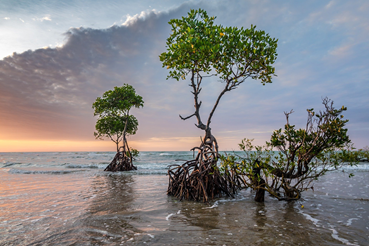
Mangroves are highly specialized, salt-tolerant (halophytic) intertidal plant communities that occupy the ecotone between terrestrial and marine environments.
1. Specialized Adaptations
- Pneumatophores (Respiratory Roots): Vertical root extensions covered with lenticels (pores) that grow upward to breach water surfaces, allowing atmospheric oxygen intake in anaerobic, waterlogged mudflats.
- Stilt and Prop Roots: Adventitious root networks branching from the lower trunk to firmly anchor the flora in unstable, shifting substrates against powerful wave impacts and tidal surges.
- Vivipary Reproduction: An evolutionary adaptation where seeds germinate while still attached to the parent tree, developing into mature propagules before dropping, which prevents seeds from rotting or suffocating in tidal muds.
- Salt Regulation Mechanisms: Species either filter out bulk salt at the root level via ultrafiltration (Rhizophora) or channel and excrete absorbed salt through specialized secretory glands located on their leaves (Avicennia).
2. Geographic Distribution in India
| Coastline | Major Sites | Key Ecological Features |
| East Coast (Largest Share) | Sundarbans (WB), Bhitarkanika (Odisha), Pichavaram (TN), Coringa (AP). | Supported by massive river deltas providing rich sediment and heavy freshwater influx. The Sundarbans acts as a primary buffer against Bay of Bengal cyclones. |
| West Coast (Highly Fragmented) | Gulf of Kutch (Gujarat), Thane Creek (MH), Mandovi-Zuari (Goa). | Characterized by steep rocky coasts and lower silt loads. Gujarat holds the second-largest mangrove area in the country. |
| Islands | Andaman & Nicobar Islands. | Pristine, deep fringing mangrove formations that transition directly into coral reef systems. |
Strategic Value & Conservation Frameworks
1. Ecosystem-based Adaptation (EbA) vs. Grey Infrastructure
- The Adaptation Asset: Research identifies India as a global “hotspot” for coastal EbA, with mangroves protecting more individuals per hectare than almost any other country. They act as superior natural buffers compared to hard structures like seawalls, which are expensive to maintain and often transfer erosion risks to adjacent coastal stretches.
- Blue Carbon & Co-benefits: Mangroves sequester up to four times more carbon than terrestrial tropical rainforests. Ground-level projects in the Sundarbans have restored over 4,600 hectares, creating tangible socio-economic co-benefits by protecting local livelihoods through crab farming and honey collection.
2. Policy Bottlenecks and Governance
- Terminology Confusion: The policy space suffers from overlapping labels like Nature-based Solutions (NbS), Ecosystem-based Disaster Risk Reduction (Eco-DRR), and Coastal Adaptation (EhCA). This lacks a clear classification system, meaning interventions are often hidden within generic developmental programs rather than tracked as distinct climate adaptations.
- The MISHTI Scheme: The Mangrove Initiative for Shoreline Habitats & Tangible Incomes (MISHTI) aims to restore 540 square kilometers across nine States. However, it is primarily framed as a standalone restoration scheme rather than a core component embedded within integrated coastal planning and adaptation policies.
- Legal Protections: Mangroves are legally shielded under the Coastal Regulation Zone (CRZ-I) classification of the Environment (Protection) Act, 1986, which heavily restricts industrial and commercial construction in these eco-sensitive areas.
Q. With reference to coastal protection and adaptation strategies in India, consider the following statements:
1. Over the past decade, public expenditure by coastal states has leaned heavily toward engineered grey measures like seawalls and groynes rather than natural ecological buffers.
2. The MISHTI initiative is an integrated framework designed explicitly to align blue carbon accounting directly with industrial carbon credit registries.
3. Hard infrastructure solutions like coastal seawalls can cause structural trade-offs by shifting erosion risks and damage to adjacent coastal areas.
Which of the statements given above are correct?
(a) 1 and 2 only
(b) 2 and 3 only
(c) 1 and 3 only
(d) 1, 2 and 3
Solution
Correct Answer: (c) 1 and 3 only
• STATEMENT 1 IS CORRECT: Public spending across India's coastal landscape reveals a strong preference for engineered measures over green interventions, with states allocating over ₹2,641 crore to hard protection measures during the last decade.
• STATEMENT 2 IS INCORRECT: The MISHTI scheme focuses primarily on the physical restoration of mangrove habitats across states to safeguard coastal communities. It is currently framed as a restoration program and is not yet fully integrated into mainstream coastal adaptation policies or industrial carbon accounting systems.
• STATEMENT 3 IS CORRECT: Engineered grey structures are not only expensive to maintain but can also alter local wave dynamics, which can displace underlying risks and accelerate coastal erosion in neighboring areas.