
After Reading This Article You Can Solve This UPSC Mains Model Question:
Assess the multidimensional security threats posed by the evolution of drone warfare, particularly focusing on non-state actors and border management. In this context, discuss the strategic necessity of ‘Atmanirbhar Bharat’ in building robust indigenous counter-drone capabilities. 15 Marks (GS 3, Science & tech)
Context
Recent conflicts in Ukraine, Lebanon, Israel-Iran theatre and West Asia have demonstrated that drones have become central to modern warfare. Cheap, mass-produced unmanned systems are reshaping military doctrines, battlefield tactics, defence economics, and strategic deterrence.
Introduction
Traditionally, military power was determined by advanced platforms such as fighter aircraft, tanks, warships, and missiles. However, recent conflicts in Ukraine and West Asia have demonstrated that inexpensive, mass-produced drones can deliver surveillance, precision strikes, and intelligence capabilities at a fraction of the cost. Consequently, warfare is increasingly shifting from platform-centric warfare to drone-centric warfare.
How Drones Have Changed Modern Warfare
1. Persistent Surveillance and Visibility
· Enhanced Situational Awareness: Drones provide real-time intelligence, continuous surveillance, target acquisition, and artillery correction, enabling unprecedented battlefield visibility and information dominance.
· Increased Battlefield Vulnerability: Persistent drone surveillance has eliminated traditional concealment, making frontlines and rear areas equally vulnerable, with rapid detection often leading to immediate engagement and destruction.
2. Democratisation of Military Power
· Democratisation of Military Capability: Drones have lowered the barriers to military power by enabling smaller states and non-state actors to acquire effective surveillance and strike capabilities without requiring large defence budgets or advanced conventional arsenals.
· Shift in Battlefield Economics: Low-cost drones can destroy high-value military assets such as tanks and artillery systems, creating an asymmetric cost advantage and reducing the traditional dominance of technologically superior militaries.
3. Precision Strike Capability
Modern drones can:
- Deliver explosives accurately
- Attack moving targets
- Conduct kamikaze missions
- Destroy critical infrastructure
FPV (First-Person View) Drone Revolution
What are FPV Drones?
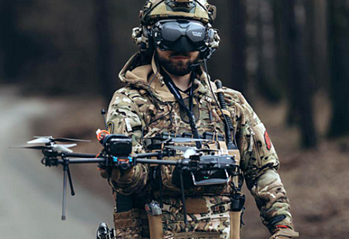
FPV (First-Person View) drones are unmanned aerial systems operated through onboard cameras that transmit live video feeds to VR-style goggles worn by operators. Originally developed for recreational racing and aerial photography, they have been adapted into highly effective military strike and reconnaissance platforms.
Advantages of FPV Drones
- High Precision: FPV drones allow operators to accurately engage specific targets through real-time visual control.
- Low Cost: They deliver precision strike capabilities at a fraction of the cost of conventional missiles and weapon systems.
- Easy Production: Most FPV drones can be rapidly assembled using readily available commercial components.
- High Adaptability: They can be easily modified for reconnaissance, kamikaze attacks, bombing, interception, and electronic warfare missions.
Fibre-Optic FPV Drones: The Next Generation
What Makes Them Unique?
Fibre-optic drones use cable-based communication instead of radio signals, making them highly resistant to jamming and electronic warfare. This ensures reliable operation even in contested battlefield environments..
Benefits of Fibre-Optic Drones
- Resistant to Electronic Warfare: Fibre-optic communication prevents disruption from enemy jamming and electronic interference.
- Difficult to Jam: Since signals travel through physical cables rather than radio frequencies, conventional jamming techniques become ineffective.
- Reliable Communication: Provides uninterrupted transmission of commands and video feeds even in contested electromagnetic environments.
- Enhanced Battlefield Survivability: Greater communication reliability improves mission success and operational effectiveness in high-threat zones.
Recent Uses
1. Hezbollah’s Drone Model: Low-Cost Asymmetric Warfare
- Hezbollah extensively employs Iranian-origin drones such as Ababil, Mohajer, and Shahed for surveillance, reconnaissance, and precision strike missions.
- The recent adoption of fibre-optic FPV drones has enhanced its ability to evade Israeli electronic warfare and counter-drone systems.
2. Israel’s Counter-Drone Strategy: Multi-Layered Air Defence
- Israel has developed a layered Counter-UAS architecture combining electronic warfare systems and specialised radars to detect and neutralise hostile drones.
- AI-enabled systems such as the Iron Drone Raider provide cost-effective interception through net capture and direct collision mechanisms.
3. Iran’s Drone Strategy: Tool of Strategic Deterrence
- Iran views drones as instruments of deterrence, coercion, and power projection, complementing its conventional military capabilities.
- Through Shahed-series drones and proxy-operated networks, Iran extends its strategic influence across Iraq, Syria, Lebanon, and Yemen.
Emerging Trends in Drone Warfare
1. Swarm Warfare
- Mass Saturation Attacks: Large numbers of drones operate simultaneously to overwhelm enemy air defences and exhaust interception capabilities.
2. AI-Enabled Drones
- Autonomous Combat Systems: Artificial intelligence enables drones to navigate, identify targets, and support decision-making with minimal human intervention.
3. Integration with Electronic Warfare
- Multi-Domain Drone Battles: Future conflicts will witness continuous competition between drones, counter-drones, and electronic warfare systems.
4. Hybrid Warfare
- Integration Across Domains: Drones are increasingly combined with cyber operations, information warfare, and precision strikes to achieve strategic objectives beyond the battlefield.
Implications and Challenges of Drone Warfare for India
1. Border Security Threats
Drones are increasingly being used for arms smuggling, drug trafficking, and surveillance activities along India’s western and northern borders.
2. Need for Advanced Military Modernisation
India must strengthen indigenous drone manufacturing, anti-drone systems, AI-enabled surveillance, and swarm drone capabilities to maintain battlefield superiority.
3. Strategic Importance of Atmanirbhar Bharat
Future military power will depend on domestic industrial capacity, manufacturing scale, and defence innovation ecosystems rather than solely on expensive platforms.
4. Proliferation to Non-State Actors
The low cost and easy availability of drones enable terrorists, insurgents, and other non-state actors to acquire advanced combat capabilities.
5. Ethical and Humanitarian Concerns
The growing use of autonomous drones raises concerns regarding accountability, civilian casualties, and compliance with international humanitarian law.
6. Regulatory and Governance Challenges
The absence of comprehensive international norms, export controls, and drone governance frameworks creates risks of misuse and unchecked proliferation.
Way Forward
1. Strengthen Indigenous Drone Technology
Invest in domestic development of advanced drones to reduce import dependence and enhance strategic autonomy.
2. Accelerate AI and Autonomous Systems
Promote AI-enabled drones with capabilities such as autonomous navigation, target recognition, and decision support.
3. Build Robust Counter-Drone Capabilities
Develop advanced anti-drone systems, electronic warfare tools, and directed-energy weapons to neutralise emerging threats.
4. Integrate Drones into Military Doctrine
Institutionalise drone warfare through doctrinal reforms, specialised training, and greater tri-service coordination.
5. Foster a Strong Defence Innovation Ecosystem
Support defence startups, strengthen R&D infrastructure, and scale domestic manufacturing under Atmanirbhar Bharat.
6. Promote Global Cooperation and Norms
Work towards international regulations, responsible military drone usage, and collaboration on counter-drone technologies.
Conclusion
As warfare enters the age of autonomous systems, victory will increasingly belong to nations that combine innovation, industrial resilience, and drone dominance. For India, mastering this revolution is both a strategic necessity and an opportunity.