
Context
- The States of Madhya Pradesh, Gujarat, Maharashtra, and Rajasthan have reached an agreement to settle pending payments related to the Narmada Water Disputes Tribunal (NWDT) Award.
- The settlement is expected to improve inter-state cooperation in water resource management and ensure uninterrupted water and power benefits from the Sardar Sarovar Project.
About Narmada Water Disputes Tribunal (NWDT)
- Establishment: The Central Government constituted the NWDT on October 6, 1969, under Section 4 of the Inter-State Water Disputes Act, 1956.
- The Stakeholders: The adjudication involved four states: Madhya Pradesh, Gujarat, Maharashtra, and Rajasthan.
- The Tribunal spent a decade deliberating and delivered its final binding Award on December 7, 1979.
About the Narmada River
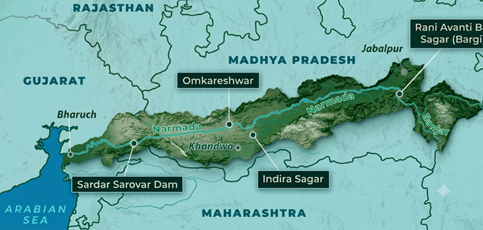
- Origin: The Narmada originates from the Amarkantak Plateau in the Anuppur district of Madhya Pradesh. It flows westwards in a rift valley between the Satpura in the south and the Vindhyan range in the north.
- Flow Direction: It flows westward over a length of approximately 1,312 km before emptying into the Gulf of Khambhat (Arabian Sea) near Bharuch in Gujarat.
- States Covered: It flows through Madhya Pradesh, Maharashtra, and Gujarat. Madhya Pradesh holds the lion’s share of its basin area (nearly 87%).
- The Narmada basin extends over MP, Gujarat, Maharashtra, and Chhattisgarh, which is nearly 3% of the country’s total geographical area.
- It forms a picturesque gorge in marble rocks and Dhuandhar waterfall near Jabalpur.
Important Dams on the Narmada
| Dam | State | Importance |
| Sardar Sarovar Dam | Gujarat | Multipurpose project for irrigation, drinking water and hydropower |
| Indira Sagar Dam | Madhya Pradesh | India’s largest reservoir by storage capacity |
| Omkareshwar Dam | Madhya Pradesh | Hydropower and irrigation |
| Maheshwar Dam | Madhya Pradesh | Hydroelectric project |
| Bargi Dam | Madhya Pradesh | First major completed dam on the Narmada |
| Constitutional & Legal Provisions of Inter- state Rivers Article 262: Parliament may provide for adjudication of disputes relating to inter-State rivers. Parliament may exclude the jurisdiction of the Supreme Court and other courts in such disputes. Inter-State River Water Disputes Act, 1956: Provides for establishment of Water Disputes Tribunals.Tribunal awards are binding on the concerned States |
Consider the following statements regarding the Narmada Water Disputes Tribunal (NWDT):
1. It was established under the provisions of the Inter-State Water Disputes Act, 1956.
2. The tribunal awarded the largest share of utilizable water to the state of Gujarat.
3. Rajasthan, despite being a non-riparian state, was allocated a share of the Narmada waters by the tribunal.
Which of the statements given above are correct?
(a) 1 and 2 only
(b) 2 and 3 only
(c) 1 and 3 only
(d) 1, 2 and 3
The correct answer is (c) 1 and 3 only.
Detailed Explanation:
• Statement 1 is correct: The Narmada Water Disputes Tribunal (NWDT) was constituted by the Central Government in October 1969 under Section 4 of the Inter-State Water Disputes Act, 1956 to adjudicate the water-sharing dispute among the concerned states.
• Statement 2 is incorrect: The tribunal assessed the total utilizable quantum of water at 28 Million Acre Feet (MAF). It awarded the largest share to Madhya Pradesh (18.25 MAF), followed by Gujarat (9.00 MAF).
• Statement 3 is correct: Even though Rajasthan is a non-riparian state (the river does not flow through its territory), it was allocated a share of 0.50 MAF by the tribunal to meet the critical irrigation and drinking water needs of its drought-prone desert districts.