
Context
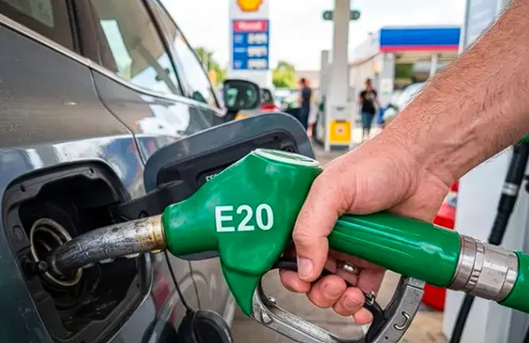
- A petition has been filed in the Supreme Court challenging the “silent compulsion” of the nationwide E20 petrol rollout. The petition seeks full public disclosure of the chemical composition of the fuel and its technical compatibility safeguards, urging the court to establish an independent expert committee to evaluate the real-world impacts of higher ethanol blends on legacy vehicles.
Key Technical & Legal Challenges
- Legacy Compatibility: BIS specifications confirm E20 compatibility is strictly vehicle-specific, exposing older, uncalibrated engines to accelerated component wear and fuel-pump failures.
- Constitutional & Consumer Scrutiny: A Supreme Court petition by advocate Narendra Kumar Goswami invokes fundamental freedoms, Article 300A (right to property), and the Consumer Protection Act, arguing that full disclosure of fuel compatibility in a state-mandated market is a strict constitutional requirement.
- Resource Strain: Scaling 1G biofuels diverts essential food crops and severely depletes groundwater via water-intensive feedstocks like sugarcane.
What is E20 Fuel and How is it Structured?
- Composition: E20 is a specialized automotive fuel blend consisting of 20% ethanol and 80% conventional petrol by volume.
- Octane Upgrade: Standard petrol in India holds a Research Octane Number (RON) of 91 to 92. In contrast, E20 fuel is mandated to have a minimum rating of 95 RON.
- Combustion Mechanics: RON functions as a direct indicator of fuel stability. A higher octane rating increases the fuel’s resistance to premature detonation under high pressure, leading to smoother and cleaner engine combustion.
- Energy Density: Ethanol possesses a lower energy density compared to pure petrol. Consequently, uncalibrated engines using E20 fuel experience a minor reduction in real-world fuel economy and mileage.
Chemical & Material Properties of Ethanol
- Formula: Ethanol (C₂H₅OH) is a clear, volatile, and biodegradable alcohol.
- Hygroscopic: Absorbs moisture from the air, which may cause phase separation and corrosion in older fuel systems.
- Source: Produced by fermenting biomass such as sugarcane, maize, wheat, and damaged food grains.
- Fuel Grade: Mixed with denaturants to make it undrinkable.
India’s Ethanol Blending Policy
- Launch: Ethanol Blended Petrol (EBP) Programme to reduce crude oil imports, cut emissions, and support farmers.
- E10 Target: Achieved nationwide in June 2022.
- E20 Target: Advanced from 2030 to ESY 2025–26.
- Achievement: India reached 19.93% ethanol blending by July 2025, effectively achieving the E20 target ahead of schedule.
With respect to the Ethanol Blended Petrol (EBP) Programme and the chemical properties of biofuels, consider the following statements:
I. E20 fuel is formulated with a lower Research Octane Number (RON) than conventional petrol to match the combustion parameters of uncalibrated legacy vehicles.
II. Ethanol is a hygroscopic substance, which makes it highly prone to moisture absorption and subsequent phase separation when stored in conventional fuel tanks.
III. Fuel-grade ethanol is legally treated with denaturants during the manufacturing process to render the alcohol unfit for human consumption.
How many of the statements given above are correct?
(a) Only one
(b) Only two
(c) All three
(d) None
Answer: B
Explanation:
● Statement I is incorrect: Conventional petrol in India typically carries an octane rating of 91 to 92 RON, whereas E20 fuel is mandated to feature a higher minimum rating of 95 RON to ensure enhanced combustion stability.
● Statement II is correct: Ethanol is highly hygroscopic in nature, meaning it readily absorbs water from its surroundings. This water accumulation can cause the fuel mixture to separate into distinct layers (phase separation) and accelerate the corrosion of older engine components.
● Statement III is correct: Fuel ethanol must be processed with chemical denaturants to ensure it cannot be diverted or consumed as an alcoholic beverage, maintaining its strict classification as an industrial energy resource.