
After Reading This Article You Can Solve This UPSC Mains Model Question:
The Supreme Court’s interpretation of “industry” reflects the need to balance labour protection with legal certainty and changing economic realities. Discuss. 15 Marks (GS 2, Polity & Governance)
Context
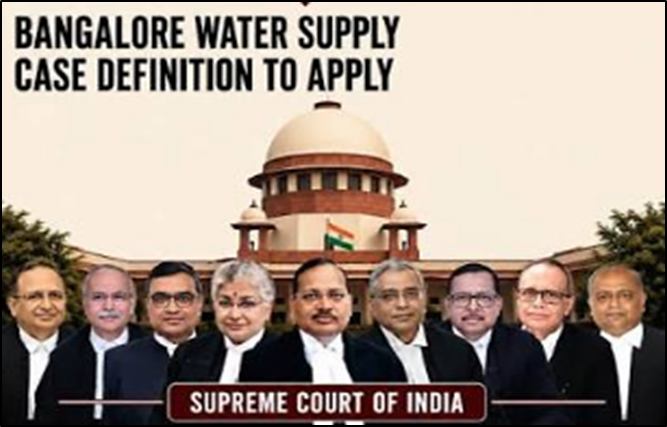
A nine-judge Supreme Court Bench has clarified the meaning of “industry” under labour law. It retained the 1978 Bangalore Water Supply “triple test” for pending cases under the repealed Industrial Disputes Act, while holding that the Industrial Relations Code, 2020 must be interpreted independently.
Introduction
The meaning of “industry” has long been debated in relation to hospitals, educational institutions, charities and government activities. The Court retained the 1978 Triple Test for pending cases while treating the new Labour Code independently, balancing labour rights, judicial precedent and legal certainty.
What is the “Industry” Debate?
Industrial Disputes Act, 1947
- Section 2(j): Defined “industry”, creating uncertainty over which institutions and activities came under labour laws.
- Hospitals: Whether healthcare institutions could be treated as industries for labour-law protection.
- Universities: Whether educational institutions fall within the definition of an industry.
- Charitable Institutions: Whether non-profit organisations can qualify as industries despite having no profit motive.
- Government Departments: Whether government-run activities constitute an industry or a sovereign function.
Bangalore Water Supply Case, 1978 — Triple Test
- Systematic Activity: The activity must be organised and carried out in a structured manner.
- Employer–Employee Cooperation: The activity must involve cooperation between employers and employees.
- Goods/Services: The activity must produce or provide goods or services to satisfy human needs.
Why is the Latest Judgment Significant?
1. Continuity of Labour Rights
- Pending cases: Existing disputes under the old Act will continue under the 1978 Triple Test.
- Legal certainty: Prevents disruption of long-pending labour claims.
2. Clarifies the New Labour Code
- Independent framework: The Industrial Relations Code, 2020 has its own definition and exclusions.
- No automatic application: The 1978 judgment cannot simply be applied to the new Code.
3. Reinforces Stare Decisis
- Judicial precedent: Established judgments of larger Benches should not be overturned casually.
- Exceptional grounds: Reconsideration requires grounds such as manifest error or serious public mischief.
4. Clarifies Sovereign Functions
- Not every State activity: Government activity does not automatically qualify as a sovereign function.
- Narrow exception: Only core and inalienable governmental functions are generally excluded.
5. Relevant to Changing Work Patterns
- New employment landscape: Privatisation, outsourcing, contract work, gig work and platform employment make the definition of “industry” increasingly significant.
Constitutional Dimension
- Equality & Association: Articles 14 and 19(1)(c) ensure equality and protect workers’ right to form associations and trade unions.
- Dignity & Livelihood: Article 21 links labour protection with the right to live with dignity and livelihood.
- Social & Economic Justice: Articles 38 and 39 seek social justice and protection of livelihood and workers’ interests.
- Decent Work: Articles 41, 42 and 43 promote the right to work, humane working conditions, living wages and a decent standard of life.
Challenges / Issues Highlighted by the Judgment
1. Expansive vs Narrow Interpretation
- A broad definition strengthens worker protection.
- But excessive expansion can create uncertainty for employers and institutions.
- A narrower definition may provide clarity but risk excluding vulnerable workers.
2. Continuing Ambiguity
- The fractured judgment shows continuing disagreement over the boundary between:
- Economic activity
- Welfare activity
- Sovereign function
3. Changing Nature of Work
- Traditional labour laws were designed around conventional employer–employee relationships.
- Gig work, platform employment, outsourcing and contractual work are creating new regulatory challenges.
4. Judicial Interpretation vs Legislative Policy
- Courts interpret statutory provisions, while Parliament determines the legislative framework.
- The new Labour Code therefore requires interpretation primarily on the basis of its own text and legislative scheme.
Way Forward
- Ensure Clear Legislative Definitions: Parliament should provide precise definitions in labour laws to reduce ambiguity and prolonged litigation.
- Implement Labour Codes Effectively: Labour reforms should balance worker protection, ease of doing business, industrial flexibility and social security.
- Adapt Laws to New Forms of Work: Labour protections must evolve to cover gig, platform, contract and informal workers in the changing labour market.
- Maintain Narrow Sovereign-Function Exemption: Only core and inalienable governmental functions should be excluded, not ordinary welfare or service activities.
- Balance Competing Interests: Labour policy should harmonise worker welfare, economic efficiency, legal certainty and social justice.
Conclusion
The judgment balances labour rights with statutory clarity, while allowing the new Labour Code to evolve independently. India must pursue economic growth without compromising dignity of labour and social justice.
| Important Current to Concept From This Article for UPSC Triple Test Industrial Relations Code, 2020 |