
Context
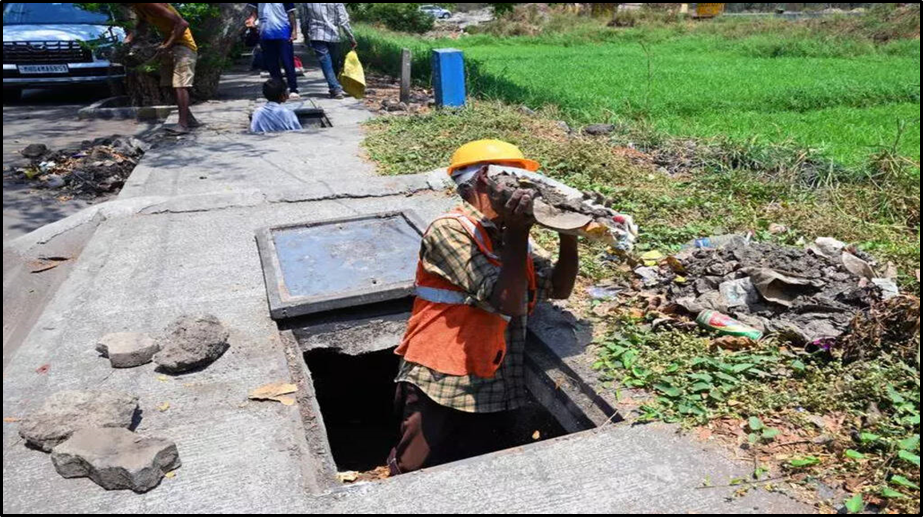
Recently, the Union Government has proposed expanding the National Action for Mechanised Sanitation Ecosystem (NAMASTE) scheme from urban to rural areas. The proposed expansion will also cover drain cleaners and workers engaged in Sewage Treatment Plants (STPs) and Faecal Sludge Treatment Plants (FSTPs).
About NAMASTE
NAMASTE stands for National Action for Mechanised Sanitation Ecosystem.
- Launched: 2023–24
- Objective: To promote the mechanisation of sanitation work and ensure the safety and dignity of sanitation workers.
- Nodal Ministry: Ministry of Social Justice and Empowerment, in convergence with the Ministry of Housing and Urban Affairs (MoHUA).
- Initial Focus: Sewer and Septic Tank Workers (SSWs).
- Later Expanded to Include: Waste Pickers.
- To eliminate hazardous and unsafe sanitation practices and move towards zero fatalities in sewer and septic tank cleaning.
Key Components of NAMASTE
1. Identification & Profiling
- Identifies and profiles sanitation workers for welfare and safety support.
- 90,915 SSWs and 1.3 lakh Waste Pickers profiled so far.
2. Mechanisation & Safety
- Promotes mechanised cleaning, PPE, training and skill development.
3. Emergency Response
- Supports Emergency Response Sanitation Units (ERSUs) in Urban Local Bodies (ULBs).
4. Livelihood Support
- Promotes self-employment and sanitation enterprises.
- Provides capital subsidy of up to 50% of the project cost.
- Also supports Private Sanitation Service Organisations (PSSOs).
Proposed Expansion
The Ministry of Social Justice and Empowerment has proposed expanding NAMASTE to:
- Rural areas
- Drain cleaners
- Workers engaged in Sewage Treatment Plants (STPs)
- Workers engaged in Faecal Sludge Treatment Plants (FSTPs)
Proposed Outlay
- ₹498.73 crore
- Proposed implementation period: up to 2030–31
| Important CTC from this article for UPSC NAMASTE Scheme National Commission for Scheduled Castes (NCSC) |
Q. With reference to the NAMASTE Scheme, consider the following statements:
1. NAMASTE aims to promote the mechanisation of sanitation work and improve the safety of sanitation workers.
2. The scheme initially focused on Sewer and Septic Tank Workers and was later expanded to include Waste Pickers.
3. The proposed expansion of the scheme seeks to include workers engaged in Sewage Treatment Plants and Faecal Sludge Treatment Plants.
4. NAMASTE is implemented exclusively by the Ministry of Housing and Urban Affairs.
Which of the statements given above are correct?
(a) 1, 2 and 3 only
(b) 1 and 4 only
(c) 2, 3 and 4 only
(d) 1, 2, 3 and 4
Answer: (a)
Explanation:
Statements 1, 2 and 3 are correct. NAMASTE promotes mechanisation, safety and livelihood support for sanitation workers. It initially covered SSWs, later expanded to Waste Pickers, with the proposed expansion covering rural areas, drain cleaners and STP/FSTP workers.
Statement 4 is incorrect as the scheme is under the Ministry of Social Justice and Empowerment, with convergence with MoHUA.