
After Reading This Article You Can Solve This UPSC Mains Model Question:
“The indiscriminate use of facial recognition technology at protest sites can create a chilling effect on fundamental freedoms.” Discuss with reference to the Right to Privacy and the Right to Peaceful Protest in India. 10 Marks (GS2, Governance)
Context
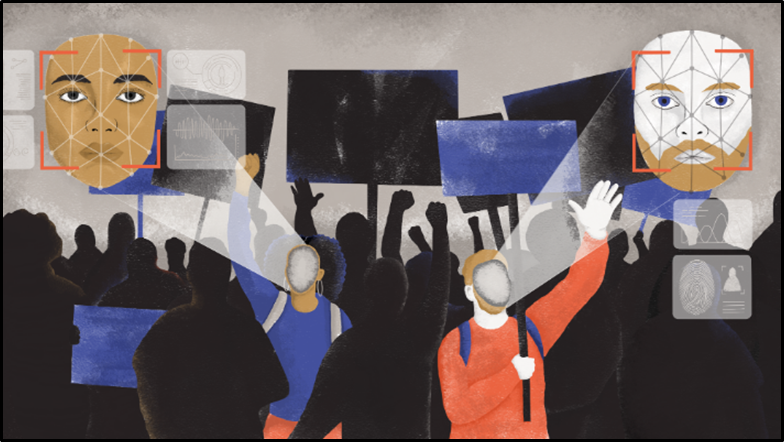
The article highlights the use of facial recognition technology (FRT) by the Delhi Police at protest sites, raising concerns about privacy, freedom of speech and expression, right to protest, surveillance, and lack of a dedicated legal framework. The issue is especially significant because biometric surveillance can identify individuals participating in political demonstrations and may create a chilling effect on democratic dissent.
Introduction
The increasing deployment of AI-enabled facial recognition at public gatherings represents a technological shift in policing. While surveillance may serve legitimate objectives such as crime prevention and public safety, indiscriminate biometric monitoring of protesters without clear statutory safeguards raises serious constitutional and civil-liberty concerns.
Current Relevance
- Normalisation of biometric surveillance: Facial recognition technology is increasingly being deployed in public spaces and protest sites, creating concerns that mass surveillance may become a routine policing practice.
- Privacy without a dedicated legal framework: India currently lacks a specific statutory framework governing facial recognition, raising questions about the legality of collecting, processing, storing and sharing citizens’ biometric data.
- Chilling effect on democratic protests: The possibility of being identified and tracked can discourage citizens from participating in demonstrations, potentially weakening the Article 19(1)(b) right to peaceful assembly.
- Indiscriminate data collection: Facial recognition can capture the biometric information of all individuals within the camera’s range, including innocent bystanders who are not suspected of any offence.
- Weak accountability and oversight: Unclear rules regarding data access, retention, deletion, private contractors and authorisation create risks of misuse and make it difficult to establish accountability.
Recent Concerns Associated with Facial Recognition
1. Absence of a dedicated legal framework
- India presently lacks a specific statute comprehensively regulating facial recognition technology by law-enforcement agencies.
- The Digital Personal Data Protection Act, 2023 provides a data-protection framework, but its broad exemptions for certain State functions raise concerns regarding effective safeguards against governmental surveillance.
- Therefore, the central question is not merely whether technology can be used, but under what law, for what purpose and with what safeguards.
2. Right to Privacy under Article 21
- The Supreme Court in Justice K.S. Puttaswamy v. Union of India (2017) recognised privacy as a fundamental right under Article 21.
- Facial recognition involves the collection and processing of biometric data, which is highly sensitive because a person’s face is a permanent identifier.
- Mass identification of protesters without adequate safeguards can therefore constitute a significant privacy intrusion.
3. Impact on freedom of speech and expression
- Article 19(1)(a) protects freedom of speech and expression, while Article 19(1)(b) guarantees the right to assemble peacefully and without arms.
- Fear that participation in a protest could result in identification, profiling or future surveillance may discourage citizens from exercising these rights.
- This is known as the chilling effect, whereby surveillance indirectly suppresses constitutionally protected expression.
4. Indiscriminate nature of facial recognition
- Conventional policing can be targeted towards individuals suspected of specific offences.
- Facial recognition at a protest, however, may initially scan everyone within the camera’s range, including completely innocent participants.
- Thus, the technology creates a concern of mass surveillance rather than targeted surveillance.
5. Proportionality concerns
- Any restriction on fundamental rights must satisfy the constitutional proportionality principle.
- The State must demonstrate:
- Legitimate aim – whether there is a genuine public-interest objective.
- Rational connection – whether FRT is capable of achieving that objective.
- Necessity – whether a less restrictive alternative exists.
- Balancing – whether the benefits justify the infringement of fundamental rights.
- In the present case, conventional policing, targeted investigation and ordinary video surveillance could potentially achieve public-order objectives with comparatively lower privacy costs.
6. Risk of false positives
- Facial recognition systems are not infallible.
- False positives can result in innocent individuals being wrongly identified as suspects.
- In a protest context, such errors can have serious consequences, including detention, investigation, intimidation or reputational harm.
Way Forward
1. Enact a dedicated FRT law
India should establish a comprehensive statutory framework specifically governing facial recognition by law-enforcement agencies.
2. Purpose limitation
FRT should be permitted only for clearly defined and legitimate purposes, rather than allowing open-ended surveillance.
3. Targeted rather than mass surveillance
Deployment should focus on specific suspects or clearly established threats, rather than scanning every participant at a demonstration.
4. Judicial/independent authorisation
High-risk biometric surveillance should require prior judicial or independent authorisation, except in narrowly defined emergencies.
5. Data minimisation and deletion
Only necessary information should be collected, with strict retention periods and mandatory deletion where identification is unnecessary.
Conclusion
Facial recognition can strengthen law enforcement and public security, but technological capability cannot by itself constitute constitutional legitimacy. India needs a framework where security is balanced with privacy, liberty and democratic dissent. The principle should be “targeted surveillance, not indiscriminate surveillance”, backed by legality, necessity, proportionality, transparency and independent oversight.
| Important Current To Concepts From This Article For UPSC The Automated Facial Recognition System Digital Personal Data Protection Act |