
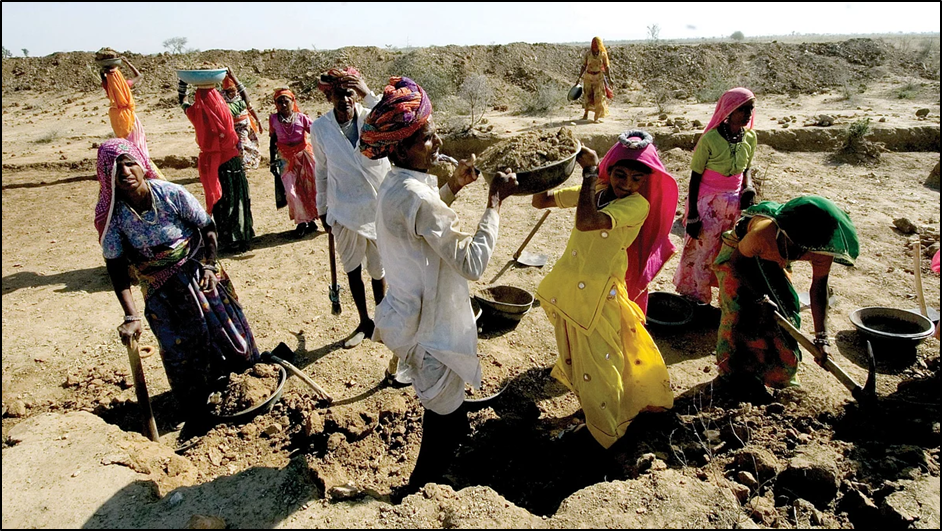
Context
- The Supreme Court, while hearing a petition concerning delayed payment of wages under MGNREGA, observed that the scheme is a “good, effective scheme” and should be implemented properly.
About MGNREGA
- Full Name: Mahatma Gandhi National Rural Employment Guarantee Act, 2005
- Initially enacted as the National Rural Employment Guarantee Act (NREGA), 2005.
- Renamed MGNREGA in 2009.
- Implemented by the Ministry of Rural Development.
Objective
- To enhance the livelihood security of rural households by providing at least 100 days of guaranteed wage employment in a financial year to every rural household whose adult members volunteer to undertake unskilled manual work.
Key Features of MGNREGA
1. Demand-Driven Employment
- Provides employment within 15 days of demand.
- Failure to provide work makes the applicant eligible for unemployment allowance.
2. Statutory Guarantee
- Guarantees employment under an Act of Parliament.
- The Right to Work is a Directive Principle under Article 41, not a Fundamental Right.
3. Timely Wage Payment
- Wages should be paid within 15 days.
- Delay attracts compensation, as per applicable rules.
Constitutional Connection
- Article 21: Guarantees the Right to Life and Personal Liberty, including life with dignity through judicial interpretation.
- Article 41: Directs the State to provide for the Right to Work, Education and Public Assistance, subject to its economic capacity.
- MGNREGA employment is a statutory entitlement, not a Fundamental Right.
About VB-G RAM G Act, 2025:
- MGNREGA, 2005 was repealed with effect from 1 July 2026 and replaced by the Viksit Bharat–Guarantee for Rozgar and Ajeevika Mission (Gramin) [VB-G RAM G] Act, 2025.
- The new Act provides a statutory guarantee of 125 days of wage employment per rural household in a financial year, compared to 100 days under MGNREGA.
- Existing job cards and ongoing works were transitioned to the new framework.
| Important Current to Concept from This Article for UPSC 1. National Rural Employment Guarantee Act (MGNREGA) 2. VB-G RAM G Act, 2025 |
Q. With reference to the Mahatma Gandhi National Rural Employment Guarantee Act (MGNREGA), consider the following statements:
1. It provides a statutory guarantee of at least 100 days of wage employment in a financial year to every rural household whose adult members volunteer to undertake unskilled manual work.
2. The Right to Work under MGNREGA is explicitly guaranteed as a Fundamental Right under Article 21 of the Constitution.
3. If employment is not provided within the stipulated period after demand, the applicant may become entitled to an unemployment allowance.
4. Social audit is an important mechanism for ensuring transparency and accountability under MGNREGA.
Which of the statements given above are correct?
(a) 1 and 2 only
(b) 1, 3 and 4 only
(c) 2, 3 and 4 only
(d) 1, 2, 3 and 4
Answer: (b) 1, 3 and 4 only
• Statement 1 – Correct: MGNREGA guarantees at least 100 days of wage employment to eligible rural households.
• Statement 2 – Incorrect: The Right to Work is not explicitly a Fundamental Right under Article 21. Article 41 deals with the right to work as a Directive Principle of State Policy.
• Statement 3 – Correct: Failure to provide employment within the stipulated period can lead to entitlement to an unemployment allowance.
• Statement 4 – Correct: Social audit is an important accountability mechanism under MGNREGA.