
Context
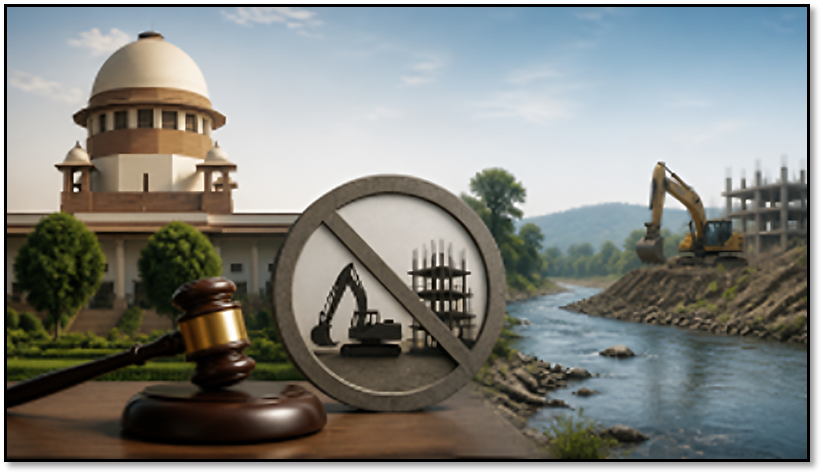
- Recently, The Supreme Court has banned construction and development activities within 100 metres of the Jojari River in Rajasthan to curb pollution and protect the river ecosystem.
- It has also prohibited hazardous industries within 500 metres of either side of the river’s existing flow path and directed the authorities to prepare a 20-point plan to address pollution.
About Jojari River
- The Jojari (Jojri) River is a seasonal river of Rajasthan and forms part of the Luni River system.
- It passes through Pali and Jodhpur districts and ultimately joins the Luni River near Balotra.
Why is the Jojari Important?
1. Link with the Luni River System
- The Jojari is a tributary of the Luni, an important river of western Rajasthan.
- The Luni originates near the Pushkar Valley/Ajmer region and flows southwestwards towards the Rann of Kachchh.
- The Luni is notable because its water becomes increasingly saline downstream.
2. Industrial Pollution
- Industrial activities, particularly textile processing and dyeing, have contributed to the deterioration of the river.
- Untreated or inadequately treated industrial effluents can introduce organic pollutants, chemicals, salts and heavy metals into water bodies.
Environmental Principles & Constitutional Linkages
- Precautionary Principle: Prevent environmental harm even without complete scientific certainty.
- Polluter Pays Principle: Polluter bears the cost of preventing and remedying environmental damage.
- Sustainable Development: Balance development with environmental protection and inter-generational equity.
- Public Trust Doctrine: State holds natural resources like rivers, forests and water bodies in trust for the public.
- Constitutional Basis: Article 21 – clean environment as part of right to life; Article 48A – State’s duty to protect environment; Article 51A(g) – citizens’ duty to protect nature.
About Luni River
- Origin: Near the Pushkar Valley/Ajmer region of Rajasthan.
- Direction: Flows generally towards the southwest.
- Important tributaries: Jojari, Sukri, Bandi and Jawai.
- Characteristic: It is an ephemeral/seasonal river in much of its course.
- Lower course: Its water becomes increasingly saline.
- Terminal region: The river system ultimately drains towards the Rann of Kachchh.
| Important CTC from this article for UPSC: Jojari River Luni River |
Q. Consider the following statements regarding the Jojari River:
1. It is a tributary of the Luni River system.
2. It flows through the arid region of Rajasthan.
3. The Luni River ultimately drains towards the Rann of Kachchh.
4. The Jojari is a perennial river originating in the Himalayas.
Which of the statements given above are correct?
(a) 1, 2 and 3 only
(b) 1 and 4 only
(c) 2 and 3 only
(d) 1, 2, 3 and 4
Answer: (a)
• Statement 1 is Correct: The Jojari River is a tributary of the Luni River in Rajasthan and joins the Luni near Balotra.
• Statement 2 is Correct: The Jojari flows through the arid and semi-arid region of Rajasthan, particularly around Jodhpur and Pali, where water availability is limited.
• Statement 3 is Correct: The Luni River flows southwestwards and its drainage system ultimately reaches the Rann of Kachchh.
• Statement 4 is Incorrect: The Jojari is not a Himalayan river and is not a perennial river. It is associated with the seasonal drainage system of Rajasthan.