
Context
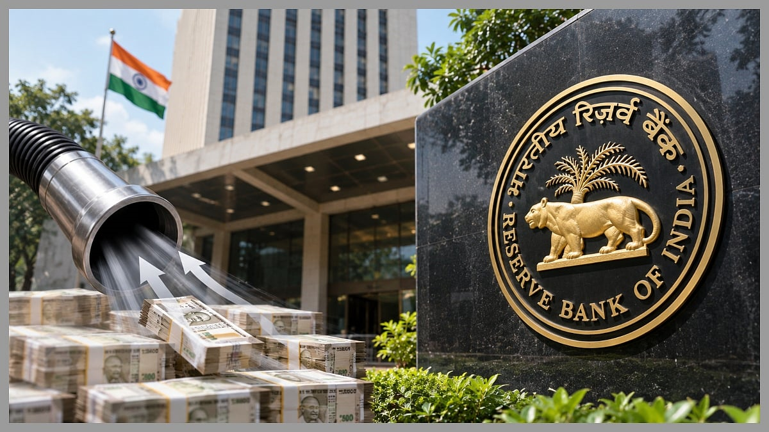
- Recently, the Reserve Bank of India (RBI) absorbed ₹71,971 crore of surplus liquidity from banks through an overnight Variable Rate Reverse Repo (VRRR) auction.
About Variable Reverse Repo Rate (VRRR)
- Definition: VRRR is a sub-tool under the Liquidity Adjustment Facility (LAF) where the central bank absorbs surplus liquidity from commercial banks at a market-determined, variable rate rather than a fixed rate.
- Mechanism: Banks park their surplus funds with the RBI for a designated tenor (e.g., overnight/1-day, 7-day, 14-day) against government securities acting as collateral.
- Unlike the fixed reverse repo rate, the interest rate under VRRR is variable and is discovered through the auction process.
- Nature: It is a temporary liquidity management operation rather than a change in the policy rate.
- Recent Auction Highlights: Against a notified amount of ₹75,000 crore, banks placed bids absorbing ₹71,971 crore (approx. 96% subscription) at a cut-off rate of 5.24% for a 1-day tenor.
Why Does RBI Absorb Liquidity?
- Excess liquidity means banks have more funds available than they immediately need for lending and other purposes.
- If surplus liquidity remains high for a prolonged period, it can:
- Increase the availability of money in the financial system.
- Put downward pressure on short-term interest rates.
- Potentially contribute to inflationary pressures if it leads to excessive demand.
- Cause the overnight money-market rate to move away from the RBI’s desired policy corridor.
- Therefore, RBI uses liquidity-management operations to maintain appropriate liquidity conditions.
| Important Current to Concept (CTC) for UPSC VRRR |
Q. With reference to the Variable Rate Reverse Repo (VRRR) operation of the Reserve Bank of India (RBI), consider the following statements:
1. VRRR is used by the RBI to absorb surplus liquidity from the banking system.
2. Under VRRR, the interest rate is determined through an auction rather than being fixed in advance by the RBI.
3. In a VRRR operation, the RBI provides funds to banks against eligible securities.
Which of the statements given above is/are correct?
(a) 1 and 2 only
(b) 2 and 3 only
(c) 1 and 3 only
(d) 1, 2 and 3
Answer: (a) 1 and 2 only
Explanation:
• Statement 1 – Correct: VRRR is a liquidity absorption tool. Banks park their surplus funds with the RBI.
• Statement 2 – Correct: The rate is variable and is discovered through an auction.
• Statement 3 – Incorrect: VRRR involves banks placing funds with RBI. It is the repo/VRR operation through which RBI provides liquidity to banks.