

About Fundamental Rights
- Fundamental Rights are basic civil, political and personal guarantees under Part III (Articles 12–35) of the Indian Constitution, enforceable through courts and often called the “Magna Carta of India.”
- Inspired by the U.S. Bill of Rights, their draft was shaped by the Advisory Committee led by Sardar Vallabhbhai Patel and its Sub-Committee on Fundamental Rights chaired by J.B. Kripalani. The Constitution was adopted on 26 November 1949 and came into force on 26 January 1950.
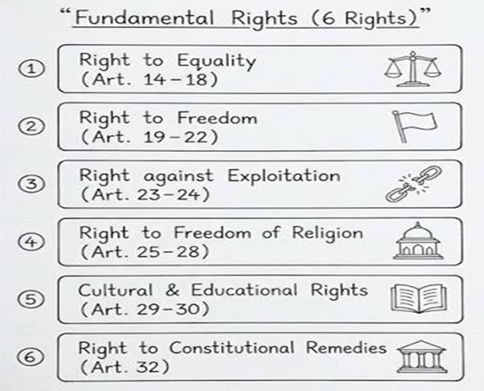
Key Features of Fundamental Rights
- Justiciable: Courts can enforce Fundamental Rights through Articles 32 and 226.
- Not Absolute: Subject to reasonable restrictions in the public interest.
- Amendable: Parliament can amend them, but cannot violate the Basic Structure.
Important Statements on Fundamental Rights
| Person / Authority | Statement / View on Fundamental Rights |
| Dr. B.R. Ambedkar | Article 32 is the “heart and soul of the Constitution.” |
| K.M. Munshi | Fundamental Rights were necessary to establish individual liberty and democratic governance. |
| Sir Ivor Jennings | Criticised the Indian Fundamental Rights as being too detailed and subject to numerous restrictions. |
| Granville Austin | Described Fundamental Rights and Directive Principles as the “conscience of the Constitution”, working together to achieve social revolution. |
| Supreme Court – Kesavananda Bharati (1973) | Fundamental Rights are subject to Parliament’s amending power, but their basic features cannot be destroyed. |
| Supreme Court – Maneka Gandhi (1978) | Article 21 must be interpreted broadly, and the procedure restricting life or liberty must be just, fair and reasonable. |
Conclusion
Part III guarantees six Fundamental Rights (Articles 14–32), enforceable by courts and subject to reasonable restrictions. Some apply only to citizens, while others apply to all persons. During a National Emergency, enforcement may be suspended except for Articles 20 and 21. Right to Property is a legal right under Article 300A.
| This concept has been elaborately discussed in the following article – Visa Guarantee |