
About DNA Sequencing
- Definition and Meaning: DNA sequencing is a molecular technique used to determine the precise order of nucleotide bases (Adenine, Thymine, Guanine and Cytosine) in a DNA molecule.
- Basic Principle: It involves identifying the sequence of four nitrogenous bases (A, T, G and C) that constitute the genetic information stored in DNA.
- Objective: It helps understand genetic information, identify genetic variations, detect disease-associated mutations and study the genetic characteristics of organisms.
- Genetic Code: DNA contains four nitrogenous bases – Adenine (A), Thymine (T), Guanine (G) and Cytosine (C). Their specific arrangement determines the genetic information carried by DNA.
- Significance: DNA sequencing provides information about the genetic composition of organisms and has applications in medical diagnosis, biotechnology, agriculture, forensic science and evolutionary studies.
Types and Techniques of DNA Sequencing
1. Sanger Sequencing (First-Generation Sequencing):
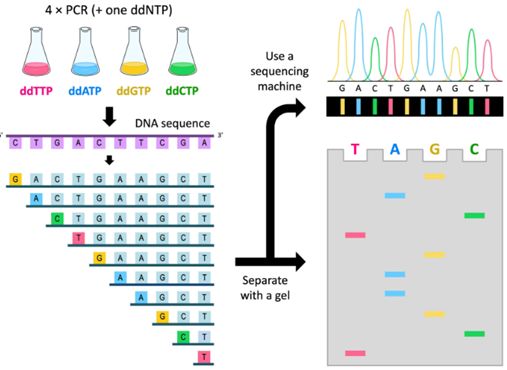
- It is a DNA sequencing technique developed by Frederick Sanger.
- It uses chain-terminating modified nucleotides called dideoxynucleotides (ddNTPs) to determine the sequence of DNA.
- It is particularly useful for sequencing relatively short DNA fragments with high accuracy.
2. Next-Generation Sequencing (NGS):
- NGS refers to advanced DNA sequencing technologies that enable the simultaneous sequencing of millions of DNA fragments.
- It allows large-scale and high-throughput sequencing at comparatively lower costs per base than traditional Sanger sequencing.
- It is widely used in genome analysis, cancer research, genetic disease diagnosis and pathogen identification.
3. Third-Generation Sequencing:
- It involves technologies that can sequence individual DNA molecules directly, often without requiring prior amplification.
- Single-Molecule Real-Time (SMRT) Sequencing: Developed by Pacific Biosciences (PacBio), it monitors DNA synthesis in real time.
- Nanopore Sequencing: It involves passing DNA molecules through extremely small protein pores and identifying nucleotide sequences through changes in electrical signals.
- These technologies can generate long DNA reads, helping identify complex genetic variations and structural changes.
Process of DNA Sequencing
- DNA Extraction: DNA is isolated from biological samples such as blood, saliva, tissue or microorganisms.
- DNA Preparation: The extracted DNA is prepared for sequencing. Depending on the technique, it may involve fragmentation, amplification and the addition of sequencing adapters.
- Sequencing Reaction: The DNA fragments are processed using sequencing technologies to identify the order of nucleotide bases.
- Data Generation: Sequencing instruments generate data representing the nucleotide sequence of the DNA fragments.
- Sequence Alignment: The obtained DNA sequences are compared with a reference genome or assembled to reconstruct the original DNA sequence.
- Data Analysis: Bioinformatics tools are used to identify genetic variations, mutations and other biologically significant information.
Important Concepts Related to DNA Sequencing
- Whole Genome Sequencing (WGS): It involves determining the complete DNA sequence of an organism’s genome, including both coding and non-coding regions.
- Whole Exome Sequencing (WES): It focuses on sequencing the exome, which consists of the protein-coding regions of the genome.
- Genetic Mutation: It refers to a change in the nucleotide sequence of DNA, which may affect gene function and can contribute to genetic disorders or cancer.
- Genetic Variation: It refers to differences in DNA sequences among individuals or populations.
- Bioinformatics: It involves the application of computational tools and statistical techniques to analyse biological data, including large-scale DNA sequencing datasets.
Applications of DNA Sequencing
- Medical Diagnosis: Helps identify genetic mutations associated with inherited disorders and certain cancers.
- Cancer Detection: Enables identification of cancer-associated genetic alterations and supports molecular profiling of tumours.
- Personalised Medicine: Helps identify genetic variations that influence an individual’s response to particular medicines, supporting more targeted treatment.
- Infectious Disease Surveillance: Helps identify pathogens, track mutations and monitor the evolution and transmission of infectious diseases.
- Agriculture and Crop Improvement: Supports the identification of desirable genetic traits for developing improved crop varieties with better productivity and disease resistance.
- Forensic Science: DNA profiling helps establish biological relationships and identify individuals in criminal investigations.
- Evolutionary Studies: Helps understand genetic relationships among organisms and trace evolutionary changes over time.
- Biodiversity Conservation: Supports species identification, population genetics and the conservation of threatened species.
Conclusion
DNA sequencing is a fundamental biotechnology tool that enables the identification and analysis of genetic information. Its integration with Artificial Intelligence, bioinformatics and precision medicine has significant potential to transform disease diagnosis, healthcare, agriculture and biodiversity conservation.
| This Concept Has Been Mentioned In The Article: AI-Based Blood Test Uses DNA Changes to Detect Multiple Types of Cancer |