
Context
- Recently, U.S. President Donald Trump stated that normalization of ties with Israel should be mandatory for Saudi Arabia and other prominent Muslim-majority nations—including Qatar, Pakistan, Egypt, Turkiye, and Jordan—by simultaneously signing onto the Abraham Accords. This demand has been positioned as a core requirement to advance protracted peace negotiations and finalize a deal to end the conflict with Iran that erupted in late February, adding a fresh layer of diplomatic complexity to West Asian geopolitical dynamics.
1. Conceptual Framework & Signatories
- The Core Mechanism: Brokered by the United States in September 2020, the Abraham Accords are a series of joint bilateral agreements aimed at normalizing diplomatic, economic, and strategic relations between Israel and Arab-Muslim nations.
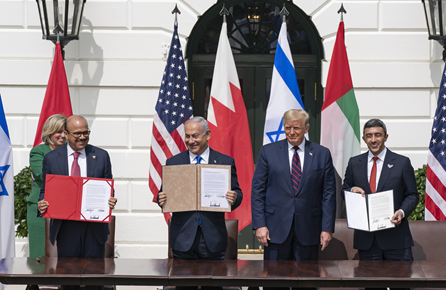
- The Original Architecture: * Initial Signatories (2020): The United Arab Emirates (UAE) and Bahrain were the first to sign the accords at the White House.
- Subsequent Entrants (Late 2020/2021): Morocco officially joined the normalization process (linked with US recognition of Moroccan sovereignty over Western Sahara), and Sudan signed the declarative section of the accords.
- The 2026 Expansion Directive: The latest diplomatic push seeks to institutionalize a multi-nation, simultaneous expansion of the framework to include non-signatories and traditional regional powers like Saudi Arabia, Qatar, and Pakistan, alongside existing treaty states like Egypt and Jordan.
2. Paradigm Shift in West Asian Geopolitics
- Bypassing the Arab Peace Initiative (2002): Historically, Arab states adhered to the Saudi-led 2002 initiative, which stated that formal recognition of Israel would only happen after the creation of an independent Palestinian state based on 1967 borders. The Abraham Accords decoupled these issues, prioritizing immediate strategic alignment over the resolution of the two-state conflict.
- The Counter-Iran Axis: The underlying security architecture of the accords functions to consolidate a regional front against Iran’s ballistic missile capabilities, nuclear program, and regional asymmetric proxy networks.
3. High-Yield Strategic Implications for India
- The I2U2 Grouping: The diplomatic space created by the Abraham Accords directly enabled the formation of the I2U2 framework (India, Israel, the UAE, and the US), focusing on joint space, energy, water, and food security projects.
- Connectivity Corridors: This normalization provides the foundational political stability required for major trans-continental infrastructure projects like the India-Middle East-Europe Economic Corridor (IMEC).
- De-hyphenated Bilateralism: The alignment allows India to deepen its defense and technology partnerships with Israel while scaling up commercial and energy ties with the Gulf Cooperation Council (GCC) nations without political friction.
Q. Consider the following statements regarding international diplomacy in West Asia:
STATEMENT I: The Abraham Accords represents a series of normalization agreements between Israel and Arab-Muslim nations brokered by the United States.
STATEMENT II: Egypt and Jordan were the original Arab states to pioneer the signing of the Abraham Accords framework in September 2020.
Which one of the following is correct in respect of the above statements?
(a) Both Statement I and Statement II are correct and Statement II is the correct explanation for Statement I
(b) Both Statement I and Statement II are correct and Statement II is not the correct explanation for Statement I
(c) Statement I is correct but Statement II is incorrect
(d) Statement I is incorrect but Statement II is correct
Solution & Explanation
Correct Answer: (c)
• STATEMENT I IS CORRECT: The Abraham Accords are a US-brokered diplomatic framework initiated in 2020 designed to establish full diplomatic recognition, economic ties, and security collaboration between Israel and participating Muslim-majority states.
• STATEMENT II IS INCORRECT: The pioneering Arab countries to sign the Abraham Accords in September 2020 were the United Arab Emirates (UAE) and Bahrain. Egypt (1979) and Jordan (1994) had already established independent bilateral peace treaties with Israel decades prior to the creation of the Abraham Accords architecture.