
After Reading This Article You Can Solve This UPSC Mains Model Question:
“Article 142 of the Indian Constitution acts as a constitutional safety valve to ensure complete justice.” Discuss the significance of Article 142 in the Indian judicial system. Also examine the concerns regarding judicial overreach associated with its use. (15 Marks, GS-2 Polity)
Context
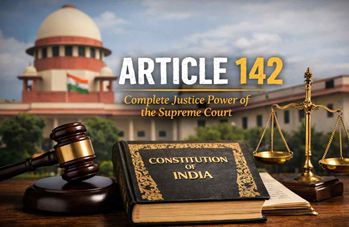
The Right to Life under Article 21 of the Indian Constitution has been progressively expanded by the Supreme Court of India to include various dimensions of dignified human existence. In a recent judgment, Phalodi Accident vs National Highways Authority of India (2025) the Supreme Court recognised the Right to Safe Travel on National Highways as a Fundamental Right under Article 21. This judgment reflects the growing importance of Article 142, which empowers the Supreme Court to deliver “complete justice”.
The Grim Reality of Road Safety in India
The judgment highlights a severe disproportion between infrastructure scale and public safety:
- The Disparity: National Highways (NH) comprise only 2% of India’s total road network but account for 30% of all road fatalities.
- The Data: In the first six months of 2025 alone, NHs witnessed approximately 26,770 deaths. While this represented an 11% decrease compared to 2024, the absolute numbers remain alarmingly high.
- State Policy Goal: The government aims to reduce road accidents by 50% by 2030 using a “4E” Strategy:
- Education
- Engineering (both road infrastructure and vehicle safety)
- Enforcement
- Emergency Medical Services
Core Concept: Article 142 and “Complete Justice”
A. Nature of the Power
- Constitutional Safety Valve: Article 142 empowers the SC to pass any decree or order necessary for doing “complete justice” in any cause or matter pending before it. It acts as a mechanism to fill legal vacuums where statutory law is silent or inadequate.
- Residuary and Extraordinary: This jurisdiction is implicitly vested with trust. It allows the court to transcend strict procedural and statutory constraints to prevent a travesty of justice or an abuse of process.
B. Legal and Substantive Evolution
- Delhi Judicial Service Association vs. State of Gujarat (1991): The SC held that the power to do complete justice exists at an entirely different level and quality. Statutory restrictions in ordinary laws cannot limit this constitutional power.
- Canara Bank vs. Debasis Das (2003): The Court observed that the Constitution prioritizes substantive justice (the actual removal of injustices) over mere technical legal justice. Where statutory law falls short, the principles of natural justice (fairness) must prevail.
- Hitesh Bhatnagar vs. Deepa Bhatnagar (2011): The Court explicitly recognized the weight of this power, noting that extraordinary care and caution must be observed when invoking Article 142.
Comparative Jurisprudence: Supreme Court vs. High Courts
Can High Courts also deliver “complete justice”?
- Anil Kumar Jain vs. Maya Jain (2009): The SC clarified that the extraordinary powers of High Courts under Article 226 are not at par with the Supreme Court’s absolute powers under Article 142.
- The Nuance: While justice as a philosophical concept must always be “complete,” the High Courts must operate within a more circumscribed manner. Article 142 remains a unique tool uniquely optimized for the SC to apply “due process of law” to rapidly changing socio-economic and political realities.
Critical Analysis: The Debate on Judicial Overreach
- Undermines Separation of Powers: Excessive use of Article 142 allows the judiciary to run parallel administration, encroaching upon the defined domains of the Executive and Legislature.
- Creates Legal Unpredictability: Bypassing established statutory laws on a case-by-case basis compromises legal certainty, creating an unpredictable and inconsistent environment for governance.
- Fills Critical Governance Vacuums: Proponents argue it acts as a vital constitutional safety valve to deliver substantive justice when statutory laws are silent or inadequate.
- Adapts to Evolving Social Realities: It empowers the Supreme Court to rapidly protect fundamental rights amidst emerging societal shifts (e.g., live-in relationships, LGBTQ+ rights) before the legislature acts.
- Risks Institutional Backlash: Frequent policy-making by the courts can lead to institutional friction, friction that is best avoided by maintaining strict judicial self-restraint as a rule of last resort.
Way Forward
- Institutionalize Judicial Self-Restraint: The Supreme Court should invoke Article 142 only as a weapon of last resort to fill clear legislative vacuums, ensuring it maintains the institutional balance of Separation of Powers.
- Transition from Ad-Hoc Directives to Structured Policy: The Executive must proactively convert judicial directives into permanent statutory rules, ensuring that long-term safety goals do not rely solely on court monitoring.
- Strengthen Inter-Agency Enforcement Infrastructure: State governments must aggressively implement the “4E” strategy (Education, Engineering, Enforcement, Emergency Care) by establishing a unified National Road Safety Authority for strict accountability.
- Establish Strict Time-Bound Grievance Redressal: A robust, independent mechanism must be set up to penalize concessionaires and highway authorities for poor engineering and sub-standard road maintenance that leads to accidents.
- Harmonize Lower Courts with Higher Judicial Principles: While High Courts lack Article 142 powers, they should aggressively use their Article 226 jurisdiction to enforce the newly recognized “Right to Safe Travel” at regional and state highway levels.
Conclusion
While Article 142 acts as a vital safety valve for substantive justice, the state must proactively implement the “4E” strategy to secure the Right to Safe Travel, balancing judicial intervention with robust executive accountability.