
After Reading This Article You Can Solve This UPSC Mains PYQ ( 2014):
Most of the unusual climatic happenings are explained as an outcome of the El Niño effect. Do you agree?. 15 Marks (GS-1, Geography)
Context
- Following a 40% June monsoon deficit, the IMD has forecast below-normal July rainfall. This raises concerns over crop losses, food inflation, and macroeconomic risks due to El Niño.
- Severe El Niño events have historically caused major droughts, including the Great Famine (1876–78); since 2000, 6 of 11 below-normal monsoon years occurred during El Niño.
- Traditionally, community water bodies helped mitigate drought impacts through decentralized water harvesting.
Introduction
The Southwest Monsoon anchors India’s agrarian framework. With El Niño increasing the frequency of severe rainfall deficits, shifting from reactive disaster relief to proactive, structural drought-proofing is now critical to sustain rural demand, manage inflation, and ensure macroeconomic stability.
What is El Niño?
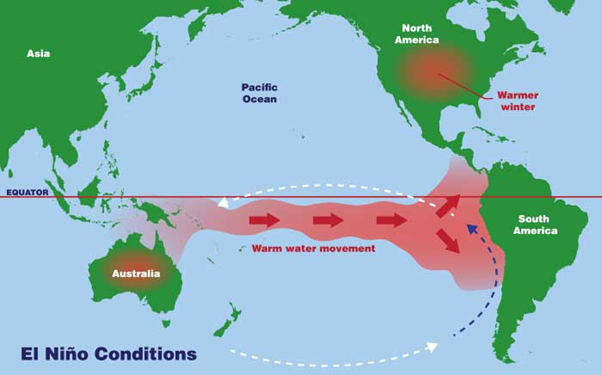
- El Niño is a climate pattern characterized by the unusual warming of sea surface temperatures in the eastern and central equatorial Pacific Ocean.
- During an El Niño event, trade winds weaken or reverse, preventing the upwelling of cold water and shifting warm surface water eastward.
- This alteration in global atmospheric circulation typically weakens the easterly trade winds over the Indian Ocean, fundamentally suppressing the Indian Southwest Monsoon.
Economic Implications of El Niño for India
1. Agricultural Shock
- A deficient monsoon severely impacts the sowing and yield of crucial rain-fed Kharif crops like rice, cotton, and pulses.
- Scarcity of surface water forces farmers to rely on groundwater extraction, sharply increasing input costs for diesel and electricity.
2. Inflationary Spiral
- Dropping agricultural output creates an immediate supply-side shock, rapidly driving up prices of essential dietary staples and vegetables.
- High food inflation aggressively erodes household budgets, leaving less disposable income for non-agricultural goods.
3. Rural Demand Contraction
- A fall in farm incomes directly damages the rural non-farm sector, severely hitting industries dependent on rural purchasing power.
- This stress cascades into the wider economy, signaling early squeezes in sectors like automobiles, two-wheelers, and real estate.
4. Productivity Tax from Heat
- Severe heat stress reduces the physical efficiency of India’s vast informal outdoor workforce.
- This leads to a massive loss of workable hours, disproportionately affecting vulnerable urban and rural demographics.
5. Macroeconomic Dilemma
- The RBI faces the stagflation threat of slowing growth combined with rising food inflation.
- Tighter monetary policies to control inflation make borrowing expensive, which stifles corporate capital expenditure and business expansion.
Challenges in Adapting to Monsoon Deficits
1. Severe Irrigation Deficit
- Out of 315 districts vulnerable to a poor monsoon, 111 face primary concerns due to a severe lack of protective irrigation facilities.
- This leaves a massive portion of the national crop output entirely dependent on unpredictable rainfall patterns.
2. Rapid Reservoir Strain
- Central Water Commission data indicates critical reservoir storage levels are falling significantly below the historical normal.
- While the system can meet immediate requirements, consecutive poor monsoons severely strain long-term water and hydropower security.
3. Input Supply Constraints
- Geopolitical tensions compound the pressure on fertilizer supplies and increase operational costs for farmers.
- Pest attacks and global supply chain disruptions further threaten overall agricultural productivity.
4. Current Account Pressures
- Sustained crop failures force the government to import essential commodities and release buffer stocks.
- This widens the Current Account Deficit and puts downward pressure on the value of the rupee.
5. Agricultural Export Threats
- A poor monsoon jeopardizes India’s agricultural export trajectory, which traditionally contributes significantly to core export revenues.
- Reduced output forces export bans to ensure domestic food security, causing a loss of global market share.
Way Forward
1. Ex-Ante Risk Reduction
- Public investment must shift from reactive crop insurance payouts to proactive, localized infrastructure resilience.
- Focusing on risk reduction ensures that agricultural systems are fundamentally prepared for climate shocks before they occur.
2. Contingency Crop Planning
- State agricultural departments must operationalize District Agriculture Contingency Plans (DACPs) effectively.
- This involves substituting water-guzzling crops with short-duration, drought-tolerant millets, pulses, and oilseeds.
3. Micro-Irrigation Expansion
- Accelerate the penetration of drip and sprinkler irrigation to optimize the water footprint in agriculture.
- Expanding the Pradhan Mantri Krishi Sinchayee Yojana ensures better crop yields even under severe water stress.
4. Decentralized Water Governance
- Restore traditional community tanks and decentralized water bodies to ensure local drinking water security.
- These historical systems act as vital buffers for groundwater recharge during prolonged dry spells.
5. Statutory Heat Action Plans
- Localize and legally enforce Heat Action Plans to protect the informal outdoor workforce.
- This includes mandating altered working hours, shaded worksites, and climate insurance for wage-loss compensation.
6. Ecosystem-Based Urban Adaptation
- Implement cool roof policies and restore urban wetlands to aggressively counter the Urban Heat Island (UHI) effect.
- Integrating green-blue infrastructure into urban planning is critical for sustainable microclimate management.
Conclusion
El Niño climate shocks severely threaten India’s macroeconomic stability. To safeguard rural livelihoods and growth, India must aggressively pivot from reactive disaster management to proactive climate adaptation through resilient agriculture, robust heat action plans, and decentralized water governance.