
After Reading This Article You Can Solve This UPSC Mains Model Question:
The transition to a fully digital framework in Census 2027, coupled with a statutory caste enumeration, presents both historic opportunities and complex administrative challenges. Discuss. 15 Marks (GS-1, Indian Society)
Context
The upcoming Census 2027 introduces a statutory caste enumeration alongside a fully digital methodology. However, the pre-test phase has highlighted methodological concerns regarding the “open column” self-declaration, necessitating a shift towards a pre-loaded, curated digital taxonomy to ensure the generation of reliable socio-economic data.
Introduction
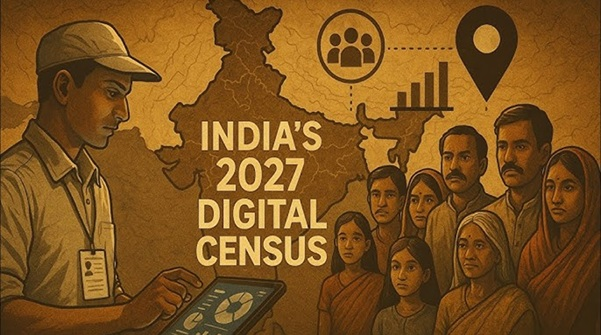
Census 2027 marks a watershed moment in India’s administrative history as the 16th national census and the 8th since independence. Moving beyond traditional paper-based methods, it is the world’s first fully digital population census. The inclusion of a statutory caste enumeration aims to generate empirical data for targeted social justice, requiring an infallible digital methodology to prevent the demographic fragmentation seen in past exercises.
What Makes Census 2027 Unique?
- Fully Digital Execution: Replaces traditional paperwork with mobile applications, a Census Management and Monitoring System (CMMS) portal, and digital Houselisting Block (HLB) mapping.
- Self-Enumeration Facility: Introduces a citizen-centric online portal allowing individuals to submit household information digitally before field operations begin.
- Statutory Caste Enumeration: Marks the first comprehensive and legally backed counting of castes in independent India since the 1931 Census.
Phases of the Census
- Phase 1: Houselisting and Housing Census (HLO): Conducted from April to September 2026. This phase involves geo-tagging buildings and capturing data on housing conditions, amenities, and assets. An optional 15-day self-enumeration period precedes the house-to-house survey in each state.
- Phase 2: Population Enumeration (PE): Scheduled for February 2027 (with adjusted timelines beginning September 2026 for snow-bound regions like Ladakh, J&K, Himachal Pradesh, and Uttarakhand). This phase collects granular individual-level data, including demographics, migration, and caste details.
Scale of 2027 Census
- Massive Coverage: The exercise covers over 1.4 billion people across 36 States and Union Territories, including over 6.3 lakh villages and 9,700 towns.
- Extensive Workforce: It involves the deployment of approximately 3.2 million enumerators, supervisors, and master trainers, making it the largest administrative exercise globally.
About Caste Census: The Methodological Shift
- The Pitfalls of Open Declaration: The 2011 Socio-Economic and Caste Census (SECC) utilized an unguided “open column,” resulting in over 46 lakh fragmented, unusable caste entries due to phonetic variations, sub-castes, and overlapping clan names.
- Curated Digital Taxonomy: To rectify past errors, experts advocate pivoting towards pre-loading enumerators’ hand-held devices with a standardized, state-specific directory of recognized castes, ensuring the data collected is coherent and administratively actionable.
Significance of Caste Enumeration
- Precision in Affirmative Action: Replaces outdated 1931 demographic baselines with contemporary empirical data to structurally rationalize reservation quotas.
- Equitable Sub-Categorization: Generates granular data necessary to implement the sub-categorization of backward classes, preventing dominant groups from monopolizing welfare benefits.
- Identification of the Creamy Layer: Supplies multi-dimensional socio-economic indicators required to objectively identify and exclude affluent segments within reserved categories.
- Targeted Policy Formulation: Correlates specific caste identities directly with health, education, and economic deprivations, shifting governance towards evidence-based resource allocation.
- Democratic Delimitation: Provides accurate demographic compositions essential for the rational delimitation of electoral constituencies, ensuring equitable political representation.
Challenges Associated with Caste Enumeration
- Risk of Identity Ossification: Formal enumeration of primordial identities risks solidifying societal fault lines and reinforcing the very hierarchies the Constitution seeks to abolish.
- Taxonomical Complexity: Harmonizing fluid, self-perceived social status and overlapping regional dialects into a rigid national master list presents an immense bureaucratic hurdle.
- Politicization of Data: The revelation of precise demographic proportions may trigger aggressive political mobilization and competitive demands for quota expansions beyond legal caps.
- Administrative Burden: Reconciling localized data entries with conflicting Central and State lists for SCs, STs, and OBCs requires highly complex backend deduplication.
- Data Security Risks: The centralized digital collection of sensitive socio-economic and caste-based identities raises significant privacy and cybersecurity concerns.
Global Best Practices
- United States – Census Bureau Framework: Utilizes a highly structured, self-identified racial and ethnic categorization system coupled with robust digital privacy safeguards, ensuring data is used strictly for civil rights compliance and resource distribution rather than societal stratification.
- United Kingdom – ONS Ethnic Group Classifications: Employs carefully curated, standard drop-down taxonomies that evolve through extensive public consultation, minimizing data fragmentation while accurately capturing diverse demographic shifts.
Way Forward
- Mandate Pre-Loaded Digital Registries: Abandon the “open column” format entirely in Phase 2, deploying standardized, pre-curated drop-down options on enumerators’ digital devices.
- Implement Robust Deduplication Algorithms: Utilize advanced backend analytics within the CMMS to automatically resolve phonetic variations and merge identical clan entries in real-time.
- Harmonize Central and State Schedules: Form an expert inter-disciplinary commission to reconcile discrepancies between state-level registries and the central list prior to nationwide enumeration.
- Focus on Socio-Economic Correlation: Strictly link demographic identity mapping with economic and developmental indices to maintain focus on welfare delivery over political categorization.
- Ensure Stringent Data Privacy: Enforce end-to-end encryption, strict access controls, and compliance with the Digital Personal Data Protection (DPDP) Act to prevent the systemic misuse of sensitive population data.
- De-Link from Political Mobilization: Communicate the census objectives explicitly as an economic and developmental mapping project, shifting the public narrative away from competitive backwardness.
Conclusion
The integration of a statutory caste enumeration within India’s first digital census is an administrative necessity for actualizing targeted social justice. By abandoning flawed, open-ended methodologies in favor of a scientifically curated digital taxonomy, the state can transform abstract demographic identities into precise, actionable tools for equitable national development.