
After Reading This Article You Can Solve This UPSC Mains PYQ (2020)
The new tri-nation partnership AUKUS is aimed at countering China’s ambitions in the Indo-Pacific region. Is it going to supersede the existing partnerships in the region? Discuss the strength and impact of AUKUS in the present scenario.15 Marks (GS-2 , International Relations)
Context
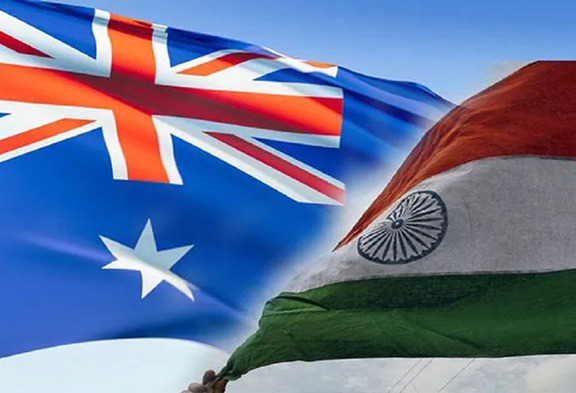
Prime Minister Narendra Modi’s state visit to Australia highlights the shift in bilateral ties into a high-velocity, multi-domain “T-20 mode”. Moving beyond legacy social connections, the relationship has expanded into deep structural collaborations across defense, technology, and clean energy.
Introduction
The India-Australia relationship has transformed from historical divergence into a comprehensive strategic partnership driven by shared maritime interests. Bound by the vision of a free and open Indo-Pacific, both democracies are leveraging their economic complementarities to build resilient supply chains.
What is the Structural Architecture of the Engagement?
The Foundational Pillars
- Legacy Matrix: The relationship was historically anchored by the 3 Cs — of Commonwealth, Cricket and Curry — and subsequently matured through the three Ds — Democracy, Diaspora and Dosti.
- Strategic Shift: Transcending these socio-cultural foundations, the contemporary partnership has rapidly shifted focus towards two crucial new dimensions: Development and Defence.
Economic and Investment Highways
- ECTA Dividends: Under the Economic Cooperation and Trade Agreement (ECTA), 100% of Indian exports enjoy duty-free access, while India provides preferential access to 90% of Australia’s trade value.
- Bilateral Targets: Trade volume is projected to scale from $33 billion toward a shared target of $100 billion by 2030, supported by ongoing CECA negotiations.
- Capital Flows: Two-way cumulative investment is approaching $50 billion, anchored by major infrastructure and clean energy projects.
Defense and Maritime Security Framework
- Strategic Dialogue: Defense cooperation represents the fastest-growing sector, systematically elevated through the 2+2 Ministerial Dialogue.
- Operational Interoperability: Comprehensive trilateral and multilateral military drills—including AUSINDEX, Malabar, and Talisman Sabre—foster deep tri-service coordination.
- Logistics Integration: Supported by the Mutual Logistics Support Agreement (MLSA), both navies have institutionalized maritime domain awareness and base access.
Energy, Technology, and Knowledge Corridors
- Renewable Energy Taskforces: Joint initiatives in solar and green hydrogen align Australia’s critical mineral reserves with India’s manufacturing targets.
- Civil Nuclear Cooperation: Advanced arrangements for future Australian uranium exports are being finalized to augment India’s civil nuclear program.
- Educational Corridors: Over one lakh Indian students are enrolled in Australia, backed by the Maitri Scholarship Program and new Australian university campuses in India.
Significance of the Partnership
1. Anchors Indo-Pacific Stability
- Functions as a geostrategic pillar within the Quad framework to counter unilateral revisionism and secure critical sea lines of communication (SLOCs).
2. Secures Critical Mineral Supply Chains
- Aligns Australia’s resource wealth with India’s manufacturing ambitions, guaranteeing stable access to lithium, cobalt, and nickel.
3. Drives Plurilateral Minilateralism
- Counters market dominance through overlapping minilaterals like the India-Japan-Australia Supply Chain Resilience Initiative (SCRI).
4. Bridges the Global South and West
- Synergizes India’s leadership in the Global South with Australia’s traditional alliances to coordinate capacity building in Pacific Island Countries.
5. Optimizes Human Capital Synergy
- Mitigates Australia’s structural workforce shortfalls by integrating highly skilled Indian youth through targeted mobility visa frameworks.
Challenges Associated with the Relationship
1. Asymmetric Trade Dependencies on China
- Australia maintains extensive primary commodity trade with Beijing, whereas India pursues active economic and industrial decoupling.
2. Regulatory and Immigration Barriers
- Persistent procedural friction surrounding work permits, professional credential recognition, and student visa backlogs restricts optimal talent mobility.
3. Defense Industrial Bottlenecks
- Transitioning from strategic military exercises to concrete defense co-production and technology transfers faces severe bureaucratic delays.
4. Divergent Climate and Energy Politics
- Balancing Australia’s position as a major fossil fuel/coal exporter with India’s dual demand for energy security and decarbonization requires alignment.
5. Implementation Lag in Trilateral Layouts
- Broad convergences on values do not automatically translate to rapid execution in trilateral formats like India-Indonesia-Australia.
Way Forward
1. Finalize the Full CECA Framework
- Conclude the Comprehensive Economic Cooperation Agreement to eliminate remaining tariff lines and ease persistent non-tariff barriers.
2. Standardize Vocational and Skill Recognition
- Harmonize training qualifications between both nations to deploy certified Indian workers in Australia’s solar and mining sectors.
3. Operationalize the Uranium Export Supply Line
- Fast-track practical arrangements for uranium exports to inject long-term fuel security into India’s civil nuclear energy architecture.
4. Deepen Defense Co-Production in Maritime Assets
- Move past standard joint exercises toward deep technology co-development in sub-surface drones, cyber-defense suites, and space systems.
5. Expand Joint Research in Priority Sectors
- Direct public and private funding into joint cross-border innovation hubs for advanced computing, health care, and aerospace.
6. Deploy Modular Trilateral Initiatives
- Prioritize swift, high-visibility joint projects combining Australian financing with India’s Digital Public Infrastructure (DPI) in the neighborhood.
7. Build Broad-Based Sports Cooperations
- Deepen cooperation in sports medicine, training, and infrastructure ahead of major events like the Brisbane Olympics 2032.
8. Institutionalize a Critical Minerals Sovereign Fund
- Create a dedicated bilateral financial vehicle to directly secure joint ventures in midstream mineral processing and refining.
Conclusion
The introduction of a high-velocity “T-20 mode” marks a profound shift towards permanent defence co-production and resilient mineral supply chains. Overcoming regulatory hurdles will allow both nations to safeguard mutual prosperity and ensure a secure Indo-Pacific order.