
Context
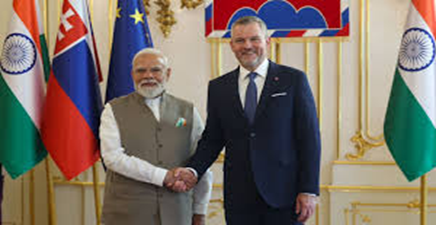
- India and Slovakia elevated their ties to a ‘Comprehensive Partnership’ by signing multiple MoUs across key sectors during Prime Minister Narendra Modi’s historic visit to Bratislava. The visit was particularly significant as it marked the first-ever visit by an Indian Prime Minister to Slovakia since its establishment in 1993, opening a new chapter in bilateral relations
Key Pillars of India-Slovakia Comprehensive Partnership
1. Joint Action Against Terrorism and Global Security
- Joint Working Group (JWG): Both nations agreed to formalize the formation of a Joint Working Group on Terrorism to institutionalize intelligence and security sharing.
- Condemnation of Terror Attacks: Prime Minister Modi and his Slovak counterpart Robert Fico strongly condemned the April 2025 terror attacks in Pahalgam.
- Global Sanctions and Frameworks: The leaders jointly called for action against entities listed in the UN Security Council 1267 Sanctions Committee, alongside the sponsors of terrorism. Furthermore, they agreed to actively work towards the swift adoption of the Comprehensive Convention on International Terrorism (CCIT) within the United Nations framework.
2. Economic Ties, Trade, and Industry
- Sectoral Focus: The expanding trade map primarily targets critical industrial sectors including automobiles, railways, electronic goods, green technology, and advanced manufacturing.
- Trade Booster: Prime Minister Modi underlined that the ongoing India-EU Free Trade Agreement negotiations will add significant momentum to this newly minted bilateral partnership.
3. Labour Mobility and Social Security
- Regulated Migration: A major MoU on labor migration was signed to facilitate safer, regular mobility and structured information exchange between the designated authorities of both nations.
- Social Security Agreement: The two administrations agreed to conclude a comprehensive social security agreement to protect the welfare of professionals moving across borders.
4. Education, Institutional Linkages, and Multilateralism
- STEM & Academic Exchange: An MoU between the Higher Education Ministries was finalized to facilitate deeper academic linkages, prioritizing the mutual mobility of researchers and students in STEM fields and humanities.
- UN Reform: Reaffirming their commitment to a multipolar world order, both sides called for an expansion of permanent and non-permanent seats within a reformed United Nations Security Council (UNSC).
| Mapping Dynamics for Prelims Slovakia is a strategically significant landlocked nation in Central Europe. Candidates must retain a clear map memory of its immediate neighborhood: Land Borders: Slovakia is bordered by 5 countries: Poland (North) Ukraine (East) Hungary (South) Austria (Southwest) Czech Republic (Northwest) Geographical Trap: It does not share a land border with Germany or Romania. Capital City: Bratislava, situated close to the borders with Austria and Hungary, sits on the banks of the famous Danube River. |
Q. With reference to the bilateral relations between India and Slovakia, consider the following statements:
Statement I: India and Slovakia have officially elevated their relationship to a ‘Comprehensive Partnership’ during the historic 2026 bilateral visit by the Indian Prime Minister.
Statement II: Both nations have mutually agreed to form a Joint Working Group on Terrorism and called for the adoption of the Comprehensive Convention on International Terrorism (CCIT) within the United Nations framework.
Which one of the following is correct in respect of the above statements?
(a) Both Statement I and Statement II are correct and Statement II is the correct explanation for Statement I
(b) Both Statement I and Statement II are correct and Statement II is not the correct explanation for Statement I
(c) Statement I is correct but Statement II is incorrect
(d) Statement I is incorrect but Statement II is correct
Correct Answer: (b) Both Statement I and Statement II are correct and Statement II is not the correct explanation for Statement I
Detailed Solution:
• STATEMENT I IS CORRECT: The bilateral ties between India and Slovakia have been officially upgraded to a 'Comprehensive Partnership' during the historic visit to Bratislava. Thus, Statement I is factually correct.
• STATEMENT II IS CORRECT: The article clearly mentions that both leaders agreed to form a Joint Working Group on Terrorism and called for the adoption of the Comprehensive Convention on International Terrorism (CCIT) under the UN framework. Thus, Statement II is also factually correct.
• EXPLANATION COHERENCE: While both statements are independently true and accurate based on recent updates, Statement II outlines specific security understandings which do not serve as the direct cause or single explanation for the overarching upgrade of the entire diplomatic relationship to a Comprehensive Partnership (which spans labor migration, STEM education, trade, and automotive sectors).
Therefore, Statement II is not the correct explanation for Statement I.