
Introduction
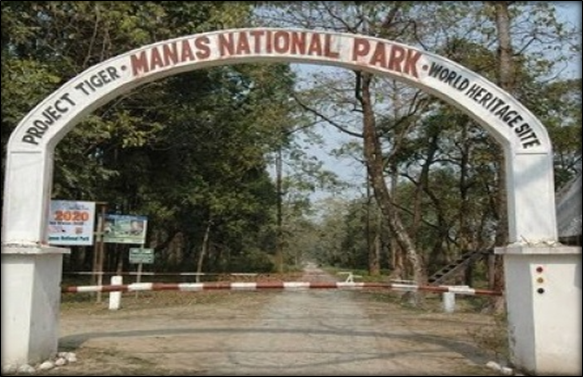
Manas National Park is a globally significant protected landscape in Assam, where Himalayan foothills, alluvial grasslands and forests support exceptional biodiversity and numerous threatened species.
Location
- Manas is located in western Assam along the Bhutan border, forming a transboundary ecological landscape with Royal Manas National Park of Bhutan.
- The 500 sq km national park forms the core of the larger Manas Tiger Reserve, while the UNESCO World Heritage property covers 39,100 hectares.
- The Manas-Beki river system drains the landscape into the Brahmaputra, creating shifting channels, alluvial terraces, marshes and floodplain habitats. U
Distinctive Features
- Manas represents a rare combination of Bhabar savannah, Terai, marshland and riverine habitats, generated by Himalayan sediment deposition and seasonal flooding.
- Its vegetation comprises alluvial grasslands, mixed moist and dry deciduous forests and semi-evergreen forests, reflecting different stages of ecological succession.
- UNESCO records nearly 60 mammal, 42 reptile, 7 amphibian and about 500 bird species, demonstrating its exceptional species diversity.
Ecological Significance and Wildlife
- Manas supports over 20 highly threatened mammals, including tiger, greater one-horned rhinoceros, Asian elephant, wild water buffalo, pygmy hog, hispid hare and golden langur.
- The park is globally important for grassland specialists, particularly the pygmy hog and Bengal florican, whose survival depends upon maintaining suitable alluvial grasslands. Centre
- Its wild water buffalo population is particularly significant, with UNESCO noting that Manas probably retains the only pure strain of this species in India.
- Its flora includes 89 tree species, 49 shrubs, 172 herbs, 36 climbers, 15 orchids, 18 ferns and 43 grasses, supporting diverse herbivore and predator communities.
Conservation and Legislative Framework
- Manas became a Tiger Reserve in 1974, a UNESCO World Heritage Site in 1985, a Biosphere Reserve in 1989 and a National Park in 1990, creating multiple layers of conservation protection.
- The Wildlife (Protection) Act, 1972 provides the principal statutory framework, supplemented by the Forest-related legal framework and protected-area management by the Assam Forest Department.
- Manas also forms part of the Elephant Reserve and Important Bird Area network, strengthening landscape-level conservation of migratory corridors and threatened species. Centre+1
- Anti-poaching efforts, long-term species monitoring and reintroduction programmes, including rhinoceros and pygmy hog recovery, have contributed to ecological restoration. UNESCO reported continuing pygmy-hog recovery and increasing tiger numbers in its 2024 assessment.
Conclusion
Manas exemplifies ecosystem-based conservation, where rivers, grasslands and forests sustain interconnected wildlife communities; protecting its ecological processes and transboundary connectivity is vital for long-term biodiversity security.
| This Concept Has Been Mentioned In The Article: Pygmy Hog Conservation: From Species Recovery to Alluvial Grassland Restoration |