
Context
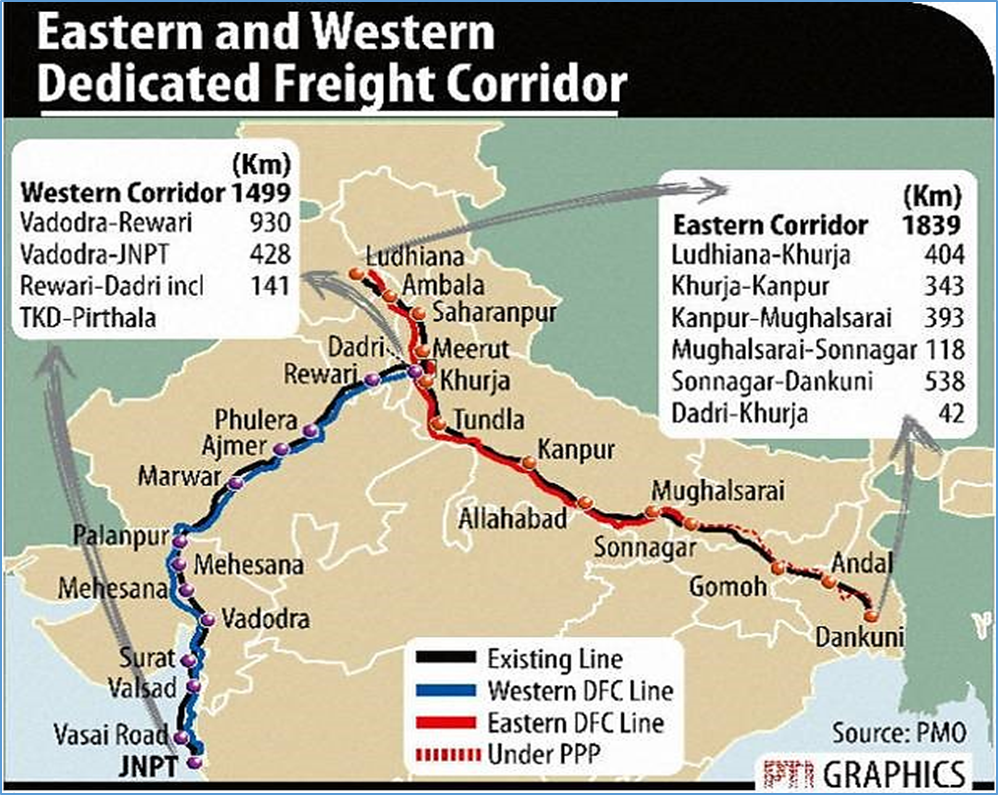
The Prime Minister inaugurated final key sections of the Western Dedicated Freight Corridor (WDFC) connecting Jawaharlal Nehru Port Trust (JNPT) in Navi Mumbai (Maharashtra) to Dadri (Uttar Pradesh), marking the operational completion of the corridor.
What are Dedicated Freight Corridors (DFCs)?
- DFCs are specialized railway tracks designed solely for freight transport. These corridors, utilizing double-stack container and heavy-haul trains, increase capacity and ensure faster freight transit.
Key Features of Western Dedicated Freight Corridor (WDFC)
- Terminals: Connects Dadri (Uttar Pradesh) to JNPT (Navi Mumbai, Maharashtra) spanning approximately 1,504 km.
- State Coverage: Traverses 5 major states — Uttar Pradesh, Haryana, Rajasthan, Gujarat, and Maharashtra.
- Funding Agency: Funded primarily by the Japan International Cooperation Agency (JICA).
- Designed for double-stack container train operations using high-reach Overhead Equipment (OHE).
- Maximum design speed of 100 km/h for freight trains (compared to ~25 km/h average on traditional tracks).
About India’s Dedicated Freight Network
- DFCCIL (Dedicated Freight Corridor Corporation of India Limited):
- A Special Purpose Vehicle (SPV) incorporated as a Public Sector Undertaking under the Companies Act, 1956 (not a statutory body).
- Functions under the administrative control of the Ministry of Railways.
- Eastern Dedicated Freight Corridor (EDFC):
- Connects Sahnewal/Ludhiana (Punjab) to Dankuni (West Bengal) covering ~1,875 km.
- Funded primarily by the World Bank.
- Present Status of Dedicated Freight Corridor (DFC)
- DFCs now handle over 10% of Indian Railways’ freight.
- An average of 325 trains run on DFC tracks daily, a 60% increase from previous years.
- Since their inception, DFCs have managed over 232 billion Gross Tonne Kilometres (GTKMs) and 122 billion Net Tonne Kilometres (NTKMs), underscoring their role in enhancing rail freight capacity.
Objectives
- Traffic Segregation: Separates freight from passenger rail corridors to release capacity on trunk routes.
- Logistics Cost Reduction: Targets lowering India’s logistics cost from ~13-14% of GDP down to single digits.
- Decarbonization: Shift of freight from road to energy-efficient electric rail reduces global greenhouse-gas emissions.
- Integration: Key element under the PM Gati Shakti National Master Plan for multi-modal connectivity.
| Important Current to Concept (CTC) from this article for UPSC: PM Gati Shakti Infrastructure Dedicated Freight Corridor (DFC) |
Q. With reference to Dedicated Freight Corridors (DFCs) in India, consider the following statements:
1. The Western Dedicated Freight Corridor (WDFC) connects Dadri in Uttar Pradesh directly to Jawaharlal Nehru Port Trust (JNPT) in Maharashtra.
2. The Western DFC is funded primarily by the World Bank, whereas the Eastern DFC is funded by the Japan International Cooperation Agency (JICA).
3. The Dedicated Freight Corridor Corporation of India Limited (DFCCIL) is a statutory body established through a dedicated Act of Parliament.
Which of the statements given above is/are correct?
(a) 1 only
(b) 1 and 2 only
(c) 2 and 3 only
(d) 1, 2, and 3
Answer: (a) 1 only
Explanation:
• Statement 1 is correct: The WDFC runs ~1,504 km from Dadri (UP) to JNPT in Navi Mumbai (Maharashtra).
• Statement 2 is incorrect: The funding agencies are reversed. The WDFC is funded by JICA (Japan), while the EDFC is funded by the World Bank.
• Statement 3 is incorrect: DFCCIL is not a statutory body; it is a Special Purpose Vehicle registered as a Public Sector Enterprise under the Companies Act, 1956, under the Ministry of Railways.