
Context
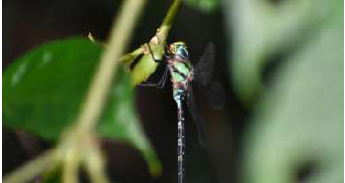
- Recently, a team of citizen scientists recorded the Long-tailed Duskhawker (Gynacantha khasiaca), a rare species of dragonfly, at Deban on the Miao–Vijoynagar Road inside Namdapha National Park and Tiger Reserve.
- This is important because the species has been rediscovered in Arunachal Pradesh after 110 years. It was last reported in 1914 from the old Abor Hills region.
1. Key Highlights of Long-tailed Duskhawker
- Taxonomy: It belongs to the family Aeshnidae under the order Odonata (which encompasses all dragonflies and damselflies).
- Physical Characteristics:
- It features two prominent compound eyes, each comprising thousands of individual lenses and photoreceptor clusters, providing it with a near-360° field of vision.
- It possesses unique flight capabilities, including the ability to hover completely still mid-air.
- Behavior: It displays crepuscular behavior (primarily active during twilight—dawn and dusk) and territorial defense characteristics (e.g., rapid patrolling along forest edges).
- IUCN Conservation Status: Listed as Data Deficient (DD) due to sparse historical records and limited distribution tracking.
- Geographical Distribution:
- Within India: Beyond Arunachal Pradesh, it has been historically or newly documented across Assam, Meghalaya, West Bengal, Uttarakhand, and Maharashtra.
- Global Distribution: Outside India, it is found in Bangladesh, Myanmar, and Nepal.
2. Ecological Significance of Odonata (Dragonflies & Damselflies)
- Indicator Species: Because their larval stages are entirely aquatic, they serve as excellent bio-indicators of freshwater ecosystem health and water quality.
- Trophic Role: They occupy critical niches in the aquatic food web, serving simultaneously as apex invertebrate predators (consuming mosquito larvae, flies, etc.) and prey for larger birds and amphibians.
- Biodiversity Data (India vs. Global):
- Global: 6,442 species across 693 genera.
- India: Home to 504 species and 27 subspecies across 152 genera and 18 families.
- Arunachal Pradesh: Records 110 species of Odonata.
3. About Namdapha National Park & Tiger Reserve
- Location: Namdapha National Park and Tiger Reserve is located in Changlang district of Arunachal Pradesh, near the India–Myanmar border, between the Patkai Range and the Dapha Bum range of the Mishmi Hills in the Eastern Himalayas.
- It is located at the junction of the Indian Sub-Continent Bio-geographic region and the Indo-China Bio-geographic region.
- Hydrology: It is bisected from east to west by the Noa-Dihing River, which originates at the Chaukan Pass on the Indo-Myanmar border.
- Altitudinal Variation & Microclimates: Ranging sharply from 200m to 4,571m above sea level, it transitions seamlessly through multiple biomes: Tropical Evergreen Rain Forests, Moist Deciduous, Sub-tropical, Temperate, and Alpine vegetation.
- The “Four Big Cats” Phenomenon: It is widely celebrated as one of the few protected areas hosting four distinct pantherine species occupying different altitudinal niches: Tiger, Leopard, Clouded Leopard, and Snow Leopard.
- It was declared as Tiger Reserve by the Government in 1983.
- Primates: Several primate species are found in the park, including the Assamese macaque, pig-tailed macaque, stump-tailed macaque, and the highly endangered Hoolock Gibbon (Hylobates hoolock), the only ape species found in India.
 Consider the following statements regarding dragonflies and damselflies:
1. Dragonflies are considered important bio-indicators of freshwater ecosystems.
2. The larval stage of dragonflies is completely terrestrial in nature.
Which of the statements given above is/are correct?
(a) 1 only
(b) 2 only
(c) Both 1 and 2
(d) Neither 1 nor 2
Answer: A) 1 only
Explanation:
• Statement 1 is correct: Dragonflies indicate the health of freshwater ecosystems.
• Statement 2 is incorrect: Their larval stage is aquatic, not terrestrial.