
Context
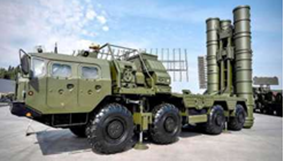
- India has received the fourth squadron of the Russian-made S-400 air defence system, which is expected to be deployed soon. After delays caused by the Russia-Ukraine conflict, deliveries are back on schedule, and the fifth and final squadron is expected to arrive in 2027.
Key Highlights of the Deal
- The Agreement: India and Russia signed a $5.43 billion government-to-government agreement in 2018 for the acquisition of five S-400 regimental systems (squadrons).
- Current Status: With this latest delivery, four squadrons have been received, leaving only one remaining.
- Modern Integration: The S-400 systems will be integrated with AI-enabled decision-support capabilities. This technology will assist human operators by identifying, prioritizing, and recommending target selections based on the nature of incoming threats. However, the final engagement decision remains with the human operator.
Technical Capabilities of the S-400
- Type: It is a mobile, surface-to-air missile (SAM) system designed by Russia’s Almaz Central Design Bureau.
- Multi-Layered Air Shield: It can engage all types of aerial targets, including aircraft, unmanned aerial vehicles (UAVs), and ballistic/cruise missiles.
- Range & Tracking: It can track up to 100 airborne targets simultaneously and engage up to 36 of them at a distance of up to 400 km at altitudes up to 30 km.
- Radar Network: It integrates multifunction radar, autonomous detection and targeting systems, anti-aircraft missile systems, and a command and control centre.
India’s Indigenous Air Defence Layer
While the S-400 forms the long-range outer layer of India’s air defense, India uses a multi-tiered network:
- Project Kusha: India’s indigenous Long-Range Surface-to-Air Missile (L-SAM) system being developed by DRDO, aiming for a 350 km range (similar to S-400 capabilities).
- MRSAM & Akash: The Medium-Range Surface-to-Air Missile (jointly developed with Israel) and the indigenous Akash missile system handle medium and short-range threats.
Q. Consider the following statements regarding the S-400 Triumf air defence system:
1. It is a long-range surface-to-air missile system acquired by India through a bilateral agreement with Russia.
2. The system integrates Artificial Intelligence (AI) to automatically fire at and neutralize incoming aerial threats without human intervention.
3. The US law 'CAATSA' primarily targets countries engaging in significant defense transactions with Russia, North Korea, and Iran.
Which of the statements given above are correct?
(a) 1 and 2 only
(b) 2 and 3 only
(c) 1 and 3 only
(d) 1, 2 and 3
Answer: C
Explanation:
Statement 1 is correct – The S-400 is a long-range air defence missile system that India bought from Russia.
Statement 2 is incorrect – The S-400 is highly advanced, but it does not automatically fire missiles on its own. Human operators make the final decision.
Statement 3 is correct – CAATSA is a US law that can impose sanctions on countries making major defence deals with Russia, Iran, or North Korea.