
Context
- Recently, the Council of Scientific and Industrial Research (CSIR) announced the introduction of an Artificial Intelligence (AI)-enabled crocodile detection and alert system in Kusupur village of Odisha’s Kendrapara district under its “Smart Village” initiative.
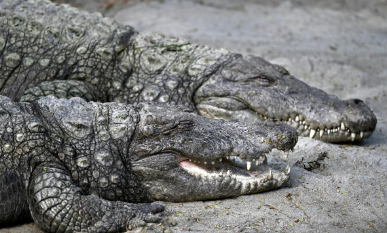
- The project aims to reduce human-crocodile conflicts in areas located near the Bhitarkanika region, which is known for its high population of saltwater crocodiles.
CSIR’s Smart Village Initiative
I. Key Features
- Implemented by the Council of Scientific and Industrial Research (CSIR).
- Kusupur village has been selected for comprehensive infrastructure and technology-led development.
- Focus areas include:
- AI-enabled crocodile detection and warning system.
- Renewable energy and green infrastructure.
- Water harvesting and drainage management.
- Community-based rural innovation and entrepreneurship.
- Sustainable construction technologies.
II. AI-Based Crocodile Alert System
- AI cameras and sensors will be installed at vulnerable entry points.
- The system will:
- Detect crocodile movement in real time.
- Generate early-warning alerts for villagers.
- Reduce human-wildlife conflict and casualties.
- Particularly important in Kendrapara district, where crocodile attacks have caused several fatalities in recent years.
About Saltwater Crocodile
I. Key Facts
- Scientific Name: Crocodylus porosus.
- Largest living reptile in the world.
- Found in:
- Eastern coast of India,
- Sundarbans,
- Andaman & Nicobar Islands,
- Southeast Asia and northern Australia.
II. Conservation Status
| Organization | Status |
| IUCN Red List | Least Concern |
| CITES | Appendix I (except certain populations) |
| Wildlife (Protection) Act, 1972 | Schedule I |
III. Physical Size & Biology
- Salt Tolerance: They possess special salt-excreting glands under their tongues, allowing them to drink and survive in highly saline oceanic environments.
- Bulletproof Armor: Their heavily scaled hide contains bony plates called osteoderms that act like natural body armor.
- Throat Valve: They have a valve at the back of their throat that seals off their airways, allowing them to open their mouths underwater without ingesting water or drowning.
About Bhitarkanika National Park
I. Location
- Situated in Kendrapara district of Odisha.
- Lies in the delta region of the Brahmani, Baitarani and Dhamra rivers.
II. Significance
- India’s second-largest mangrove ecosystem after the Sundarbans.
- Famous for:
- Saltwater crocodiles,
- Mangrove forests,
- Olive Ridley turtles,
- Rich avian diversity.
- Designated as a Ramsar Wetland Site.
The recently reported AI-based crocodile alert system in Odisha is being implemented by:
(a) Indian Council of Forestry Research and Education (ICFRE)
(b) Council of Scientific and Industrial Research (CSIR)
(c) National Innovation Foundation (NIF)
(d) National Biodiversity Authority (NBA)
Answer: (b) Council of Scientific and Industrial Research (CSIR)
Explanation:
The AI-based crocodile detection and alert system is being developed under the "Smart Village Initiative" of the Council of Scientific and Industrial Research (CSIR) and is being implemented in Kusupur village of Kendrapara district, Odisha to mitigate human-crocodile conflicts.