
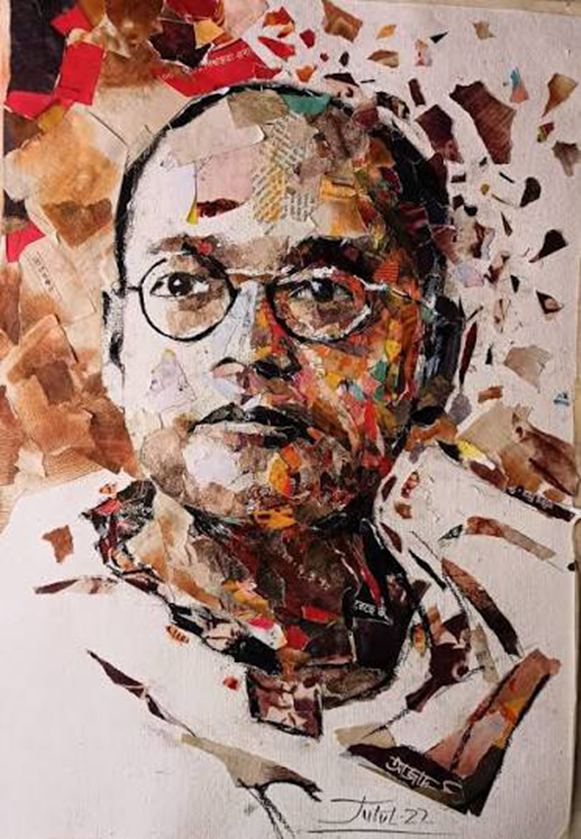
About:- Subhash Chandra Bose was a fearless nationalist defined by his revolutionary pursuit of Purna Swaraj (complete independence). His organization of the Indian National Army (INA) and his search for international alliances established him as a pivotal leader in India’s freedom struggle.
Early Life and Influences
- Born on January 23, 1897, in Cuttack (Odisha), Bose displayed brilliance and discipline from a young age.
- Educated at Presidency College, Kolkata, he qualified for the Indian Civil Service (ICS) in 1920 but resigned to join the freedom struggle.
- Deeply influenced by Swami Vivekananda’s spiritual nationalism and C.R. Das’s political mentorship, Bose developed a strong belief in action-oriented patriotism.
Core Ideology
Bose’s ideology was a synthesis of robust nationalism, socialism, and secularism.
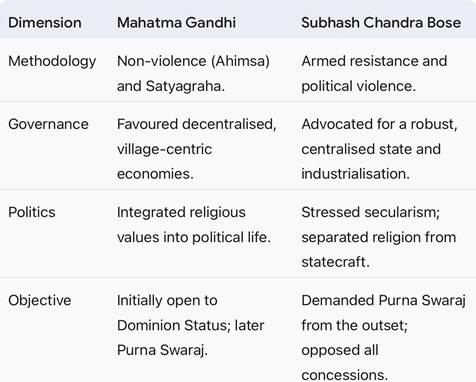
• He championed Purna Swaraj, unequivocally rejecting any compromise of dominion status.
• He envisioned a modern, industrialized India guided by state-led economic planning.
• He advocated for armed resistance, diverging sharply from the Gandhian principle of non-violence.
Political Journey
- Rose rapidly in the Indian National Congress, becoming President in 1938 (Haripura) and 1939 (Tripuri).
- Resigned after ideological clashes with Gandhi over non-violence and strategy.
- Founded the Forward Bloc (1939) to consolidate radical nationalist forces.
Formation of the Indian National Army (INA)
- During World War II, Bose sought support from Axis powers to liberate India.
- Revitalised the INA in 1942 (originally formed under Captain Mohan Singh) with Japanese assistance.
- Created the Provisional Government of Azad Hind (1943) and led campaigns under slogans like “Jai Hind,” “Dilli Chalo,” and “Give me blood, and I will give you freedom.”
- The INA embodied secularism and gender inclusivity through its Rani Jhansi Regiment.
Ideological Contrast: Bose vs. Gandhi:-
Legacy and Impact:-
- National Integration: INA’s secular, inclusive ethos fostered unity among Indians abroad.
- Economic Thought: Bose’s socialist ideals influenced Nehruvian planning.
- Inspirational Leadership: His slogans, discipline, and nationalism continue to inspire generations.