
Context
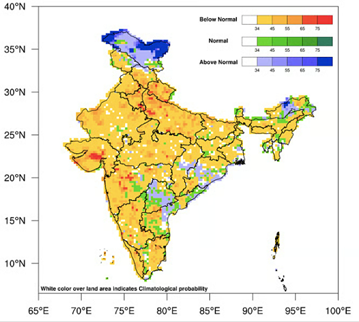
- Recently, the India Meteorological Department revised its forecast for the 2026 Southwest Monsoon, reducing it from 92% to 90% of the Long Period Average (LPA). This places the monsoon in the below-normal/deficient rainfall category.
- The IMD has also indicated that the monsoon’s arrival over the Kerala coast is likely to be delayed, shifting from the earlier expected date of May 26 to the first week of June.
1. Some Key Facts
- Long Period Average: The average rainfall received in a region over a long period (usually 30 or 50 years), used as a benchmark for rainfall and monsoon forecasts.
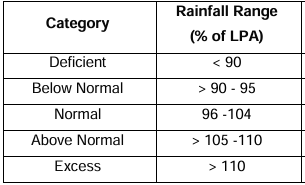
The LPA for the monsoon is defined as the average rainfall between 1971 and 2020 and is around 868.6 mm.
- Deficient Monsoon Definition: The IMD categorizes a monsoon as “deficient” when total seasonal rainfall falls under 90% of the LPA. The current probability of a deficient monsoon for 2026 is pegged at 60%.
- Terminology Distinction: The IMD does not officially use the term “drought” in its regular lexicon; that specific nomenclature is formally used by the Ministry of Agriculture.
2. Crucial Meteorological Phenomena
I. El Niño
- Current Status: There is a 92% chance of El Niño conditions persisting during the 2026 season.
- Impact: El Niño (the unusual warming of surface waters in the eastern tropical Pacific Ocean) is the primary driver behind the expected 2026 rainfall shortfall. It typically weakens the trade winds and suppresses the Indian monsoon.
II. Indian Ocean Dipole (IOD)
- Current Status: Currently absent.
- Mechanism: Often called the “Indian Niño,” IOD is an irregular oscillation of sea-surface temperatures in which the western Indian Ocean becomes alternately warmer (Positive phase) or colder (Negative phase) than the eastern part.
- Impact: A Positive IOD acts as a crucial buffer that can counter the negative impacts of El Niño by bringing more rain to India. Its current absence eliminates this safety net.
III. Madden-Julian Oscillation (MJO)
- Mechanism: The MJO is an eastward-moving band of rain clouds and winds near the equator that circles the globe every 30 to 60 days.
- Impact: It is an intra-seasonal wildcard. If a favorable (active) phase of the MJO swings over the Indian Ocean during the season, it can temporarily intensify monsoon rainfall and wind strength, potentially mitigating a deficit.
Consider the following phenomena:
1. El Niño
2. Positive Indian Ocean Dipole
3. Active Madden–Julian Oscillation over the Indian Ocean
Which of the above can significantly influence the Indian Summer Monsoon?
A. 1 only
B. 1 and 2 only
C. 2 and 3 only
D. 1, 2 and 3
Answer: D. 1, 2 and 3
Explanation:
All three phenomena significantly influence the Indian Summer Monsoon:
• El Niño
     o	 Warming of the eastern tropical Pacific Ocean.
     o	 Generally weakens the Indian monsoon and can lead to below-normal rainfall.
• Positive Indian Ocean Dipole (IOD)
     o  Warmer western Indian Ocean and cooler eastern Indian Ocean.
     o  Enhances moisture transport towards India and can offset the adverse effects of El Niño.
• Active Madden–Julian Oscillation (MJO)
     o	 An eastward-moving band of clouds and rainfall.
     o	 When active over the Indian Ocean, it strengthens monsoon rainfall and increases convection.
Hence, all three phenomena can significantly influence the Indian Summer Monsoon.