
Context
- Recently, NTPC’s proposed solar power project in the Banni grasslands of Gujarat has sparked a debate between India’s clean energy goals and environmental conservation. The project area lies near the ecologically sensitive Chhari-Dhand Wetland Conservation Reserve, one of Asia’s important grassland-wetland ecosystems.
- The Banni grasslands are home to the Maldhari pastoral community, who have depended on grazing lands for centuries. The region also supports migratory birds, wildlife, and unique biodiversity. Maldharis fear that large-scale solar installations may reduce grazing land, disturb the fragile ecosystem, and affect their traditional livelihood.
1. About the Wetland
- Ramsar Designation: Designated as a Ramsar Site (Wetland of International Importance), taking the total number of Ramsar sites in India to 98.
- Gujarat’s Count: It is Gujarat’s 5th Ramsar Site and the first in the Kachchh region.
- Other 4 sites in Gujarat: Nal Sarovar, Thol Lake, Khijadiya, and Wadhwana.
- Legal Status: It was notified as Gujarat’s first Conservation Reserve in August 2008 under the Wildlife (Protection) Act, 1972.
2. Geographical & Ecological Characteristics
- Location: Located in the Kachchh district of Gujarat.
- Ecosystem Convergence: It lies at a unique ecological intersection of three distinct landscapes:
- Banni Grasslands (arid/semi-arid grassland ecosystem)
- Tropical Thorn Forests
- Little Rann Landscape (salt flats/marshy desert)
- Hydrology: It is a seasonal, saline, desert wetland. In the local Kutchi language, “Chhari” means salty and “Dhand” means shallow wetland. It floods during the monsoon via north-flowing rivers and surrounding hills, creating extensive shallow water bodies in an otherwise arid landscape.
3. Biodiversity & Key Species
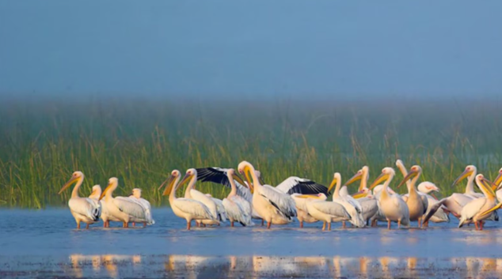
The site acts as a critical wintering ground and stopover site along the Central Asian Flyway (CAF). It holds over 35% of Gujarat’s total avifaunal diversity.
- Avifauna (Birds):
- Grey Hypocolius (Hypocolius ampelinus): A globally significant, rare passerine bird. Chhari-Dhand is famously known as one of the few places in India where this bird can be reliably sighted during winters.
- Common Crane (Grus grus): Huge congregations (up to 30,000–40,000 individuals) winter here annually.
- Other Threatened/Endangered Birds: Sociable Lapwing (Critically Endangered), Common Pochard (Vulnerable), Dalmatian Pelican, Oriental Darter, Black-necked Stork, and Indian Skimmer.
- Flora (Vegetation): Well-adapted arid vegetation, notably:
- Indian Bdellium-tree (Commiphora wightii / Guggul): Critically Endangered.
- Indian Gum Tragacanth (Sterculia urens).
- Terrestrial Mammals: Provides a sanctuary for classic arid-zone fauna including Chinkara, Wolves, Caracal, Desert Cats, and Desert Foxes.
4. Threats and Conservation Challenges
- Invasive Species: The wetland and surrounding Banni grassland face severe ecological pressure from Prosopis juliflora (an invasive exotic weed locally known as Gando Baval).
- Anthropogenic Pressures: Increasing pressure from uncontrolled tourism (including eco-tourism and nearby religious tourism circuits).
Consider the following statements regarding the "Chhari-Dhand Wetland", recently in the news:
1. It is the first Ramsar site to be designated in the state of Gujarat.
2. It is a seasonal desert wetland located adjacent to the Banni Grasslands.
3. It serves as a major wintering habitat for the rare Grey Hypocolius bird along the Central Asian Flyway.
Which of the statements given above are correct?
A) 1 and 2 only
B) 2 and 3 only
C) 1 and 3 only
D) 1, 2 and 3
Answer: B
Explanation:
•  Statement 1 is incorrect: Chhari-Dhand is Gujarat’s 5th Ramsar site and the first in the Kachchh region. It was designated as a Ramsar site alongside Patna Bird Sanctuary (Uttar Pradesh). The first Ramsar site to be designated in Gujarat was Nal Sarovar Bird Sanctuary (in 2012). The other three are Thol Lake, Khijadiya, and Wadhwana.
•  Statement 2 is correct: It is a seasonal, saline, desert wetland that sits precisely on the edge of the arid Banni Grasslands and the marshy salt flats of the Rann of Kutch. In the local Kutchi language, "Chhari" means salty and "Dhand" means shallow wetland. It gets swampy primarily during a good monsoon, fed by north-flowing rivers and surrounding hills.
•  Statement 3 is correct: The wetland is located along the Central Asian Flyway (CAF) and serves as a major wintering ground. It is globally renowned for hosting significant congregations of migratory birds, including up to 40,000 Common Cranes and the highly sought-after, rare Grey Hypocolius bird.