
Context
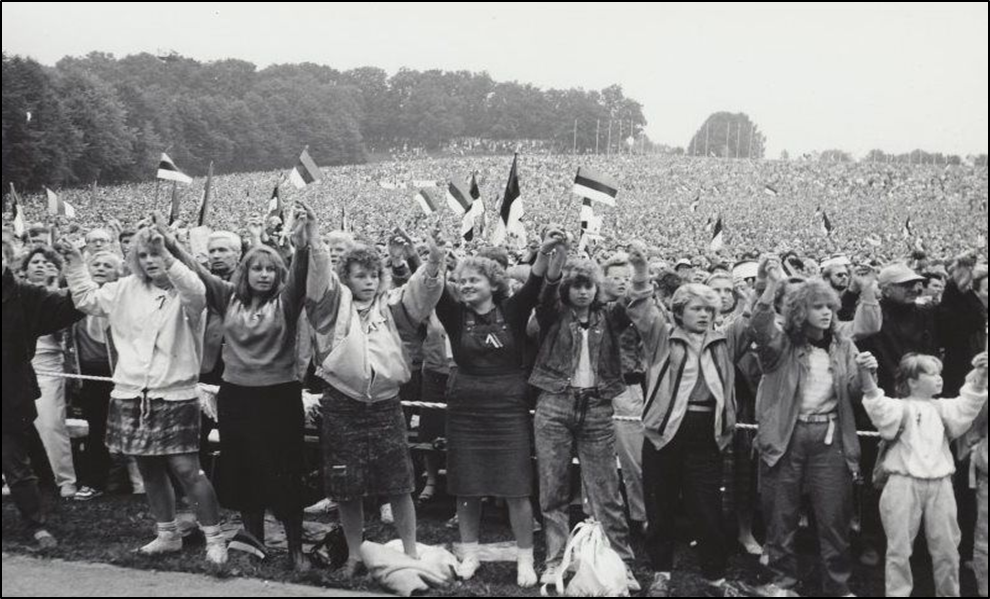
August 23, 2026, marks the 37th anniversary of the Baltic Way, a pivotal non-violent movement inspired by Gandhian philosophy that accelerated the restoration of independence for Lithuania, Latvia, and Estonia from the Soviet Union in 1990-91.
What Was the Baltic Way?
- The Baltic Way (August 23, 1989): A 675-kilometer continuous human chain formed by approximately 2 million people connecting Tallinn (Estonia), Riga (Latvia), and Vilnius (Lithuania).
- The Singing Revolution (1986–1991): The Singing Revolution refers to a series of largely peaceful mass movements for national sovereignty and independence in the Baltic republics during the late 1980s and early 1990s.
- Global Recognition: The Baltic Way is inscribed in UNESCO’s Memory of the World Register and holds a Guinness World Record for the longest human chain in history.
Why was it called the “Singing Revolution”?
- Songs, national symbols, cultural gatherings and mass public demonstrations became important instruments of political mobilisation.
The movement gained momentum during the reforms introduced by Soviet leader Mikhail Gorbachev, particularly:
- Glasnost – greater openness and transparency
Perestroika – restructuring of the Soviet political and economic system
Gandhian Imprint on Baltic Freedom Movements
- Methodological Borrowing: Baltic activists drew directly from Satyagraha, Ahimsa, non-cooperation, and the mass civil disobedience framework of Gandhi’s 1930 Dandi March.
- Public Education via Media: Richard Attenborough’s 1982 film Gandhi was broadcast continuously on national television to train citizens in non-violent confrontation techniques against armed troops.
| Important Current To Concept from This Article for UPSC Baltic State Singing Revolution (1986-91) |
Q. With reference to 20th-century geopolitical developments, consider the following statements regarding the "Baltic Way":
1. It was a 675-kilometer human chain organized in 1989 to protest against Soviet occupation.
2. The movement was organized on the 50th anniversary of the Molotov-Ribbentrop Pact.
3. The leaders of the Singing Revolution explicitly drew inspiration from Gandhian non-violence and civil disobedience.
Which of the statements given above is/are correct?
(a) 1 and 2 only
(b) 2 and 3 only
(c) 1 and 3 only
(d) 1, 2, and 3
Answer: (d) 1, 2, and 3
Explanation
• Statement 1 (Correct): ~2 million people created a 675 km human chain across Estonia, Latvia, and Lithuania in 1989 against Soviet occupation.
• Statement 2 (Correct): Staged on August 23, 1989, marking exactly 50 years since the 1939 Nazi-Soviet Molotov-Ribbentrop Pact.
• Statement 3 (Correct): Movement leaders explicitly adopted Gandhian non-violence (Ahimsa) and civil disobedience tactics.