
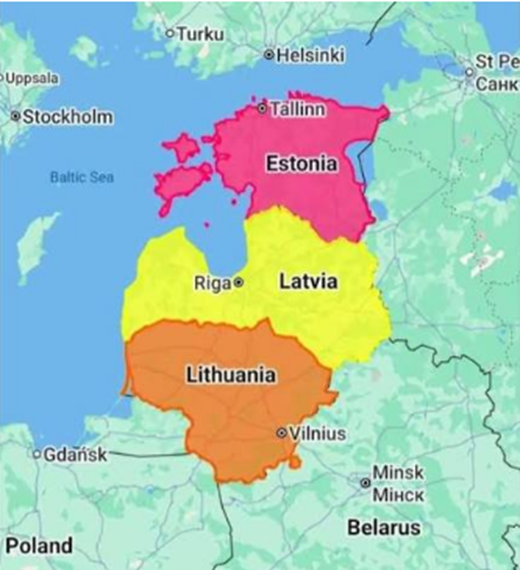
Important for GS Prelims: IR (Mapping)
Context
The Baltic nations—Estonia, Latvia, and Lithuania—constitute a geopolitically strategic littoral region along the eastern coast of the Baltic Sea.
Overview & Geography
| Country | Capital | Location & Land Borders |
| Estonia | Tallinn | Northernmost Baltic state; borders Baltic Sea (N & W), Russia (E), and Latvia (S). |
| Latvia | Riga | Central Baltic state; borders Estonia (N), Lithuania (S), Russia (E), Belarus (SE), and Baltic Sea (W). |
| Lithuania | Vilnius | Southernmost Baltic state; borders Latvia (N), Belarus (E/SE), Poland (SW), and Kaliningrad (SW). |
1. Historical Independence
- First Independence: The three nations initially gained their independence from the Russian Empire in 1918, at the conclusion of World War I.
- Post-Cold War Sovereignty: Following decades of Soviet control, all three nations successfully reclaimed their full independence from the Soviet Union in the early 1990s.
2. Demographics & Society
- Languages: The official spoken languages are Estonian, Latvian, and Lithuanian.
- Ethnic Composition: A significant demographic feature is that approximately one-quarter of the population in both Estonia and Latvia consists of ethnic Russians, a direct legacy of the Soviet era.
3. International Memberships
- European Union (EU): Consolidating their integration into Western Europe, all three Baltic States became full members of the EU in 2004.
- NATO Membership: Seeking collective defense and security guarantees, Estonia, Latvia, and Lithuania also officially joined NATO in 2004, serving as a critical strategic buffer in Eastern Europe.
| This concept has been elaborately discussed in the following article: NATO’s 2026 Ankara Summit: Strategic Transformations and Global Implications |