
Context
- Recently, advances in atomic physics and ultra-cold atom research have improved the precision of temperature measurement, helping scientists better understand the behavior of matter at extremely low temperatures. Thermometers, one of the most common scientific instruments, work on fundamental principles of heat transfer and atomic motion.
1. What is Temperature?
- Temperature is the measure of the average kinetic energy of particles in a substance.
- When particles move faster, temperature increases; when they move slower, temperature decreases.
- It determines the direction of heat flow—from hotter objects to colder ones.
2. How Does a Thermometer Work?
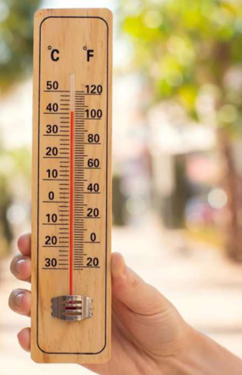
A thermometer measures temperature using materials that change predictably with heat. Thermometers work on the principle of thermal expansion.
I. Liquid Thermometers
- Traditional thermometers use liquids such as mercury (Mercury is a metal, like iron or aluminium, i.e., which conducts current and shines, but unlike our metallic utensils or spoons, it is in a liquid state) or alcohol.
- When temperature rises, the liquid expands and moves upward in a narrow tube.
- When temperature falls, the liquid contracts and moves downward.
II. Semiconductor / Resistance Thermometers
- Semiconductor resistance thermometers, commonly known as thermistors, are temperature sensors that rely on semiconductor materials (Semiconductors are materials that partially conduct electricity, and their conductivity increases with temperature) whose electrical resistance sharply changes with temperature.
- Used in: smartphones, digital thermometers, fever strips — compact and highly accurate.
III. Infrared (Contactless) Thermometers
- Every object emits infrared radiation proportional to its temperature.
- These thermometers detect that radiation without touching the object.
- Widely used during COVID-19 screening, industrial monitoring, and in astronomy.
3. The concept of Absolute Zero
- The lowest possible temperature is called absolute zero.
- It is equal to 0 Kelvin (−273.15°C).
- At this point, all atomic motion theoretically stops (zero kinetic energy).
4. Cold Atoms and Bose-Einstein Condensate (BEC)
I. What are Cold Atoms?
- Cold atoms are atoms cooled to temperatures extremely close to absolute zero.
- At this temperature they stop behaving like ordinary matter.
- Scientists use lasers and magnetic fields to slow down atomic motion.
- These ultra-cold atoms help researchers study quantum mechanics with very high precision.
- Application:
- Atomic clocks for highly accurate timekeeping
- GPS and satellite navigation systems
- Quantum computing and quantum communication
- Advanced sensors and scientific experiments
II. Bose-Einstein Condensate (BEC)
- The Fifth State of Matter: Along with solid, liquid, gas, and plasma, BEC constitutes the fifth fundamental state of matter.
- Historical Genesis: In 1924, Indian physicist Satyendra Nath Bose derived the statistical mechanics for light quanta (photons), a breakthrough he shared with Albert Einstein, who extended the theory to massive ideal gas atoms.
Consider the following statements regarding thermometers and temperature:
1. Thermistors are semiconductor devices whose electrical resistance changes with temperature.
2. At absolute zero temperature, particles possess maximum kinetic energy.
Which of the statements given above is/are correct?
(a) 1 only
(b) 2 only
(c) Both 1 and 2
(d) Neither 1 nor 2
Answer: (a) 1 only
Explanation:
• Statement 1 is correct because thermistors use semiconductor materials whose resistance varies sharply with temperature.
• Statement 2 is incorrect because at absolute zero (0 K), atomic motion theoretically stops and kinetic energy becomes minimum.