
About BRICS
- BRICS is a platform for cooperation among major emerging economies on political, economic, financial and social issues.
- It promotes the interests of the Global South and seeks a more representative and balanced global order.
- Cooperation covers areas such as development, finance, technology, trade, climate action, agriculture, health, security and people-to-people exchanges.
- BRICS advocates greater representation and equity in international institutions, including the WTO, IMF and World Bank.
Origin & Evolution
- The acronym BRIC was coined in 2001 by Goldman Sachs in the paper “The World Needs Better Economic BRICs.”
- BRIC was formally established in 2006 comprising Brazil, Russia, India and China.
- The first BRIC Summit was held in Yekaterinburg, Russia, in 2009.
- South Africa joined the grouping, transforming BRIC into BRICS.
Expansion of BRICS
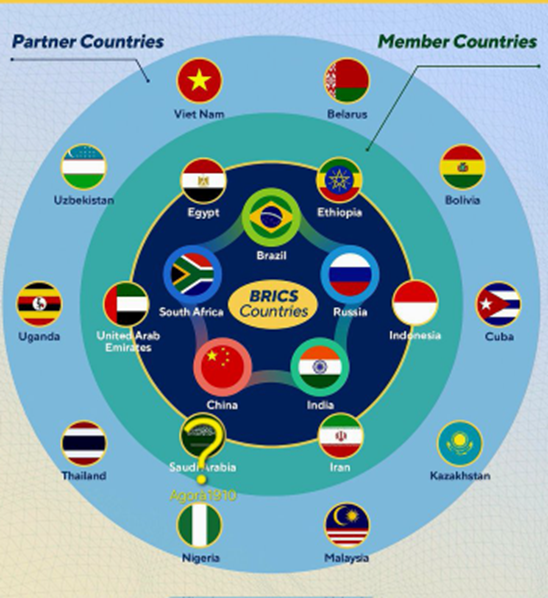
- Egypt, Ethiopia, Iran, Saudi Arabia and UAE became full members in January 2024.
- Indonesia became the 11th full member in January 2025.
Partner Countries
- Ten countries joined the BRICS Partner Country framework in 2025:
- Belarus, Bolivia, Cuba, Kazakhstan, Malaysia, Nigeria, Thailand, Uganda, Uzbekistan and Vietnam.
BRICS Presidency
- The Presidency rotates annually, from 1 January to 31 December.
- The chairing country sets annual priorities, hosts the BRICS Summit and steers ministerial and working-group meetings.
- India’s 2026 Chairship is its fourth, following 2012, 2016 and 2021.
- 2026 Theme: “Building for Resilience, Innovation, Cooperation and Sustainability.”
Key Outcomes of India’s 2026 Chairship
- Agriculture: Centres of Excellence on Agro-Ecology, Digital Agriculture Network and AGRIN.
- Health: Healthy Lifestyle Mission, TCIM cooperation and mental-health networks.
- Climate: Climate-resilient adaptation and cooperation on traditional and indigenous knowledge.
- Energy: Principles on Energy Storage and Smart Grids and a Digital Centre of Excellence.
- Urban Development: Urban Mobility Hub and climate-resilient urban infrastructure principles.
- MSMEs & Start-ups: MSME Portal, Incubator Network and Startup Innovation Fund.
- Trade & Supply Chains: Logistics Supply-Chain Framework and GVC Action Plan 2026–2030.
- Youth & Sports: BRICS Youth Cooperation Framework and Sport Technology Working Group.
Conclusion
- BRICS has evolved from a small economic grouping into a broader platform for political, economic, developmental and Global South cooperation, with its expansion enhancing its significance in the emerging multipolar world order.
| This concept has been elaborately discussed in BRICS – Evolution, Expansion and India’s 2026 Presidency |