
Introduction
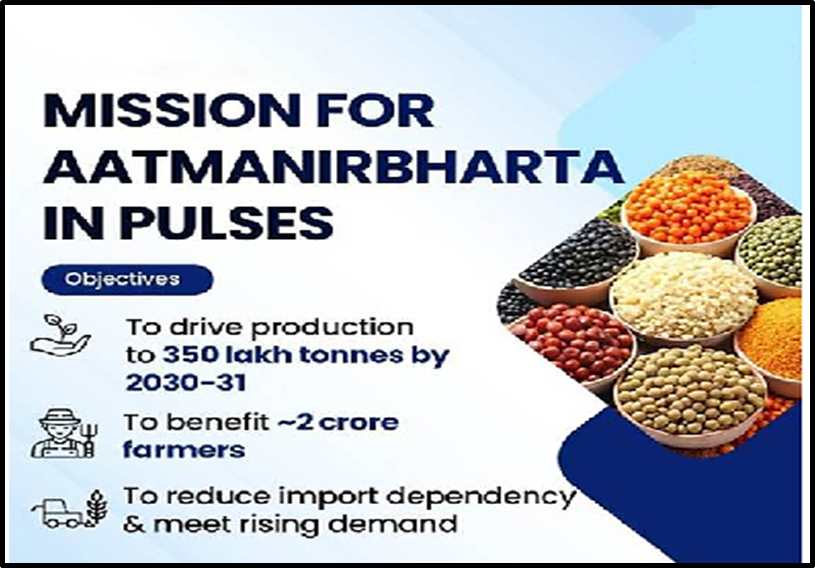
The Mission for Aatmanirbharta in Pulses, launched in 2025, aims to reduce India’s import dependence on pulses through higher domestic production.
It focuses mainly on Tur, Urad and Masoor, with an outlay of ₹11,440 crore for 2025–26 to 2030–31.
Core Objectives
The mission emphasizes an end-to-end value chain approach (seed → farm → processing → market) designed around five major pillars:
- Developing and commercially distributing climate-resilient, pest-resistant, and high-yielding seeds.
- Increasing crop productivity.
- Enhancing the protein content of domestic pulses.
- Improving post-harvest storage and management infrastructure near farm-gates.
- Assuring remunerative and stable prices to pulse-growing farmers.
Key Facts
| Announced in | Union Budget 2025-26 |
| Cabinet approval | 1 October 2025 |
| Duration | 2025-26 to 2030-31 (6 years) |
| Nature | Centrally Sponsored Scheme |
| Financial outlay | Rs. 11,440 crore |
Key Targets by 2030–31
The scheme sets ambitious operational targets to close yield gaps and expand cultivation:
- Production: Raise total pulses production from the baseline of ~24-26 million metric tonnes (MT) to 350 lakh metric tonnes (LMT).
- Area: Expand pulses cultivation to 310 lakh hectares (adding 35 lakh hectares of new land).
- Yield: Improve the national average yield from ~850–900 kg/ha to 1,130 kg/ha (closing about 40% of the gap with the global average).
Major Pillars and Strategic Interventions
- Assured Procurement: 100% MSP-based procurement of Tur, Urad and Masoor through agencies like NAFED and NCCF to protect farmers from price crashes.
- Seed Reforms: Distribution of certified, high-yielding seeds and seed kits, with end-to-end seed traceability through the SATHI Portal.
- Seed Hubs: Establishment of local seed hubs under the One Block–One Seed Village approach to improve seed availability and quality.
- Rice Fallow Utilisation: Bringing 35 lakh hectares of rice fallows under pulse cultivation, especially short-duration rabi pulses.
- Intercropping: Promoting pulses as intercrops with crops such as sugarcane to expand cultivation without requiring additional farmland.
- Post-Harvest Infrastructure: Establishment of 1,000 decentralised dal mills with financial support to reduce losses and improve farmers’ returns.
- Data-Driven Clusters: Classifying districts based on area and yield performance to target resources for either increasing yield or expanding cultivation.
Conclusion
Aatmanirbharta in Pulses aims to make India self-reliant in pulses by increasing domestic production and reducing import dependence.
It seeks to ensure food security, better farmer incomes and affordable pulses for consumers.
| This concept has been elaborately discussed in the following article – ICAR Develops India’s First Telomere-to-Telomere Reference Genome of Pigeonpea |