
Context
The Indian Wind Turbine Manufacturers Association (IWTMA) has urged the Ministry of New and Renewable Energy (MNRE) to introduce export-linked incentives and support for indigenous forging facilities and export finance to boost India’s global competitiveness in wind turbine manufacturing.
Key Highlights
- IWTMA has proposed an export-linked incentive scheme to boost wind turbine exports.
- It has sought government support for large forging facilities, export finance and buyer’s credit.
- The industry has urged better market access under the India–EU Free Trade Agreement (FTA).
- India is cost-competitive, but lacks a large manufacturing ecosystem compared to China.
- Wind power plants have a capacity factor of 21–34%, much lower than about 85% for coal-based plants due to the intermittent nature of wind.
What are Export-linked Incentives?
Export-linked incentives are government measures provided to manufacturers based on their export performance to promote international competitiveness.
Objectives
- Increase exports.
- Improve manufacturing competitiveness.
- Encourage investment in domestic production.
- Generate employment.
- Earn foreign exchange.
What is Capacity Utilisation (Capacity Factor)?
Capacity utilisation (or Capacity Factor) is the ratio of the actual electricity generated by a power plant over a period to the maximum possible electricity it could have generated if operated continuously at full capacity.
Why is Wind Power’s Capacity Factor Lower?
- Wind is an intermittent energy source.
- Electricity generation depends on wind speed and seasonal variations.
- Turbines cannot generate power continuously unlike thermal power plants.
Wind Energy in India
- Nodal Ministry: Ministry of New and Renewable Energy (MNRE)
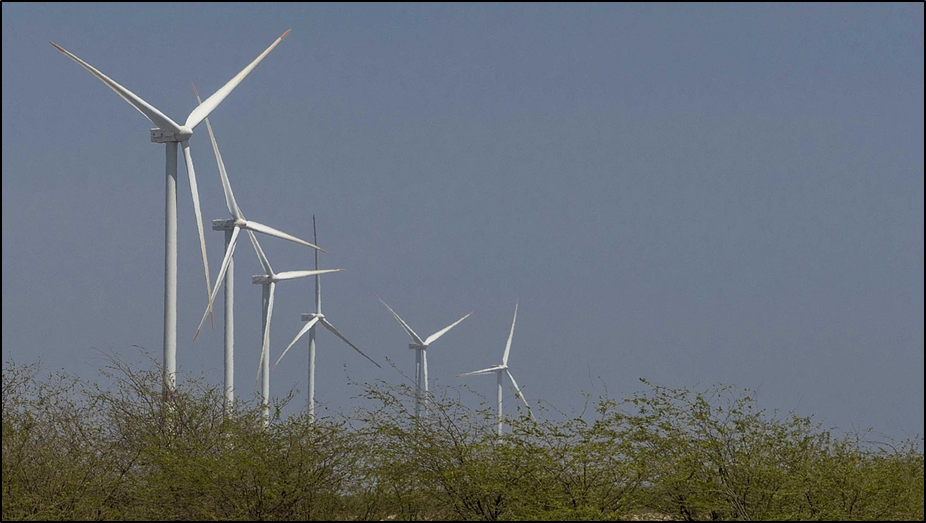
- Wind energy is a renewable source of electricity generated by converting the kinetic energy of wind into electrical energy using wind turbines.
- India is among the leading wind power producers globally.
- Major wind power producing States include Tamil Nadu, Gujarat, Karnataka, Maharashtra and Rajasthan.
Difference Between Installed Capacity and Electricity Generation
| Installed Capacity | Electricity Generation |
| Maximum power a plant can produce under ideal conditions (MW) | Actual electricity produced over time (MWh or GWh) |
| Indicates infrastructure created | Indicates actual output supplied to the grid |
| Does not account for intermittency | Depends on resource availability and plant utilisation |
| Important CTC from This Article for UPSC India-EU Free Trade Agreement 2026 |
Q. With reference to wind energy in India, consider the following statements:
1. The Ministry of New and Renewable Energy (MNRE) is the nodal ministry for wind energy development.
2. The installed capacity of a wind power plant always equals its actual electricity generation.
3. Large forgings are important components used in the manufacture of megawatt-scale wind turbines.
Which of the statements given above is/are correct?
(a) 1 and 3 only
(b) 2 only
(c) 1, 2 and 3
(d) 3 only
Answer: (a)
• Statement 1 is Correct: MNRE is the nodal ministry for renewable energy, including wind energy.
• Statement 2 is Incorrect: Actual electricity generation depends on the plant's capacity factor and wind availability; it is usually lower than installed capacity.
• Statement 3 is Correct: Large forgings are required for manufacturing critical components of megawatt-scale wind turbines.