
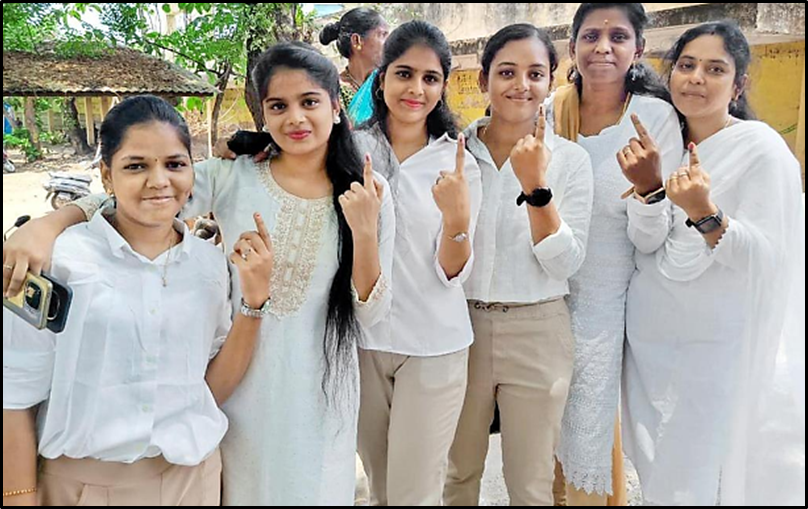
After Reading This Article You Can Solve This UPSC Mains Model Question:
The youth electorate in India is diverse and dynamic rather than a homogeneous political bloc. Discuss its significance for electoral participation and democratic outcomes. 15 Marks (GS 2, Indian Polity)
CONTEXT
Recent electoral developments have renewed focus on the role of youth in Indian democracy.
With several States heading for elections, their potential electoral influence is gaining attention.
Lokniti-CSDS data shows that youth voting varies across States, age groups and electoral contexts, rejecting the idea of a uniform “youth vote”.
INTRODUCTION
India’s youth form a significant electoral group, influencing participation, preferences and political change. However, their voting behaviour varies across age groups, regions and elections (diverse and dynamic, not a uniform bloc).
Youth participation → Diverse preferences → Electoral impact.
SIGNIFICANCE
1. Youth participation strengthens democratic representation
Youth participation enhances representativeness and inter-generational inclusion in democracy.
However, turnout varies widely across States, indicating the role of local socio-political and electoral contexts.
2. Youth is not a homogeneous electorate
Youth preferences differ across age groups, regions and socio-economic contexts.
Thus, youth should be viewed as a demographic category with diverse political preferences, rather than a uniform voting bloc.
3. Youth preferences are electorally fluid
Youth preferences can change significantly across successive elections, reflecting changing aspirations, issues and contextual factors.
This indicates that the youth electorate is dynamic rather than permanently aligned with any particular political tendency.
4. Youth preferences may diverge from electoral outcomes
Young voters may favour an electoral alternative that does not ultimately form the government.
Hence, youth preference and final electoral outcome are distinct variables.
5. Youth can contribute to electoral change
When high youth participation combines with a concentrated preference, it can significantly influence electoral outcomes.
Thus, youth participation can function as a catalyst for electoral change, particularly in closely contested elections.
6. Youth can encourage political alternatives
Young voters may show greater openness towards emerging political alternatives and new forms of political participation.
This reflects generational differences in political attitudes and expectations.
7. Youth voting reflects changing aspirations
Youth electoral behaviour can reflect aspirations related to education, employment, economic mobility, governance and representation.
Therefore, youth preferences provide an important indicator of changing societal aspirations and policy priorities
CHALLENGES
1. Low and uneven youth participation
Youth turnout varies considerably across regions, indicating uneven electoral engagement among young citizens.
Differences in social, economic and institutional contexts influence their participation.
2. Overgeneralisation of the “youth vote”
Treating youth as a homogeneous category overlooks differences in age, region, education, socio-economic status and location.
Such generalisation can lead to inaccurate assessments of youth electoral behaviour.
3. Gap between political interest and participation
Young people may show considerable interest in public affairs without translating it into formal electoral participation.
This creates a gap between political awareness and institutional engagement.
4. Vulnerability to misinformation
Greater reliance on digital platforms can increase exposure to misinformation, disinformation and algorithmic echo chambers.
This may undermine informed decision-making and the quality of democratic deliberation.
5. Limited institutional representation
Despite their demographic significance, young people remain relatively underrepresented in formal decision-making institutions.
This can create a gap between youth aspirations and institutional representation.
6. Issue–representation gap
Youth aspirations increasingly centre on employment, education, skills, mobility and economic opportunities.
However, these concerns may not always translate into sustained policy engagement and institutional outcomes.
7. Participation does not ensure empowerment
High electoral turnout alone does not guarantee meaningful democratic participation or representation.
Effective empowerment requires Participation + Informed Choice + Representation + Accountability.
WAY FORWARD
1. Strengthen youth voter participation
Expand targeted voter-awareness and registration programmes for first-time voters and underrepresented youth.
Focus on improving accessibility, awareness and participation across diverse social groups.
2. Promote informed participation
Strengthen media and digital literacy to help young citizens critically assess information and identify misinformation.
This can promote evidence-based decision-making and informed civic participation.
3. Use age-disaggregated electoral data
Analyse youth participation across distinct age groups such as 18–21, 22–25 and 26–28 years.
This enables a more nuanced understanding of generational differences in electoral behaviour.
4. Increase youth representation
Create greater opportunities for youth participation in local governance, public consultations and policymaking processes.
This can bridge the gap between demographic significance and institutional representation.
5. Address substantive youth concerns
Strengthen policies relating to education, employment, skills, entrepreneurship and social mobility.
Responsive governance can convert youth aspirations into constructive civic and developmental participation.
6. Strengthen democratic institutions
Ensure transparent electoral processes, accountable governance and accessible grievance-redressal mechanisms.
Strong institutions can enhance institutional trust and sustained civic participation among young citizens.
7. Shift from voters to stakeholders
Move beyond election-time mobilisation towards continuous youth engagement in democratic governance.
This requires creating institutional spaces for young citizens to participate, deliberate and contribute to policymaking.
CONCLUSION
The significance of youth lies not merely in their numbers, but in their participation and ability to shape democratic outcomes. India must therefore view youth as informed stakeholders in democratic governance, rather than merely an electoral constituency.
| Important Current to Concept (CTC) from This Article for UPSC Misinformation vs Disinformation |