
Context
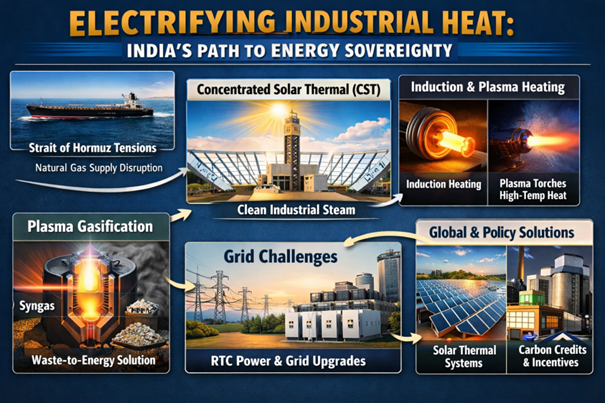
India is facing a “geopolitical ultimatum” due to the volatility in the Strait of Hormuz (a critical artery for India’s natural gas imports). As the Ministry of Petroleum and Natural Gas slashes gas allocations to non-priority industrial sectors (like ceramics and textiles), India must transition from burning hydrocarbons to Electrification of Industrial Heat and Concentrated Solar Thermal (CST) to achieve “sovereignty of heat.”
1. Key Technologies for Industrial Decarbonization
A. Concentrated Solar Thermal (CST)
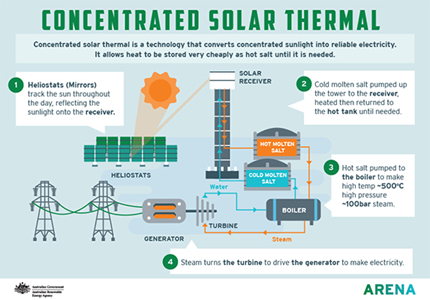
- Mechanism: Uses precisely controlled mirrors to concentrate sunlight onto a receiver to heat fluids (water or molten salt) up to 400 °C.
Utility: Ideal for textile processes (scouring/bleaching) requiring steam between 100 °C and 180 °C.
Other Applications: Primarily used for high-temperature industrial process heat (heating, cooling, drying) and utility-scale electricity generation via steam turbines.
Advantage: Unlike solar PV, CST systems can efficiently store heat in molten salt or other materials, enabling electricity production at night.
India’s Potential: Estimated at 15 GW by the MNRE.
B. Induction and Plasma Heating
Induction Heating: Uses electromagnetic fields to generate heat directly inside the material (e.g., metal). Efficiency rates can exceed 90% because there is no intermediary substance (like air or steam) to lose heat.
How it Works:
A high-frequency Alternating Current (AC) is passed through a copper coil.
This creates a rapidly fluctuating magnetic field around and inside the coil.
When a conductive workpiece (like a steel rod) is placed inside this field, Eddy Currents are induced within the material.
The material’s internal resistance to these currents generates heat instantly (Joule heating).
Key Physics Concept: Skin Effect. At high frequencies, the current tends to flow on the surface of the material. By adjusting the frequency, engineers can control whether they want to heat just the “skin” (surface hardening) or the entire core of the metal.
Industrial Use: Melting metals, brazing, and surface hardening in automotive and aerospace manufacturing.
Plasma Torches: Used in high-temperature industries. Instead of a solid workpiece, the induction coil surrounds a gas stream (e.g., argon, oxygen), creating a high-frequency electrodeless discharge that ionizes the gas into plasma.
How it Works:
An electric arc is struck between two electrodes.
A gas (like Argon, Nitrogen, or even compressed air) is passed through this arc.
The intense energy strips electrons from the gas atoms, creating Plasma—a soup of ions and electrons.
This plasma “torch” can reach temperatures of 5,000°C to 10,000°C or more.
Industrial Use:
Plasma cutting, specialized waste-to-energy (plasma gasification), and high-end metallurgy.
Plasma gasification is a high-temperature waste treatment process that uses plasma torches (about 3,000°C–10,000°C) to break down waste into elemental components. It converts organic waste into syngas (mainly carbon monoxide and hydrogen) and transforms inorganic materials into inert vitrified slag, providing a sustainable alternative to landfills.
2. Infrastructure & Grid Challenges
The transition to electric heat poses significant engineering challenges for India’s power sector:
Grid Collapse Risk: Shifting the 25% of India’s energy consumption currently served by gas pipes to electric wires could overwhelm the current grid.
Baseload Requirement:
Most factories operate 24/7, necessitating Round-the-Clock (RTC) renewable power, battery storage, and Pumped Hydro Storage.
Last-Mile Constraints:
Local grids in industrial clusters (like Ludhiana) have aging high-voltage substations. DISCOM reports suggest 25–33% of distribution transformers are already critically loaded during peak hours.
3. Global Policy Lessons & Hybrid Models
Oman (Project ‘Miraah’):
One of the world’s largest CST plants integrated with gas-fired operations. Solar generates steam during the day (reducing gas use by 80%), while gas boilers remain on standby for nighttime.
Spain (Solatom):
Use of plug-and-play solar thermal units (pre-assembled, containerized mirrors) that can be installed on factory roofs or parking lots.
Denmark:
Reformed energy markets to support ‘Heat Purchase Agreements’, where an external provider maintains the system and the factory pays a fixed rate for the heat.
4. Policy Recommendations for India
National Thermal Policy:
Necessary to survive the LPG/Natural Gas crisis.
Incentive Parity:
Extend Production-Linked Incentives (PLI) to CST mirror manufacturers (currently focused on PV cells).
Carbon Market Reform:
Allow factories to sell “avoided emissions” through the Carbon Credit Trading Scheme to offset the high capital cost of electric/plasma kilns.
Consider the following statements regarding plasma gasification:

I. It converts organic waste into syngas mainly consisting of carbon monoxide and hydrogen.

II. It produces vitrified slag from inorganic materials.

III. It operates at relatively low temperatures below 500°C.

Which of the statements given above is/are correct?
(a) I and II only
(b) II and III only
(c) I only
(d) I, II and III

Answer: A

Explanation:
•  Statement I is Correct: Plasma gasification uses a plasma torch to break down matter at the molecular level. This converts organic waste (like plastics and biomass) into Syngas (Synthetic Gas). Syngas is primarily a mixture of Carbon Monoxide and Hydrogen, which can be used to generate electricity or as a chemical feedstock.
•  Statement II is Correct: Unlike traditional incineration, this process does not produce ash. Instead, inorganic materials (like glass, metals, and soil) are melted into a molten state. When cooled, they form a vitrified slag—a glass-like, non-leachable solid that is safe for use in construction materials.
•  Statement III is Incorrect: This is the defining feature of the technology. Plasma gasification operates at extremely high temperatures, typically ranging from 4,000°C to 10,000°C (and sometimes higher). This is significantly hotter than standard incineration (which usually stays around 800°C–1,200°C). Operating below 500°C would not be sufficient to ionize gas into the plasma state.