
Context
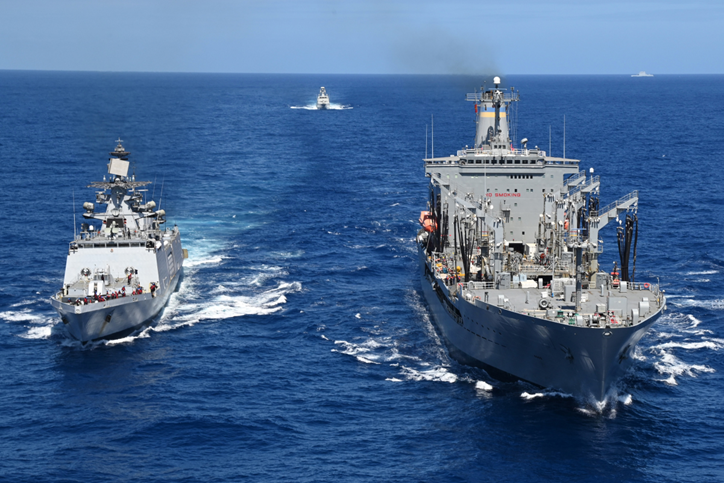
- Recently, the Indian Navy has successfully escorted three Indian-flagged merchant vessels—the LPG carriers Shivalik and Nanda Devi, and the crude oil tanker Jag Laadki—from the Gulf of Oman after they transited the volatile Strait of Hormuz. These warships are operating under Operation Sankalp to provide a “safe corridor” amidst the ongoing U.S.-Israel-Iran conflict which has effectively disrupted navigation in the Persian Gulf.
1. Overview of the Mission
- Launch Date: Officially launched on June 19, 2019.
- Objective: To ensure the safe passage of Indian-flagged merchant vessels transiting through the Gulf region (specifically the Strait of Hormuz) and to provide a sense of reassurance to the maritime community.
- Meaning: “Sankalp” is a Sanskrit word meaning “Commitment.”
- Agencies Involved: It is an integrated effort involving the Ministry of Defence, Ministry of External Affairs, Ministry of Shipping, Ministry of Petroleum and Natural Gas, and the Director General of Shipping.
2. Geographical and Strategic Focus
- Key Chokepoints: The operation focuses on the Strait of Hormuz, Gulf of Oman, and the Persian Gulf.
- Trade Significance: Nearly 62% of India’s oil imports and a significant portion of its natural gas pass through the Strait of Hormuz.
- Extended Reach: In response to the 2023-2024 Red Sea crisis, the Navy expanded the scope of Operation Sankalp to the Central and North Arabian Sea and the Gulf of Aden to counter Houthi drone threats and Somali piracy.
3. Key Assets and Operations
- Deployment: The Navy maintains a continuous presence with at least one Destroyer or Frigate (e.g., INS Talwar, INS Chennai, INS Kolkata) and regular aerial surveillance using P-8I Neptune maritime patrol aircraft and Sea Guardian drones.
- The “First Responder” Role: India has established itself as the Preferred Security Partner in the Indian Ocean Region (IOR), evidenced by successful rescue operations like those of MV Ruen and MV Chem Pluto.
- MARCOS Involvement: Elite Marine Commandos (MARCOS) are frequently deployed for boarding operations and to neutralize pirate threats.
4. Legal Framework
- Maritime Anti-Piracy Act 2022: This act provides the legal teeth to the Indian Navy to prosecute pirates apprehended during these operations, moving beyond mere “deterrence” to “legal accountability.”
Q. With reference to ‘Operation Sankalp’, recently seen in the news, consider the following statements:

1. It was launched by the Indian Navy specifically to combat the impact of oil spills in the Arabian Sea.

2. The operation involves close coordination between the Ministry of External Affairs and the Ministry of Petroleum and Natural Gas.

3. The scope of the operation is limited strictly to the territorial waters of India.

How many of the statements given above are correct?
A) Only one
B) Only two
C) All three
D) None

Solution: A) Only one

•	STATEMENT 1 IS INCORRECT: Operation Sankalp was launched in 2019 to ensure the safe passage of Indian merchant vessels amid regional tensions, not for oil spill management.
•	STATEMENT 2 IS CORRECT: It is a multi-ministerial effort involving Defence, External Affairs, Shipping, and Petroleum ministries to safeguard trade and energy interests.
•	STATEMENT 3 IS INCORRECT: The operation is conducted in international waters, specifically the Persian Gulf, Gulf of Oman, and the North Arabian Sea, far beyond India's territorial waters.