
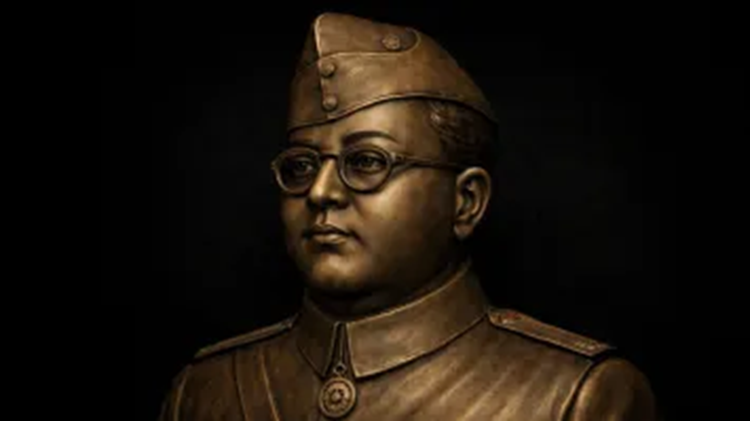
Subhas Chandra Bose’s Intellectual & Political Philosophy

After Reading This Article You Can Solve This UPSC Mains Model Question: “Subhas Chandra Bose’s concept of Samyavada was an attempt to synthesize Eastern spiritual philosophy with Western political ideologies.” Critically examine its relevance and limitations in the context of modern democratic India. 15 Marks (GS-1, Culture) Introduction Subhas Chandra Bose was not only a nationalist leader but also a serious political thinker who attempted a synthesis of Eastern spirituality and Western materialism. His thought represents a shift from idealism → pragmatism → dialectical activism. 1. Philosophical Foundations: From Vedanta to Dialectics Bose’s political actions were governed by a deep-seated philosophical evolution that moved from abstract spiritualism to "Revolutionary Pragmatism." • The Rejection of Maya: Initially a follower of Shankaracharya’s Vedanta, Bose eventually found the Doctrine of Maya (the world as an illusion) incompatible with revolutionary action. He argued that if the world is an illusion, the struggle for freedom loses its moral urgency. • The Reality of Spirit: In his autobiography, An Indian Pilgrim (1937), he shifted toward the belief that the world is a manifestation of the Spirit. He defined the essential nature of this reality as Love. • Hegelian Influence: Bose adopted Hegelian Dialectics (Thesis + Antithesis = Synthesis) as the law of progress. He believed India’s mission was to find a "Higher Synthesis" between the spiritualism of the East and the material dynamism of the West. 2. Samyavada: The Doctrine of Harmonious Equality Bose did not want India to blindly mimic Western "Isms." Instead, he proposed Samyavada—an indigenous socialist framework. • Etymology: Derived from Sāmya (equality/harmony) and Vāda (doctrine). • The Third Way: Bose viewed Fascism and Communism as competing stages in a dialectical process. He proposed a synthesis that would adopt the economic planning and social equality of Communism while retaining the nationalistic discipline and cultural identity often associated with strong-state systems. • Global Mission: In The Anti-Imperialist Struggle and Samyavada (1933), he claimed that just as France gave "Liberty" and England "Constitutionalism," India’s gift to the world would be the realization of Samyavada. 3. Economic Vision: Scientific Modernization Bose was a staunch proponent of large-scale industrialization, often putting him at odds with the Gandhian "village economy" model. • National Planning: As Congress President at the Haripura Session (1938), he established the National Planning Committee (headed by Nehru). He believed poverty could only be eradicated through a "Scientific Blueprint." • Key Pillars of Reconstruction: o Social ownership and control of production and distribution. o Abolition of landlordism (Zamidari system). o Application of scientific methods to agriculture. o Development of heavy industries alongside cottage industries. 4. Political Praxis: The "Strong State" Theory Bose held a controversial but pragmatic view on the transition of power in a post-colonial society. • The Adarsha Sangh: He believed that a fractured and impoverished India could not afford a slow, decentralized democracy immediately after independence. • Temporary Authoritarianism: He advocated for a Strong Central Government with full powers for a "period of reconstruction." He pointed to the rapid transformations in Kemalist Turkey and Soviet Russia as evidence of the efficiency of centralized rule in modernization. • Definition of Freedom: For Bose, independence was not merely political; it was the removal of caste, communalism, and wealth disparity. 5. Comparative Analysis: Bose vs. Gandhi Feature Mahatma Gandhi Subhas Chandra Bose Ideology Spiritualism & Ethical Moralism Revolutionary Pragmatism & Synthesis Means Absolute Non-Violence (Ahimsa) Force as a legitimate moral necessity Economy Decentralized, Rural (Charkha) Centralized, Industrial (Planning) State Skeptical of state power Believed in a strong, centralized state Critical Evaluation of Bose’s Intellectual & Political Doctrine 1. Strengths: The Visionary Realist • Indigenization of Socialism: Bridged the gap between Western Marxism and Indian tradition by framing Samyavada as "Harmonious Equality," making socialist ideals culturally resonant rather than a foreign import. • Early Architect of Planning: Pioneered the shift from agitation to administration by establishing the National Planning Committee (1938), recognizing that economic sovereignty is the backbone of political freedom. • Social Inclusivity: Envisioned a radical Purna Swaraj that demanded the total eradication of caste and communalism, while actively mainstreaming women in combat and leadership (e.g., Rani of Jhansi Regiment). • Pragmatic Geopolitics: Demonstrated sophisticated statesmanship by leveraging international power dynamics and alliances, viewing the global stage through the lens of strategic realism. 2. Weaknesses: The Risks of Authoritarianism • The Authoritarian Trap: His proposal for a "strong central government" with absolute powers during reconstruction risks the "slippery slope" where temporary emergency rule evolves into permanent erosion of civil liberties. • Underestimation of Diversity: A rigid, top-down "Adarsha Sangh" model arguably overlooked India’s vast ethno-linguistic diversity, which required the flexible, federal democratic structure eventually adopted by the Constitution. • The "Synthesis" Dilemma: Attempting to merge Fascism and Communism presents an ideological paradox, as both systems hold irreconcilable views on individual autonomy versus state supremacy. • Divergence from Mass Base: By prioritizing revolutionary praxis and industrialization over Gandhian Ahimsa and rural empowerment, he risked de-linking from the agrarian masses that were the movement's primary engine. Contemporary Relevance of Bose’s Doctrine for India • Economic Sovereignty & "Atmanirbhar Bharat": Bose’s push for "scientific large-scale production" is mirrored in modern Make in India and PLI schemes. His legacy of strategic foresight continues through NITI Aayog, evolving from his original National Planning Committee (1938). • Strategic Autonomy & Multi-Alignment: His pragmatic "national interest first" diplomacy serves as a precursor to India’s current Strategic Autonomy. His focus on Southeast Asia remains a cornerstone of the Act East Policy and India’s engagement in the QUAD. • Social Engineering & Inclusivity: The INA’s model of communal harmony provides a timeless blueprint for national integration. His creation of the Rani of Jhansi Regiment pioneered the vision of Nari Shakti, now realized through women’s permanent commissions in the Armed Forces. • Governance & The "Strong State" Debate: His demand for administrative efficiency aligns with the "Minimum Government, Maximum Governance" reform agenda. The debate over "decisive executive power" to bypass structural bottlenecks remains central to India’s infrastructure and land reform discussions. • Technology and Governance: As a modernist, Bose advocated applying science to social issues. This vision is manifested today in Digital India, where tools like UPI and Direct Benefit Transfer (DBT) utilize a "Scientific Blueprint" to ensure social justice. • National Character & Discipline: Bose emphasized a disciplined "Adarsha Sangh" to lead national reconstruction. This focus on duty and disciplined citizenship resonates with modern initiatives like the Fundamental Duties awareness and youth mobilization through the NCC/NSS for nation-building. Conclusion Netaji’s synthesis of Vedantic idealism and scientific modernism remains a blueprint for a self-reliant India. His legacy of strategic autonomy, social harmony, and industrial planning continues to drive India’s journey toward a developed, inclusive superpower.

After Reading This Article You Can Solve This UPSC Mains Model Question:

“Subhas Chandra Bose’s concept of Samyavada was an attempt to synthesize Eastern spiritual philosophy with Western political ideologies.” Critically examine its relevance and limitations in the context of modern democratic India. 15 Marks (GS-1, Culture)

Introduction

Subhas Chandra Bose was not only a nationalist leader but also a serious political thinker who attempted a synthesis of Eastern spirituality and Western materialism. His thought represents a shift from idealism → pragmatism → dialectical activism.

1. Philosophical Foundations: From Vedanta to Dialectics

Bose’s political actions were governed by a deep-seated philosophical evolution that moved from abstract spiritualism to “Revolutionary Pragmatism.”

  • The Rejection of Maya: Initially a follower of Shankaracharya’s Vedanta, Bose eventually found the Doctrine of Maya (the world as an illusion) incompatible with revolutionary action. He argued that if the world is an illusion, the struggle for freedom loses its moral urgency.
  • The Reality of Spirit: In his autobiography, An Indian Pilgrim (1937), he shifted toward the belief that the world is a manifestation of the Spirit. He defined the essential nature of this reality as Love.
  • Hegelian Influence: Bose adopted Hegelian Dialectics (Thesis + Antithesis = Synthesis) as the law of progress. He believed India’s mission was to find a “Higher Synthesis” between the spiritualism of the East and the material dynamism of the West.

2. Samyavada: The Doctrine of Harmonious Equality

Bose did not want India to blindly mimic Western “Isms.” Instead, he proposed Samyavada—an indigenous socialist framework.

  • Etymology: Derived from Sāmya (equality/harmony) and Vāda (doctrine).
  • The Third Way: Bose viewed Fascism and Communism as competing stages in a dialectical process. He proposed a synthesis that would adopt the economic planning and social equality of Communism while retaining the nationalistic discipline and cultural identity often associated with strong-state systems.
  • Global Mission: In The Anti-Imperialist Struggle and Samyavada (1933), he claimed that just as France gave “Liberty” and England “Constitutionalism,” India’s gift to the world would be the realization of Samyavada.

3. Economic Vision: Scientific Modernization

Bose was a staunch proponent of large-scale industrialization, often putting him at odds with the Gandhian “village economy” model.

  • National Planning: As Congress President at the Haripura Session (1938), he established the National Planning Committee (headed by Nehru). He believed poverty could only be eradicated through a “Scientific Blueprint.”
  • Key Pillars of Reconstruction:
    • Social ownership and control of production and distribution.
    • Abolition of landlordism (Zamidari system).
    • Application of scientific methods to agriculture.
    • Development of heavy industries alongside cottage industries.

4. Political Praxis: The “Strong State” Theory

Bose held a controversial but pragmatic view on the transition of power in a post-colonial society.

  • The Adarsha Sangh: He believed that a fractured and impoverished India could not afford a slow, decentralized democracy immediately after independence.
  • Temporary Authoritarianism: He advocated for a Strong Central Government with full powers for a “period of reconstruction.” He pointed to the rapid transformations in Kemalist Turkey and Soviet Russia as evidence of the efficiency of centralized rule in modernization.
  • Definition of Freedom: For Bose, independence was not merely political; it was the removal of caste, communalism, and wealth disparity.

5. Comparative Analysis: Bose vs. Gandhi

FeatureMahatma GandhiSubhas Chandra Bose
IdeologySpiritualism & Ethical MoralismRevolutionary Pragmatism & Synthesis
MeansAbsolute Non-Violence (Ahimsa)Force as a legitimate moral necessity
EconomyDecentralized, Rural (Charkha)Centralized, Industrial (Planning)
StateSkeptical of state powerBelieved in a strong, centralized state

Critical Evaluation of Bose’s Intellectual & Political Doctrine

1. Strengths: The Visionary Realist

  • Indigenization of Socialism: Bridged the gap between Western Marxism and Indian tradition by framing Samyavada as “Harmonious Equality,” making socialist ideals culturally resonant rather than a foreign import.
  • Early Architect of Planning: Pioneered the shift from agitation to administration by establishing the National Planning Committee (1938), recognizing that economic sovereignty is the backbone of political freedom.
  • Social Inclusivity: Envisioned a radical Purna Swaraj that demanded the total eradication of caste and communalism, while actively mainstreaming women in combat and leadership (e.g., Rani of Jhansi Regiment).
  • Pragmatic Geopolitics: Demonstrated sophisticated statesmanship by leveraging international power dynamics and alliances, viewing the global stage through the lens of strategic realism.

2. Weaknesses: The Risks of Authoritarianism

  • The Authoritarian Trap: His proposal for a “strong central government” with absolute powers during reconstruction risks the “slippery slope” where temporary emergency rule evolves into permanent erosion of civil liberties.
  • Underestimation of Diversity: A rigid, top-down “Adarsha Sangh” model arguably overlooked India’s vast ethno-linguistic diversity, which required the flexible, federal democratic structure eventually adopted by the Constitution.
  • The “Synthesis” Dilemma: Attempting to merge Fascism and Communism presents an ideological paradox, as both systems hold irreconcilable views on individual autonomy versus state supremacy.
  • Divergence from Mass Base: By prioritizing revolutionary praxis and industrialization over Gandhian Ahimsa and rural empowerment, he risked de-linking from the agrarian masses that were the movement’s primary engine.

Contemporary Relevance of Bose’s Doctrine for India

  • Economic Sovereignty & “Atmanirbhar Bharat”: Bose’s push for “scientific large-scale production” is mirrored in modern Make in India and PLI schemes. His legacy of strategic foresight continues through NITI Aayog, evolving from his original National Planning Committee (1938).
  • Strategic Autonomy & Multi-Alignment: His pragmatic “national interest first” diplomacy serves as a precursor to India’s current Strategic Autonomy. His focus on Southeast Asia remains a cornerstone of the Act East Policy and India’s engagement in the QUAD.
  • Social Engineering & Inclusivity: The INA’s model of communal harmony provides a timeless blueprint for national integration. His creation of the Rani of Jhansi Regiment pioneered the vision of Nari Shakti, now realized through women’s permanent commissions in the Armed Forces.
  • Governance & The “Strong State” Debate: His demand for administrative efficiency aligns with the “Minimum Government, Maximum Governance” reform agenda. The debate over “decisive executive power” to bypass structural bottlenecks remains central to India’s infrastructure and land reform discussions.
  • Technology and Governance: As a modernist, Bose advocated applying science to social issues. This vision is manifested today in Digital India, where tools like UPI and Direct Benefit Transfer (DBT) utilize a “Scientific Blueprint” to ensure social justice.
  • National Character & Discipline: Bose emphasized a disciplined “Adarsha Sangh” to lead national reconstruction. This focus on duty and disciplined citizenship resonates with modern initiatives like the Fundamental Duties awareness and youth mobilization through the NCC/NSS for nation-building.

Conclusion

Netaji’s synthesis of Vedantic idealism and scientific modernism remains a blueprint for a self-reliant India. His legacy of strategic autonomy, social harmony, and industrial planning continues to drive India’s journey toward a developed, inclusive superpower.