
After Reading This Article You Can Solve This UPSC Mains Model Question:
Examine the governance and infrastructure challenges associated with water and sanitation management in peri-urban India. Suggest a roadmap for building water-secure peri-urban settlements. (15 Marks, GS-2, Governance)
Context
India has made significant progress in water access through initiatives such as the Jal Jeevan Mission, which has expanded tap water connectivity in rural areas. However, a major governance gap exists in peri-urban areas transitional zones between rural and urban regions. These regions face severe challenges related to water supply, sanitation, governance, and environmental sustainability.
Significance of addressing Peri-Urban Water & Sanitation Crisis of India
- Secures Future Cities: It ensures that today’s rapidly growing city borders don’t turn into tomorrow’s permanent slums, building a planned and liveable Viksit Bharat by 2047.
- Boosts Economic Growth: It protects the economic dynamism of peri-urban zones where new factories and startups are emerging by providing stable water and sanitation.
- Prevents Health Crises: Proper waste and septage management stop the toxic pollution of groundwater, protecting millions of citizens from severe water-borne diseases.
- Ensures Social Justice: It prevents rural and fringe areas from becoming “zones of sacrifice,” ensuring downstream farmers do not lose their livelihoods to thirsty core cities.
- Fulfills Climate Resilience: Scaling up decentralized water recycling helps India fight climate change by securing local water sources against erratic and heavy rainfall.
The Core Issue: The “Missing Middle” (Peri-Urban Crisis)
- Rapid, Unplanned Urbanization: Over the last two decades, the number of Census Towns (settlements that are urban in character but lack urban local bodies) jumped from 1,362 to 3,784 (a 178% increase).
- Institutional Limbo: These zones are no longer villages, but are not yet recognized or administered as cities, leaving them completely out of structured urban planning.
- The 2047 Horizon: By 2047, India will need 230 million new housing units and 500 new cities. Today’s neglected peri-urban fringe is tomorrow’s city center.
Key Challenges in Peri-Urban Water and Sanitation
A. Governance & Service Delivery Gaps
- Abolition of Rural Frameworks without Urban Capacity: When rural governance is abolished, peri-urban areas are often absorbed into inefficient municipal corporations.
- Impact: Residents face urban costs without urban services.
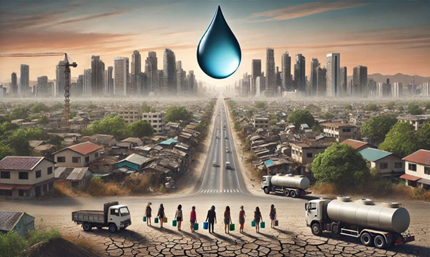
- Supply Disruptions: Water pipelines often provide irregular, highly constrained supply (e.g., alternate days, odd night hours), forcing residents to sacrifice sleep and fall prey to exploitative private water tankers.
B. Environmental Degradation & “Zones of Sacrifice”
- Resource Stripping: Thirsty, expanding core cities actively siphon resources away from surrounding peri-urban/rural zones.
- Groundwater Pollution: Lack of solid and liquid waste management leads to toxic leachate from garbage dumps filtering into and poisoning local groundwater.
C. The Sanitation Failure (The Underbelly of SBM)
- On-Site Sanitation Pitfalls: Nearly 40 million urban/semi-urban households rely on on-site systems like septic tanks.
- Unregulated Desludging: Desludging is highly irregular and illegal dumping of untreated septage into open fields and water bodies is rampant.
- The “Undo” Effect: A single 5,000-liter waste tanker illegally discharged into the open completely nullifies the hard-earned public health gains of thousands of constructed toilets.
Way Forward- Five-Point Action Plan
I. Institutional & Governance Reform
- Constitutional Compliance: State governments must formally constitute Nagar Panchayats for all Census Towns, as mandated by the 74th Constitutional Amendment Act.
- Capacity Building: Legal reclassification must be immediately supported by financial and administrative functional capacity.
II. Securing Water Sources at Origin
- Source Sustainability: Shift focus from merely providing tap connections to ensuring the longevity of water sources.
- Catchment Protection: Prevent illegal encroachments, stop solid waste dumping near aquifers, and institutionalize community-driven sanitary inspections.
III. Launching Swachh Bharat Mission (SBM) 3.0
- Peri-Urban & Septage Focus: SBM 3.0 should be launched under the Ministry of Jal Shakti, leveraging rural employment schemes (MGNREGS) to manage fecal sludge.
- Targeted Infrastructure:
- Build localized Faecal Sludge Treatment Plants (FSTPs) where central sewage treatment plants (STPs) are too far away (greater than 15–20 km).
- Mandate GPS-equipped desludging trucks to prevent illegal dumping.
- Cross-subsidize desludging costs (ranging from ₹1,500 to ₹6,000 per trip) by integrating them into monthly water bills via a small sanitation levy.
IV. Scaling Decentralized Wastewater Technologies
- Support Innovation: Move modular, plug-and-play water recycling technologies (which recover over 95% of water with minimal land/energy footprint) out of incubation into the mainstream market.
- Policy Enablers: Create an enabling market for treated used water using single-window clearances for green industries, public procurement mandates, and government-backed off-take guarantees.
V. Strategic Infrastructure & Blended Finance
- Innovative Financing: Mobilize funds using blended finance structures that combine domestic state risk-bearing with concessional international loans (e.g., World Bank) tied to clear performance/disbursement indicators.
Case Studies & Best Practices
Sultanpur Village- Multi-stakeholder coordination platform (Engineers + Panchayat + Residents). Demonstrates how local accountability fixes institutional coordination failures.
Maharashtra- Community-driven sanitary inspections of local water sources. Ensures long-term sustainability and safety of drinking water sources.
Government Initiatives
- AMRUT 2.0 (Atal Mission for Rejuvenation and Urban Transformation): Aims to make all statutory towns water-secure by ensuring universal tap water connectivity and promoting the reuse of treated wastewater.
- Swachh Bharat Mission-Urban (SBM-U) 2.0: Focuses explicitly on complete fecal sludge, septage, and wastewater management—particularly targeting smaller towns with populations under 1 lakh to prevent illegal waste dumping.
- Jal Jeevan Mission (JJM) – Rural & Extended Sustainability: Targets 100% functional household tap connections across rural-urban fringes while utilizing 15th Finance Commission tied grants to secure long-term water source sustainability.
Conclusion
Transforming India’s peri-urban “missing middle” into climate-resilient, water-secure hubs is vital to power sustainable economic growth and build liveable, equitable smart-city ecosystems by 2047.